

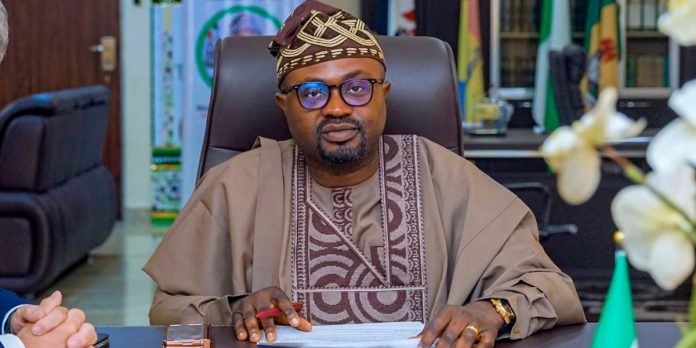
The Minister of Interior, Olubunmi Tunji-Ojo, has dismissed former Vice President Atiku Abubakar’s plan to reopen Nigeria’s land borders if elected president in 2027, declaring that the country’s borders are not closed.
Tunji-Ojo said Atiku’s proposal was based on an inaccurate portrayal of the current status of Nigeria’s borders, stressing that as Minister of Interior overseeing the Nigeria Immigration Service, he was in a position to clarify the situation.
The minister, in a statement issued on Saturday, said Nigerian borders “are not closed and so cannot be reopened.”
He recalled that several major land borders had already been reopened at different times, beginning with Seme, Illela, Maigatari and Mfum on December 16, 2020, following the reopening of the facilities by the previous administration.
According to him, Idiroko and Ikom were subsequently reopened for goods and services on April 20, 2022.
He added that Kamba and Tsamiya border crossings in Kebbi State were reopened under the current administration in February 2026, linking Nigeria with Niger Republic and Benin Republic respectively.
Tunji-Ojo said the history of Nigeria’s border management also needed to be separated from the country’s security challenges, particularly along the Cameroon border.
The minister explained that the prolonged closure of the Banki and Amchidé crossings on the Nigeria-Cameroon border was not connected to the 2019 trade policy.
He said the crossings were closed in 2014 because of Boko Haram insurgency and were subsequently reopened in 2019 after security conditions improved.
He added that Fotokol and Gambaru followed in 2021 after joint military and stabilisation efforts involving Nigeria, Cameroon, Niger and Chad.
According to Tunji-Ojo, presenting these developments as part of a single 2019 border shutdown wrongly conflates two separate issues — trade regulation and counter-insurgency.
“Folding this separate, security-driven history into one continuous 2019 shutdown misrepresents two distinct issues, trade regulation and counter insurgency, as a single failure,” he said.
The minister, however, acknowledged that not all border crossings, particularly in parts of northern Nigeria, currently operate without restrictions.
He attributed the restrictions to continuing security concerns, including banditry and residual insurgent activities in some areas.
Tunji-Ojo said tighter controls in such locations were deliberate security measures aimed at protecting traders and border communities.
“Reopening ahead of the security situation would expose traders and border communities to greater risk,” he said.
He maintained that modern border management could not be reduced to a choice between completely shutting borders and allowing unrestricted movement.
According to him, effective border management requires the simultaneous application of security measures, proper documentation, customs compliance and controlled trade facilitation.
The minister further urged Atiku, who is seeking to return to the presidency in 2027, to provide details of his proposed border policy and explain how it would differ from the approach currently being implemented by the Federal Government.
“Political competition should not become a competition to rewrite recent history,” Tunji-Ojo said.
He added that if the former Vice President had a new proposal on border management, he should set it out clearly rather than treating separate trade, security and infrastructure issues as though they were one and the same.


