
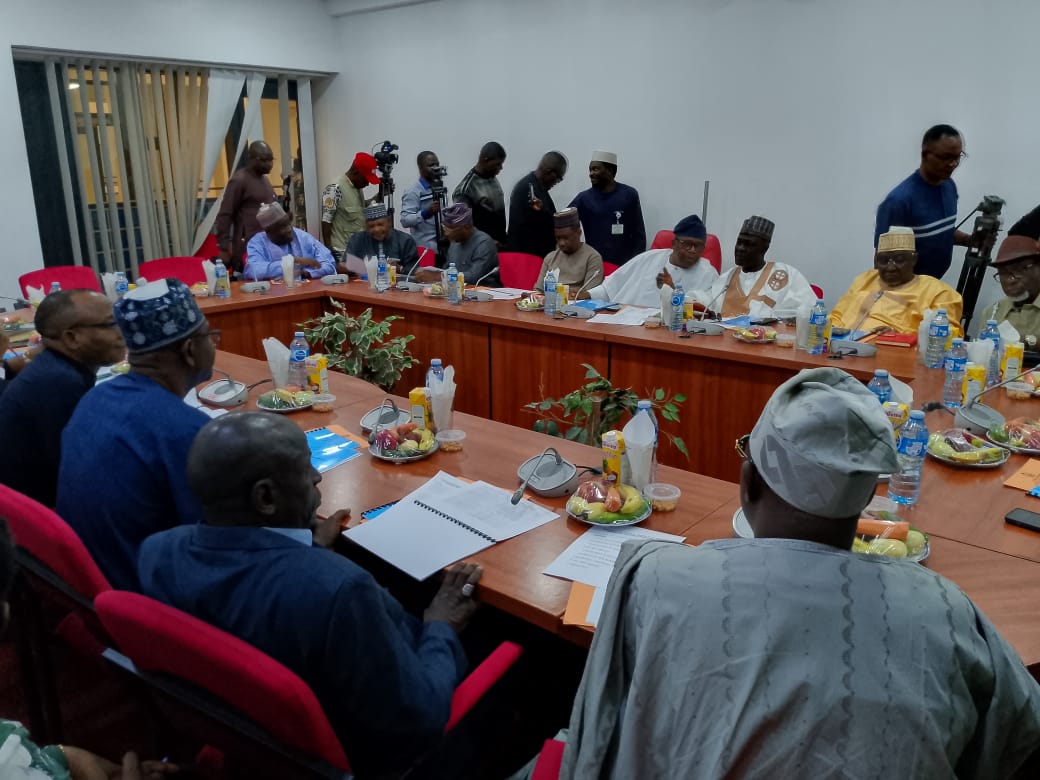
Tensions ran high in the Senate on Wednesday as lawmakers launched a rigorous interrogation of the Federal Government’s economic team over the proposed ₦58.19 trillion 2026 budget, questioning its revenue assumptions, rising debt, and the fallout from last year’s fiscal underperformance.
Chairman of the Senate Committee on Appropriation, Senator Solomon Yayi, set a combative tone, declared the era of rubber-stamp budgets over. He summoned the President’s economic team to account for both the execution of the 2025 budget and the assumptions underpinning the 2026 proposal.
“This is not routine oversight; this is a full fiscal autopsy,” Senator Yayi said, emphasizing the need for transparency on unfinished projects and funding gaps.
Among the key shifts announced was the move to a single active budget year by March 1, 2026, with outstanding commitments from 2024 and 2025 rolled into the new appropriation. Ministries, Departments, and Agencies are expected to fund 30% of prior obligations before March, with the remaining 70% absorbed into the 2026 budget.
The session began amid friction, with lawmakers openly criticizing economic officials for repeated postponements and absences. One senator warned that budgets of non-appearing agencies could be suspended.
Finance Minister and Coordinating Minister of the Economy, Wale Edun, defended the 2026 plan, unveiled a three-stage recovery strategy focusing on market corrections, stabilization, and growth acceleration toward a 7% GDP expansion. He highlighted government priorities including private investment through public-private partnerships, asset optimization, and domestic revenue mobilization, with a medium-term goal of raising tax revenue to 18% of GDP.
Edun admitted the 2025 budget underperformed significantly:
Federation revenue: 53% of target
Oil & gas revenue: 18.9% of target
Capital budget execution: 51.8%
Federal revenue shortfall: ~₦5 trillion
Debt service overrun: ₦4 trillion
Overall funding gap: ~₦9 trillion
He explained that the shortfall forced the government to prioritize salaries, pensions, and statutory transfers over capital projects. Edun noted that non-oil revenue largely benefited states, while the federal government suffered from collapsed oil receipts.
On the nation’s debt stock, now at around ₦152 trillion, the minister insisted the rise was largely due to accounting adjustments rather than new borrowing, citing previously unrecognized Ways & Means loans and exchange-rate revaluation adjustments.
Despite fiscal pressures, the government maintained funding for key social interventions, including cash transfers to nearly 9 million households, wage increases, and transport subsidies.
Lawmakers pressed Edun on the feasibility of projected oil revenue for 2026, a key determinant of the budget’s success. He deferred final validation to revenue collection agencies, emphasizing that accurate projections were critical to avoid repeating last year’s shortfalls.
Senators remained firm: funding a ₦58.19 trillion budget when the previous year achieved barely half its target poses serious risks. They warned that the budget’s passage hinges on credible revenue assurances, or it could deepen Nigeria’s fiscal deficit spiral.
The hearing is ongoing, with the remainder of the economic team expected to appear before the Appropriation Committee in what promised to be a decisive fiscal showdown.