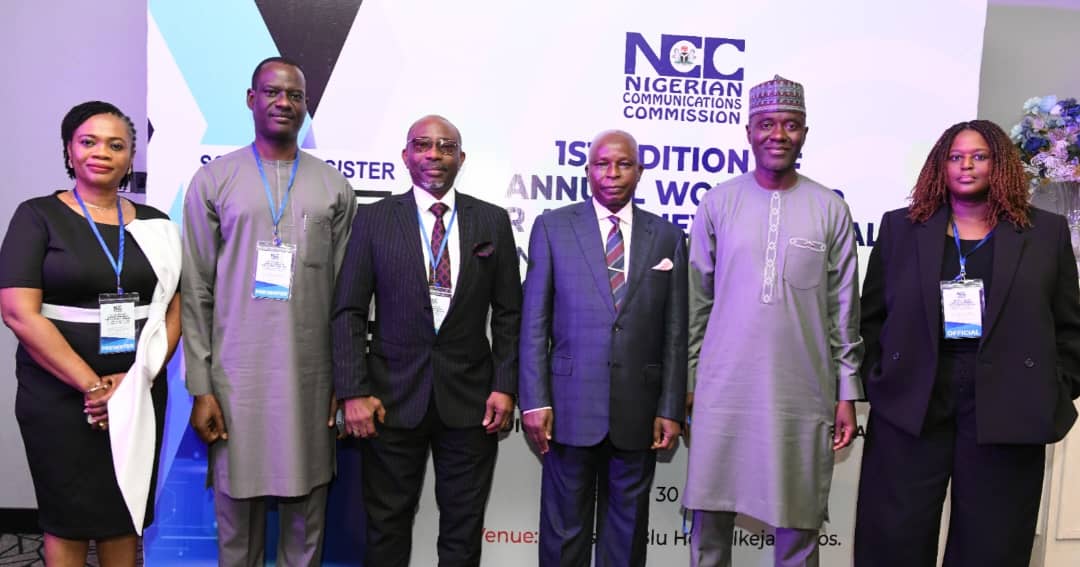
The Nigerian Communications Commission (NCC) has renewed its call for stronger institutional collaboration to tackle the persistent challenges of multiple taxation, regulatory overlaps, and infrastructure vandalism affecting the growth and sustainability of Nigeria’s telecommunications sector.
This call was made during the 1st Annual Workshop for State Attorneys-General on Emerging Issues in the Communications Sector, which commenced on Tuesday, July 30, 2025, at the Sheraton Hotel, Ikeja, Lagos.
The Executive Vice Chairman and Chief Executive Officer of the NCC, Dr. Aminu Maida, while delivering his opening remarks, described the event as a milestone in aligning the legal and regulatory ecosystems essential for Nigeria’s digital transformation.
“The theme of this workshop ‘Building and Driving Synergy in Regulating Communications for the Digital Transformation of Nigeria’ reflects the Commission’s belief that collaboration is not optional, but essential,” Dr. Maida stated.
He emphasized that the sector, while vital to national development, continues to face major hurdles that demand coordinated legal and policy responses from both federal and state governments. These include the imposition of multiple and inconsistent taxes, slow broadband rollouts caused by right-of-way disputes, and the destruction of telecom infrastructure, especially in conflict-prone areas.
Maida further noted that while communications regulation in Nigeria has evolved from market liberalization to digital service expansion and now to complex issues like data governance and cybersecurity, the legal framework must continue to adapt. He called on Attorneys-General to leverage their roles not only as legal advisers but also as key influencers of policy reform.
“We must harmonize our regulatory approaches, eliminate disincentives to growth, and work collectively to protect critical national information infrastructure as designated under the 2024 Executive Order by President Bola Ahmed Tinubu,” he said.
Delivering the keynote address, the Attorney-General of the Federation and Minister of Justice, Lateef O. Fagbemi, SAN, aligned with the NCC’s position and stressed the importance of legal clarity and uniformity in enhancing digital development.
Fagbemi underscored that the justice sector must provide a level playing field for all stakeholders in the communications industry. He identified the protection of digital rights, enforcement of data privacy laws, and prosecution of infrastructure vandals as responsibilities that lie heavily on the shoulders of legal officers across the country.
According to the AGF, “Digital transformation is critical to our socio-economic progress. The communications sector must be regulated in a way that balances innovation with accountability and investor confidence. Multiple taxation, sabotage of infrastructure, and regulatory confusion are challenges that we must address collectively.”
He cited specific examples of setbacks in the sector, including the 2024 multiple taxation crisis in Ogun State, which disrupted expansion projects, and the 2023 vandalization of telecom base stations in Kano, both of which he described as economic sabotage. In contrast, he praised Anambra State’s adoption of a unified right-of-way policy, which led to a 38% increase in fibre optic expansion within just six months.
Fagbemi further called on state Attorneys-General to proactively advise their governors on policies that enhance the digital economy, champion data protection laws, and promote harmonized enforcement approaches that support Nigeria’s broader digital agenda.
“This workshop is not just an event it is a call to action. As Attorneys-General, we must commit to working with NCC and other stakeholders to ensure Nigeria’s digital transformation journey is legally sound, inclusive, and sustainable,” he said.
The two-day workshop, hosted by the NCC, brought together Attorneys-General and legal experts from across Nigeria. Discussions focused on reforming the Nigerian Communications Act (2003), streamlining digital taxation, addressing regulatory overlaps, and protecting critical infrastructure in line with global best practices.
Participants are expected to develop actionable resolutions that will guide future engagements between the NCC and state legal institutions in strengthening Nigeria’s digital infrastructure and policy environment.