
The Senate President, Godswill Akpabio, has reaffirmed the National Assembly’s commitment to electoral reforms and called on Nigerians to uphold and respect democratic institutions as a foundation for national development.
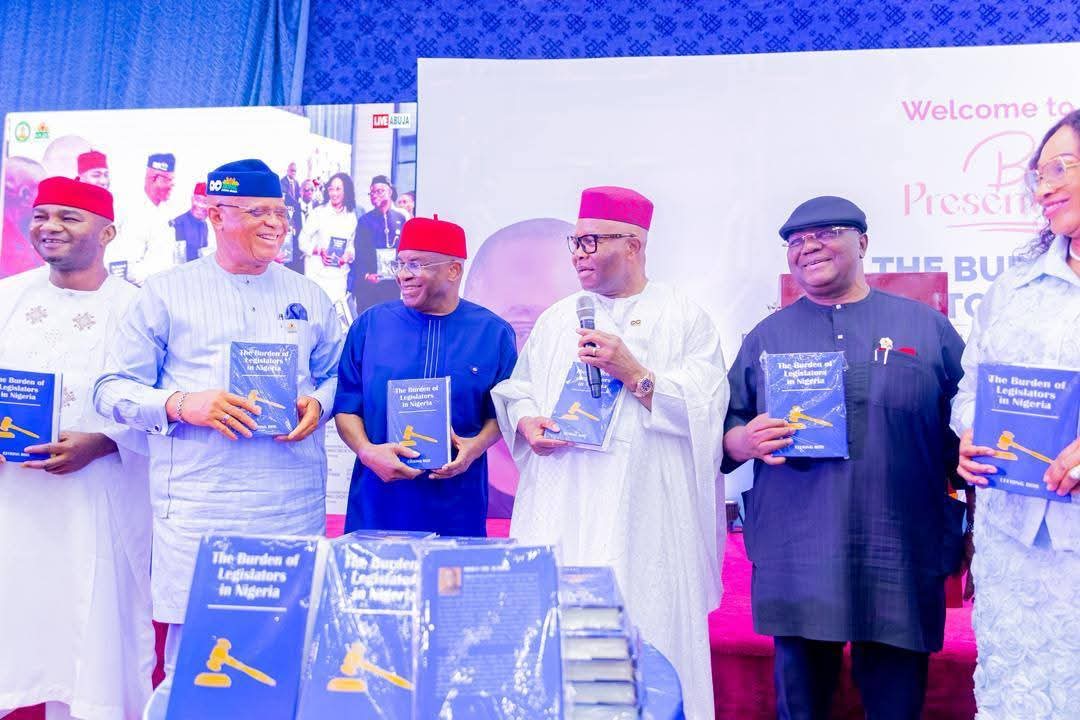
Akpabio made the call in Abuja at the public presentation of The Burden of Legislators in Nigeria, a book authored by former Senator Effiong Bob.
Describing the event as more than a literary gathering, the Senate President said it was a civic moment that invited national reflection and renewed faith in Nigeria’s democratic journey.
He praised the author for documenting his legislative experience, describing Senator Bob as a patriot and custodian of institutional memory who chose “education over silence and history over hearsay.”
According to Akpabio, the book shed light on the often misunderstood responsibilities of lawmakers and reinforces the importance of the legislature as a co-equal arm of government.
He explained that legislative duties extend beyond lawmaking to include representation, oversight, and budgetary control, noting that these constitutional responsibilities are frequently carried out under intense public scrutiny and misrepresentation.
“These are not ceremonial duties but serious obligations that require balance, discipline, and integrity,” he said.
The Senate President stressed that democracy cannot be sustained by elections alone but by strong institutions that function effectively, check excesses, reflect the will of the people, and safeguard public resources.
Addressing public debates on electronic transmission of election results, Akpabio clarified that the National Assembly has already provided for it in Nigeria’s electoral laws.
“The door is open. The law is settled. The principle is affirmed,” he stated.
However, he emphasized that the implementation of electronic transmission remains the constitutional responsibility of the Independent National Electoral Commission (INEC).
“The Senate makes the law; INEC applies it,” Akpabio said, adding that the timing, scope, and modalities of deployment rest with the electoral body.
He maintained that electoral reforms must be anchored in law, guided by technical capacity, secured against abuse, and applied uniformly across the country.
According to him, while technology has a role to play in strengthening democracy, it must not be deployed without adequate preparation and safeguards.
“Progress must be inclusive, or it becomes injustice,” he warned.
Akpabio also urged former lawmakers to document their experiences to strengthen democratic accountability and preserve institutional memory.
He noted that democracies are strengthened when public officials share their experiences openly rather than allow misinformation to dominate public discourse.
“A democracy that does not understand its legislature is a democracy at risk,” he said.
The Senate President called on Nigerians to recommit themselves to building strong institutions, promoting honest debates, and pursuing thoughtful reforms anchored on national interest.
He concluded by congratulating Senator Bob and the Effiong Bob Foundation for the publication, describing the book as a valuable contribution to democratic education and governance.
The book examined the constitutional, political, and social responsibilities of legislators and advocates greater transparency and public engagement in Nigeria’s democratic process.