
The Nigeria Customs Service (NCS) Apapa Command is set for a major boost in both trade facilitation and security with the installation of three new fixed scanners capable of examining 200 containers per hour.
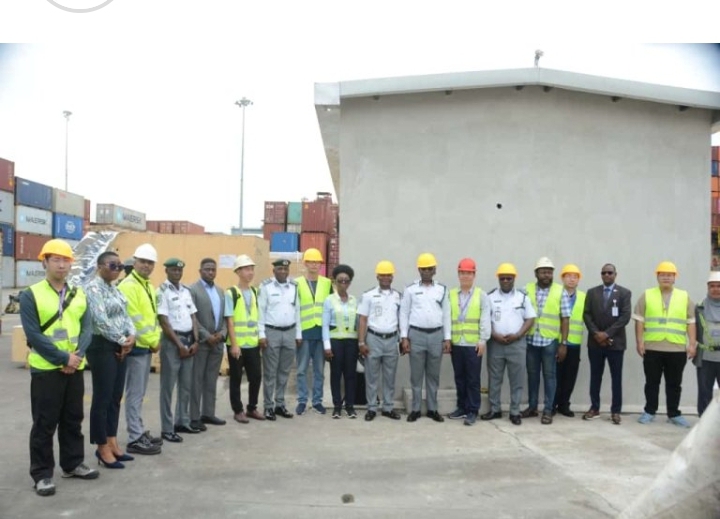
Customs Area Controller (CAC) of the Command, Comptroller Oluwadare Oshoba, disclosed this on Monday after inspecting the installation site, described the project as a landmark in the Service’s modernisation drive.
He explained that the scanners, strategically positioned close to the berthing area, would ensure faster clearance processes for genuine importers and exporters while exposing false declarations and concealments through high-tech, non-intrusive inspection.
“This is a great milestone in the history of Apapa Command. I want to, on behalf of our officers and men, thank the CGC for leading us through this era of revolutionary customs modernisation. These scanners are one of the many fruits we shall harvest from the project,” Oshoba said.
The CAC commended the Comptroller-General of Customs (CGC), Bashir Adewale Adeniyi, for his commitment to reforms, urged officers to prepare for intensive train-the-trainer sessions ahead of full deployment. He also tasked NCS ICT officers to strengthen their technical capacity for scanner maintenance, noting that these are the first of their kind in West and Central Africa.
Oshoba further revealed that the Trade Modernisation Project (TMP) has assured completion of the installation within 45 days, with two scanners supplied by TMP and one by APM Terminals. He added that APM Terminals has also pledged a mobile scanner as backup to prevent downtime.
Also speaking, TMP Team Leader, Aliyu Suleiman, explained that the scanners NUCTECH FS6000 models from Chinaare high-throughput, drive-through X-ray systems that use dual-energy technology to scan trucks and containers at speeds of up to 15 km/h.
He said the system produces detailed images that can detect concealed contraband and dangerous materials, while its modular design allows integration with technologies such as License Plate Recognition (LPR) and Radio Frequency Identification (RFID).
With the deployment, Apapa Command is expected to strengthen its role as Nigeria’s busiest port by enhancing security at entry points, reducing clearance time, boosting revenue, and curbing smuggling.