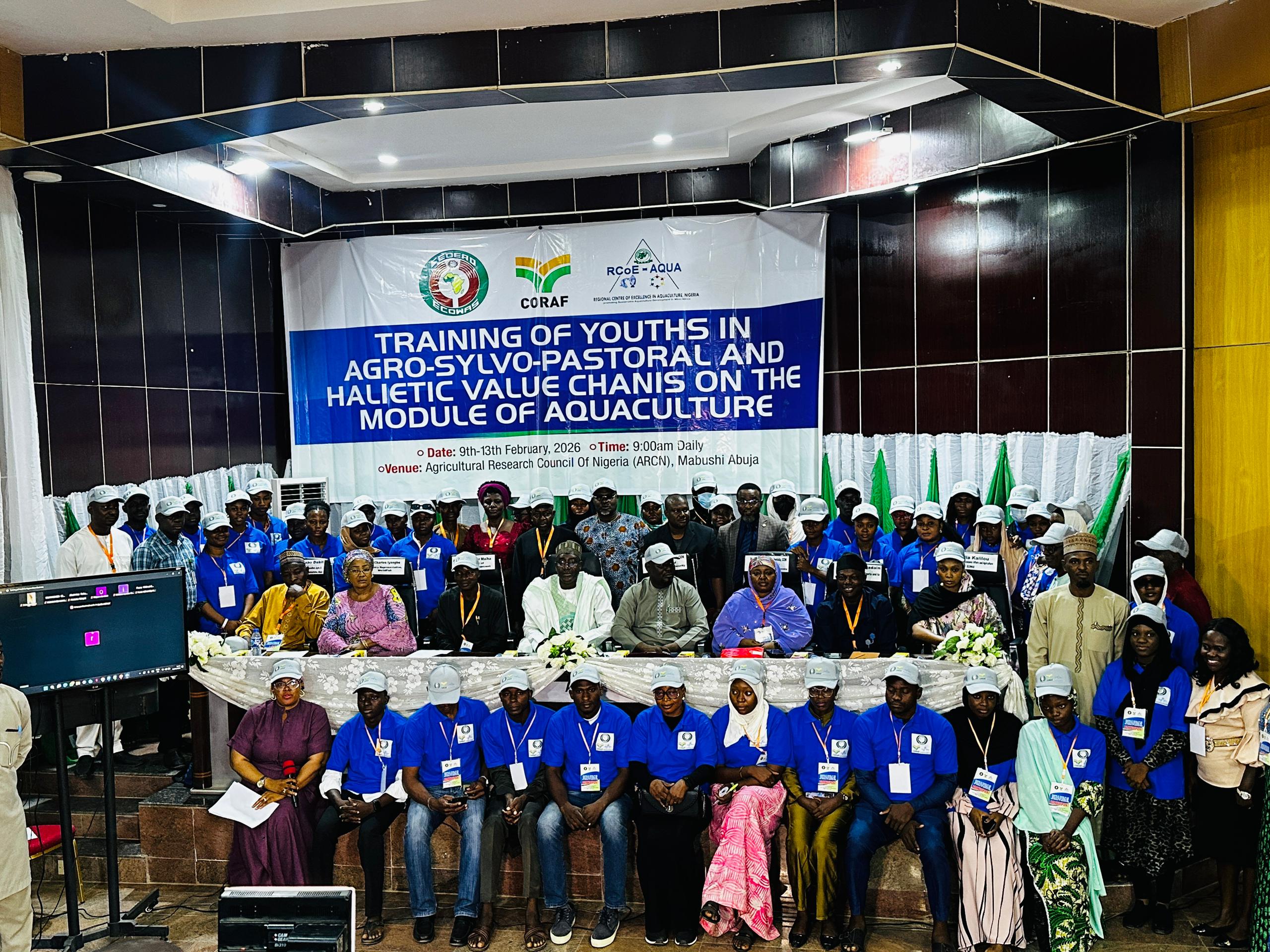
The Executive Secretary of the Agricultural Research Council of Nigeria (ARCN), Dr. Abubakar Adamu Dabban, on Monday formally opened the Nigerian edition of the 2026 Training of West African Youth in Aquaculture, a regional capacity-building programme aimed at boosting youth employment, food security and sustainable fish production.
Speaking at the opening ceremony held at the ARCN Auditorium in Abuja, Dr. Dabban said the training, organised in collaboration with the Economic Community of West African States (ECOWAS), aligned with regional priorities on youth empowerment, environmental sustainability and the development of a circular bioeconomy within the aquatic food sector.
He explained that ARCN, which oversees 16 National Agricultural Research Institutes and 18 Federal Colleges of Agriculture, is leveraging its mandate to support research-driven training and innovation across the aquaculture value chain.
The theme of the 2026 programme, “Sustainable Fish Farming Using Black Soldier Fly Larvae (BSFL),” was described as forward-looking, particularly in addressing the high cost of fish feed, which accounts for up to 60–70 per cent of aquaculture production costs.
According to Dr. Dabban, the current training is the third edition under the ECOWAS–ARCN collaboration. While 230 youths were trained in the first two editions, a total of 200 youths are participating this year across four specialised institutions: ARCN, the National Institute for Freshwater Fisheries Research (NIFFR), the Nigerian Institute for Oceanography and Marine Research (NIOMR), and the Nigerian Stored Products Research Institute (NSPRI).
He noted that the multi-institutional approach is designed to provide participants with broad exposure to fish production systems, feed innovation, post-harvest management and agribusiness development.
The training modules covered Black Soldier Fly Larvae production for sustainable aquatic food systems, freshwater, brackish and marine fish farming, fish processing and value addition, as well as aquaculture economics and business plan development.
Dr. Dabban stressed that the integrated structure would equip participants with both technical and entrepreneurial skills required to establish viable aquaculture enterprises.
Highlighting the demographic realities of the region, he said West Africa’s youthful population presented a major opportunity for economic transformation if young people are equipped with relevant, market-driven skills. He added that aquaculture remains one of the fastest-growing food production sectors globally, yet Africa continues to face significant fish supply deficits.
He identified BSFL technology as a sustainable alternative to conventional fishmeal and soybean meal, noting that insect-based protein promotes waste recycling, reduces pressure on wild fish stocks and improves farm profitability.
Dr. Dabban also commended ECOWAS for implementing the programme through its youth employability and agricultural development initiatives, leveraging technologies generated by the Regional Centre of Excellence in Aquaculture hosted in Nigeria.
Addressing the participants, he urged them to see themselves as future employers and innovators, and to replicate the knowledge and technologies gained within their communities to drive job creation and food security across the region.
He expressed appreciation to ECOWAS, CORAF, implementing institutions and facilitators for their commitment to youth empowerment and agricultural transformation.
The programme was officially declared open with a call for active participation and regional collaboration to unlock the full potential of aquaculture in West Africa.