
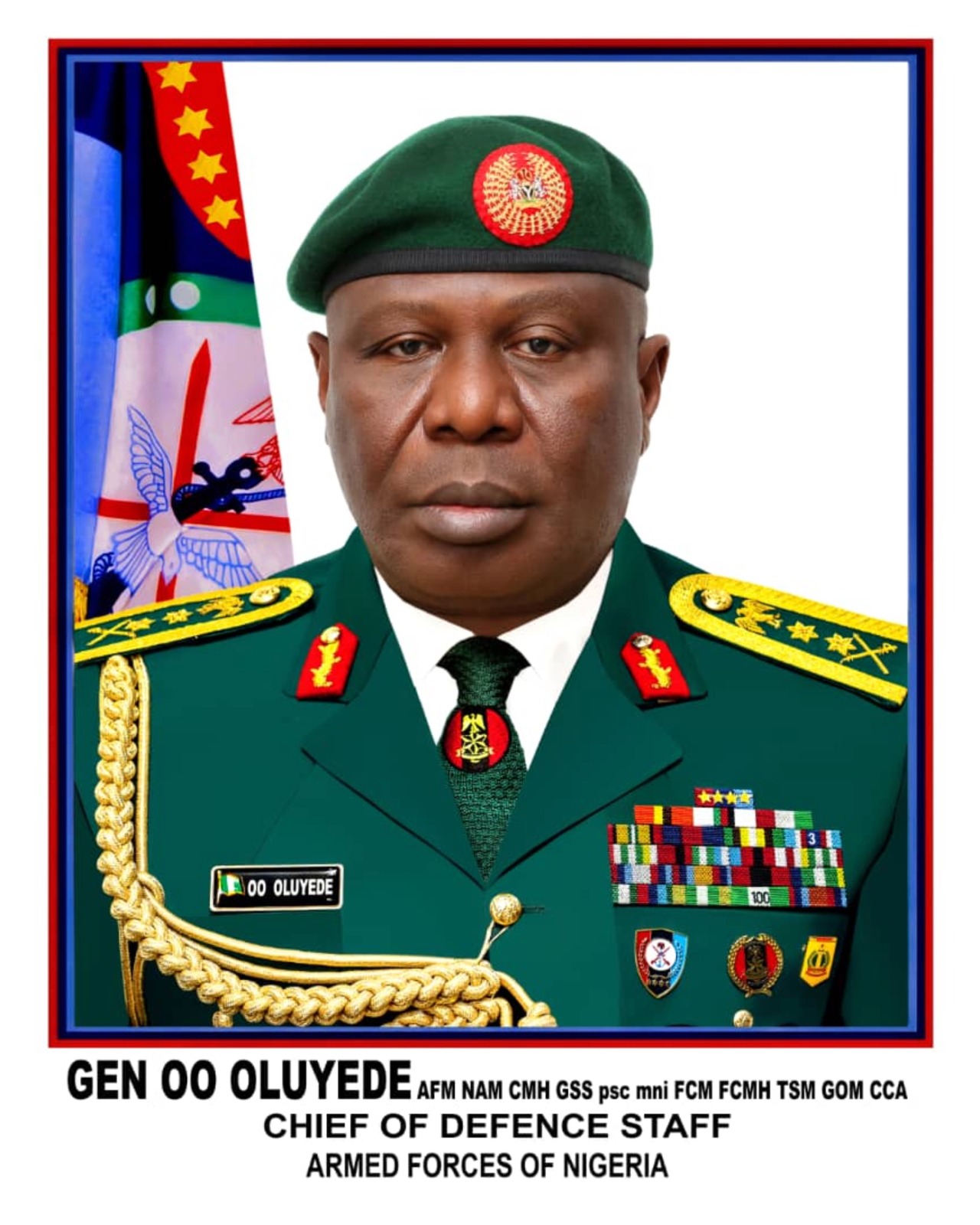
The Chief of Defence Staff (CDS), General Olufemi Oluyede, has reaffirmed the Armed Forces’ commitment to structured rehabilitation and reintegration of repentant insurgents as Nigeria move to expand Operation SAFE CORRIDOR across multiple regions of the country.
This assurance was conveyed during a high-level stakeholders’ meeting convened by Defence Headquarters in collaboration with Operation SAFE CORRIDOR at the Nigerian Army Resource Centre, Abuja, to finalise modalities for transferring rehabilitated clients to national and state authorities for reintegration.
The meeting drew participants from federal ministries, the Office of the National Security Adviser, state governments, neighbouring countries including Burkina Faso, Chad, Niger and Cameroon, as well as international partners such as the European Union, the United Kingdom, Norway, the Foreign, Commonwealth and Development Office (FCDO), the International Committee of the Red Cross (ICRC), and the International Organization for Migration (IOM).
Represented by the Chief of Defence Operations, Major General Jamal Abdusalam, the CDS emphasised that Nigeria’s counter-insurgency strategy combines military operations with humanitarian stabilisation initiatives aimed at preventing renewed cycles of violence.
He described Operation SAFE CORRIDOR as a vital component of Nigeria’s security architecture, noting that while military offensives create opportunities for stability, structured rehabilitation and reintegration help consolidate long-term peace.
According to him, since its establishment in 2016, the programme has processed thousands of individuals through a controlled Disarmament, Rehabilitation and Reintegration (DRR) framework designed to encourage voluntary surrender, generate intelligence and support national recovery efforts.
Earlier, the Coordinator of Operation SAFE CORRIDOR, Brigadier General Yusuf Ali, credited the programme’s progress to sustained leadership support and improved inter-agency collaboration anchored on a whole-of-government approach.
He explained that the initiative operates as a multi-agency humanitarian stabilisation programme involving personnel drawn from 17 Services, Ministries, Departments and Agencies, guided by constitutional provisions and international humanitarian standards.
Providing operational updates, Brigadier General Ali disclosed that 117 clients from Borno State recently completed the DRR programme at the Mallam Sidi Camp, highlighting improved coordination between federal and state authorities in reintegration and monitoring processes.
He further revealed that the programme has expanded to Nigeria’s North-West region, where a DRR camp established last year is being repositioned in collaboration with Zamfara State into a broader Victim Healing, Rehabilitation and Reintegration framework focused on psychosocial recovery, community reconciliation and livelihood support.
In the North-Central region, Benue State has formally requested the establishment of a DRR facility, with Defence Headquarters already assessing proposed locations to ensure compliance with national security and sustainability standards.
The stakeholders’ meeting also sought to clarify responsibilities among state governments and relevant agencies, develop structured resettlement support systems, outline community sensitisation strategies and ratify graduation timelines for rehabilitated participants.
Participants received updates on de-radicalisation and reintegration activities, alongside presentations and interactive sessions aimed at strengthening collaboration among local and international partners.
The Defence Headquarters said the engagement underscores Nigeria’s determination to consolidate security gains through coordinated rehabilitation, reintegration and peacebuilding initiatives nationwide.