

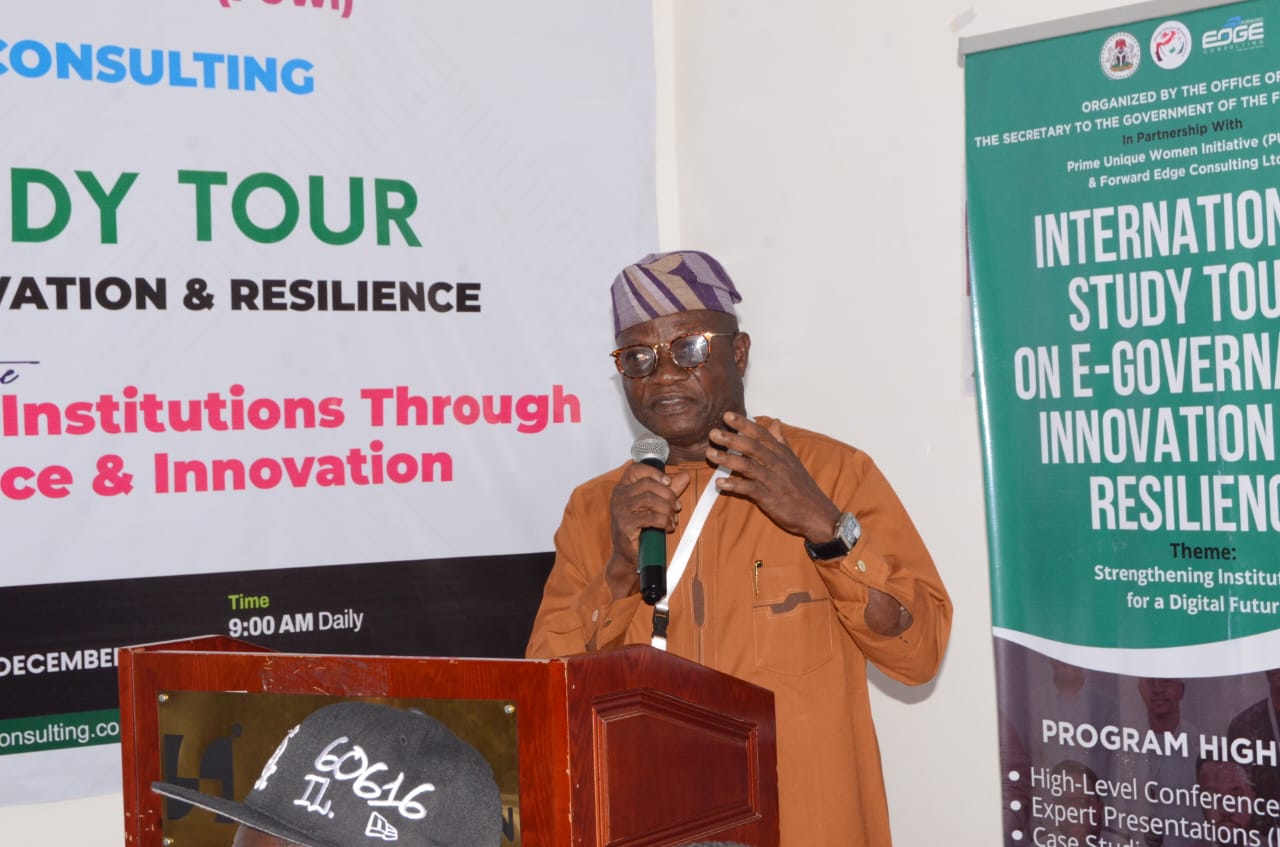
Nigeria’s agitation toward a fully digitized and citizen-focused public sector took a center stage yesterday at the international 4- Day Study Tour on e-Governance, Innovation and Resilience held in Swiss – Belinn, Nairobi, Kenya as experts Brainstormed on challenges, gaps, realities and pathways to modernizing public institutions across Africa.
Presenting a well detailed and researched paper with titled: “Modernization of Public Institutions: Gaps, Realities and Pathway to Enhance Effective e-Governance,” Dr TPL Bassey Ita Etim-Ikang, PhD who is also a developmental expert and analyst urged for immediate reforms driven by innovation, technology and institutional resilience.
In his powerful lecture during the occasion,Etim-Ikang (PhD) revealed that public and private institutions globally have moved rapidly from analog systems to digital ecosystems, propelled by breakthroughs in information and communication technology.
According to him: “governance in the 21st century has been reshaped by digital transformation, making paperless processes, real-time service delivery and electronic governance not only possible but inevitable for effective administration process.
While his analysis was anchored on Nigeria’s experience, the presenter traced the Nigeria ’s transition from manual administrative systems to modernization through reforms and structural reorganization.
According to him, the adoption of e-governance tools has been critical in repositioning public institutions in order to deliver faster, more transparent and citizen-friendly services, while reducing bureaucratic bottlenecks that once defined public service operations in the country.
The presentation which was among the best in recent times also highlighted key implementing frameworks already in place in Nigeria such as the National Identity Management Commission (NIMC) noting that the technology deployed digital identity solutions nationwide, and Galaxy Backbone, which he said has provides core e-governance infrastructure linking ministries, departments and agencies (MDAs).
These platforms, Etim-Ikang noted, form the backbone of Nigeria’s emerging digital public service architecture.
Earlier in his presentation, the lecturer also informed that the Nigeria’s growing e-governance hubs were also showcased, with government portals and the Government Contact Centre (GCC) simplifying citizens’ access to services and information.
Consequently, Etim-Ikang also told his listeners that Institutions such as the National Information Technology Development Agency (NITDA) as well as the Digital Transformation Centre Nigeria were identified as drivers of innovation, while Lagos State has since been recognized as a global e-governance hub, hosting the UN-affiliated ICEGOV 2025 conference.
While drawing attention to the grassroots dimension, Etim-Ikang in his paper noted that Nigeria’s 8,813 political wards across the 774 local government areas represent a vast but underutilized opportunity for digital inclusion.
He equally informed that the Projects such as NITDA’s planned 1,600 ICT centres and the 774 Local Government Connectivity initiative were very crucial to extending e-governance benefits to all rural communities even as it aslo enhanced participatory governance.
On the ongoing Federal Government reforms, Etim-Ikang used the opportunity to outline major policy deliverables already underway which include the digitization of full operations in the Ministry of Police Affairs, the Federal Government’s push for paperless civil service operations by December 2025 including the implementation of a five-year strategic plan for the Federal Civil Service.
With his powerful presentation, Etim-Ikang also cited leadership development programmes and international partnerships which includes the Federal Inland Revenue Service(FIRS) collaboration with France, as evidence of Nigeria’s alignment with global best practices.
Despite numerous gains, the discordants identified persistent regular gaps as some factors hindering effective e-governance in Nigeria.
According to the presenter, challenges such as limited ICT infrastructure in the country has created some resistance to change within the bureaucracy, low digital literacy rate among public servants, funding constraints, cyber fraud risks, data manipulation, energy challenges and weak political among others to fully implement comprehensive e-government policies across the largest black continent.
The paper, however emphasized that realities on ground includes factors such as rising citizen expectations, global digital trends and ongoing national digital initiatives have negatively impacted on Nigeria with little choice but to accelerate modernization.
The lecturer, however proffered several workable solutions to bridge the technological gaps even as he also proposed uncommon strategic investments in infrastructure along with aggressive capacity building and inclusive stakeholder engagement, pilot projects at community levels, enabling legislation, international partnerships and the integration of renewable energy solutions among others.
He also Highlighted some expectations while pointing out flagship e-governance and deliverables which includes IPPIS, TSA, GIFMIS, REMITA, e-procurement platform, SERVICOM just to mention a few.
He, conclusively informed his audience that above mention factors have drastically improved transparency, accountability and service delivery across all segment of the governance.
The presenter was optimistic when he conclusively encouraged his teaming audience to always be hopeful submitting that strengthening public institutions through innovation, creativity and digital processes remains Nigeria’s surest pathway to effective peoples oriented governance, along with people’s oriented economic diversification as well as sustainable national development across all fares.
Etim-Ikang(PhD) is an orator of high repute and author of several books.