
It is either Nasir El-Rufai is a very lucky man, or he is a very strong man. He was arrested by his friends, charged variously for multiple offences, none of the various courts has yet ruled on his bail application, but he arrived home in Abuja on Saturday. His jailers mourned with him and said he needed to arrive home early enough to bury his mother who died the previous day.
“But, the court is already seized of the matter. How did he do it outside the courtroom?” An exasperated lawyer asked me.
“That is the practical definition of power; you can’t find it in any dictionary,” I told him.
A disciple of Confucius asked him: “Is there any one word that could guide a person throughout life?” Confucius replied: “How about ‘reciprocity’! Never impose on others what you would not choose for yourself?” So, here, one question lingers: if Nasir were president, would a former friend in his custody be allowed to go home and mourn such a loss? It is a question he owes the public an answer to.
While we wait for his answer, let me add, quickly, that his arrest and prosecution illustrate a deeper contest between reason and unreason. Arrested on February 16, 2026, detained, released two days later, and rearrested immediately on February 18, the sequence reads less like a coherent legal process and more like a struggle for control of the levers of power. The situation raises an unsettling question: should process itself become punishment? If an offence is bailable, must the system wait for personal tragedy before conceding a right already guaranteed by law? In this drama, the court emerges diminished, reduced to learning, from social media, what it had deferred to pronounce.
One only wishes Nigeria could extend the ‘right’ enjoyed by El Rufai to all detainees in similar situations. But that is not the way of the world. When a slave falls sick, the household rebukes him as a habitual invalid; but when the master’s child complains of fever, medicine and delicacies compete for his lips.
Chief Ebenezer Babatope was the Director of Organisation of Chief Obafemi Awolowo’s Unity Party of Nigeria (UPN) in 1983 when General Muhammadu Buhari axed the second republic. Babatope was detained without trial by Buhari throughout his 20 months in power. His father fell ill while he was in Buhari’s jail. When Babatope’s father died, he pleaded with Buhari to let him go home to bury and mourn his father. The reply he got from Buhari was a query on how he knew that his father died. Ebino Topsy was supposed to be incommunicado in detention.
You’ve heard repeatedly that there is something called karma, a concept of moral cause and effect. Rooted in Hindu philosophy, karma slithered its way into English language and became a moral weapon against the wicked. Roman statesman, Cicero, uttered it his elegant way: “ut sementem feceris, ita metes” (literally: “as you have sown, so shall you reap”). Others said it in a shorter form: “quod severis metes.” The translation is the same.
Beyond Roman philosophy, most religions affirm the principle of sowing and reaping as an inevitability in human life. Yet, it does not operate evenly for all.
If you are strong and lucky, every force on earth, including karma, will worship you and stand on your mandate. I cite the luckiest Nigerian ever, Muhammadu Buhari. Buhari’s autumn came in August 1985, he lost power and was detained by his friend and successor, Ibrahim Babangida. Then his mother died. How was he treated? Because he was not Babatope, the General did not get the same treatment he gave the UPN man.
Buhari’s biographer, John Parden, wrote in the book ‘Muhammadu Buhari: The Challenges of Leadership in Nigeria’ that “after the death of his mother in December 1988, Buhari was released and (he) travelled to Daura for the mourning.”
Different strokes. Detained Nasir El-Rufai was back in Abuja on Saturday, released outside the formal processes of the court, to mourn and bury his mother who died the previous day.
I have nothing against Bola Tinubu releasing his destiny helper from where he kept him. After all, as the Yoruba remind us, “bí a bá ńjà, bí i ti ikú kọ”—our quarrels are not meant to be fatal. Besides, in this season, every birth, every death is political and will be so treated. Someone said if the president did not release the man on time to bury his mother, the sun would have risen in the west and set in the east. They said the president’s politics would have suffered the fatwa of the mallam(s). I don’t know if I should believe that.
The lesson here (if it is a lesson) is that if you are strong enough, it is possible to sin against the powerful, get arrested by a motley of agencies, have your lawyers file your bail application, have the matter adjourned till March 31, and yet secure freedom on March 28 without any formal pronouncement from the court.
Literature has long anticipated this tense drama. I consult the master here, William Shakespeare. In ‘Measure for Measure’, power bends justice even as it preaches morality; authority manipulates outcomes while cloaked in virtue, and the law becomes theatre. In ‘King Lear’, power detaches from moral legitimacy: authority remains, but justice collapses. In ‘Macbeth’, ambition overrides order, hollowing out legitimacy and turning institutions into mere instruments. Across these works, the pattern is constant: when power escapes restraint, process becomes performance, and justice, an afterthought.
Beyond Shakespeare’s theatre of power, Jonathan Swift’s satire speaks with unvarnished contempt for its duplicities. In ‘Gulliver’s Travels’, he exposes the absurdity and arbitrariness of legal and political systems that hide behind the façade of rules. Consider the tiny officials of Lilliput, quarrelling over trivialities while exercising immense authority. Their pettiness is not comic relief alone; it is a mirror showing how institutions often cloak arbitrariness in the language and ritual of procedure.
Dig deeper into literature and you encounter Franz Kafka’s ‘The Trial’: the protagonist here was arrested and prosecuted by a system he cannot comprehend.
“I don’t know this law…It probably exists only in your heads,” he told those keeping him.
“You’ll find out when it affects you,” a policeman replied the detainee.
Kafka’s enduring insight is stark: a legal system that cannot explain itself has already abandoned justice. The quintessential nightmare of opaque authority.
Then comes George Orwell, the great anatomist of political power. In ‘Animal Farm’, rules shift with the convenience of those in control; in ‘Nineteen Eighty-Four’, authority goes further still, defining reality itself. In Orwell’s world, power bends process, rewrites it, works hard on it until truth becomes whatever power says it is.
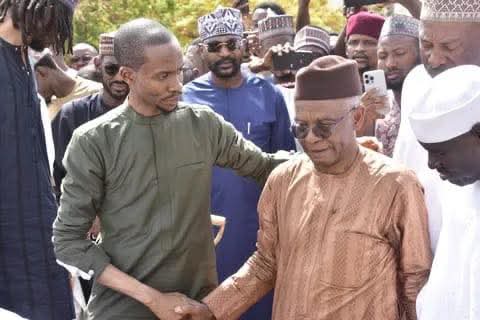
At the burial of his mum on Sunday, those who jailed El Rufai were fully there. They sat with him as co-mourners.
“Will he go back to jail now that the burial is over?”, a ‘wicked’ professor-friend asked me.
I didn’t know what answer to give her.
What, then, are the implications of El-Rufai’s ordeal and reprieve for democracy?
The episode raises profound questions about institutional integrity. Judicial supremacy is eroded when outcomes of trials appear to originate from outside the courtroom. The court, in such circumstances, risks becoming symbolic rather than decisive. Citizens are left to ask: where does authority truly reside?
When a justice system begins to operate with two courts, one visible, the other invisible, democracy is already in a kidnappers’ den. If bail and other legal reprieves are granted without transparent legal grounding, they invite a deeper anxiety: that the same unseen authority that grants relief can, with equal arbitrariness, impose punishment.
In all of this, the real losers are the courts: arbiters turned onlookers, spectators in their own game.