
The Federal Government has appointed the Athena Centre for Policy and Leadership to the Governing Board of the Nigerian Research and Education Network (NgREN) and its digital services arm, the Tertiary Education Research Applications and Services (TERAS), as part of renewed efforts to modernise Nigeria’s research ecosystem and deepen data-driven governance.
NgREN serve as Nigeria’s national research and education backbone, providing high-speed connectivity, shared digital resources, and collaboration infrastructure for universities and research institutions, while TERAS powers the digital applications that support research, data exchange, and virtual learning across the tertiary education system.
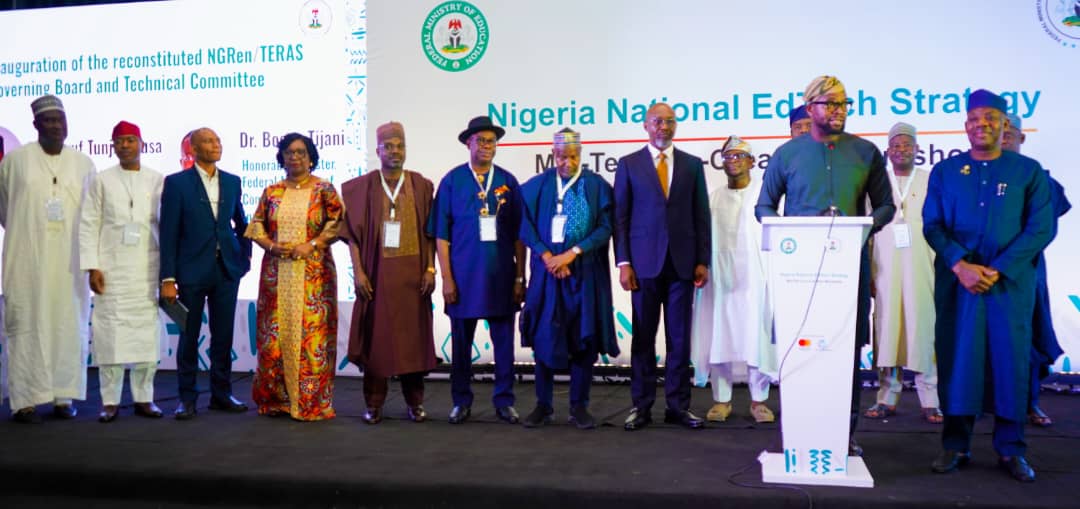
The new Board was inaugurated by the Minister of Education, Dr. Tunji Alausa, alongside the Minister of Communications, Innovation and Digital Economy, Dr. Bosun Tijani, during the Nigeria National EdTech Strategy Mid-Term Co-Creation Workshop held with support from the Mastercard Foundation and the World Bank Group.
Members of the Board included the Executive Secretaries of the NUC, NBTE, NCCE, and TETFund; representatives of vice chancellors, rectors and provosts; as well as key digital infrastructure bodies such as the NCC, Galaxy Backbone and USPF. The Athena Centre joins the Board as the sole civil society representative.
Dr. Alausa praised the Athena Centre for its contributions to national transparency and governance reforms, noting that the Ministry’s Federal Tertiary Institutions Governance Transparency Portal (FTIGTP) was inspired by the Centre’s research and advocacy. He expressed confidence that the reconstituted Board will deliver measurable progress within two years to enhance Nigeria’s research capacity and digital readiness.
Represented on the Board by its Chancellor, Chief Osita Chidoka, the Athena Centre welcomed the government’s commitment to transparency, digital innovation and evidence-based policymaking.
Reaffirming the Ministry’s direction, Dr. Alausa stated: “For the first time, Nigeria is building a unified data architecture for basic, secondary and tertiary institutions. You cannot reform what you cannot measure, and we are determined to measure what matters.”
On his part, Dr. Tijani underscored the importance of integrated systems, warning that digital transformation is undermined when institutions operate in silos. “Our priority is a national architecture where platforms talk to each other and every school is connected,” he said.
Chidoka commended the reforms but stressed the need for stronger participation of state governments, who own the majority of schools in the country. He argued that sustainable transformation in the education sector requires state-level investment, leadership and commitment.
“For education to succeed, states must invest, lead and commit. The Federal Government must coordinate and support, but it cannot carry the burden of school management alone,” he said.
The Athena Centre reaffirmed its commitment to supporting federal and state authorities in strengthening education data systems, digital governance and transparent accountability.