

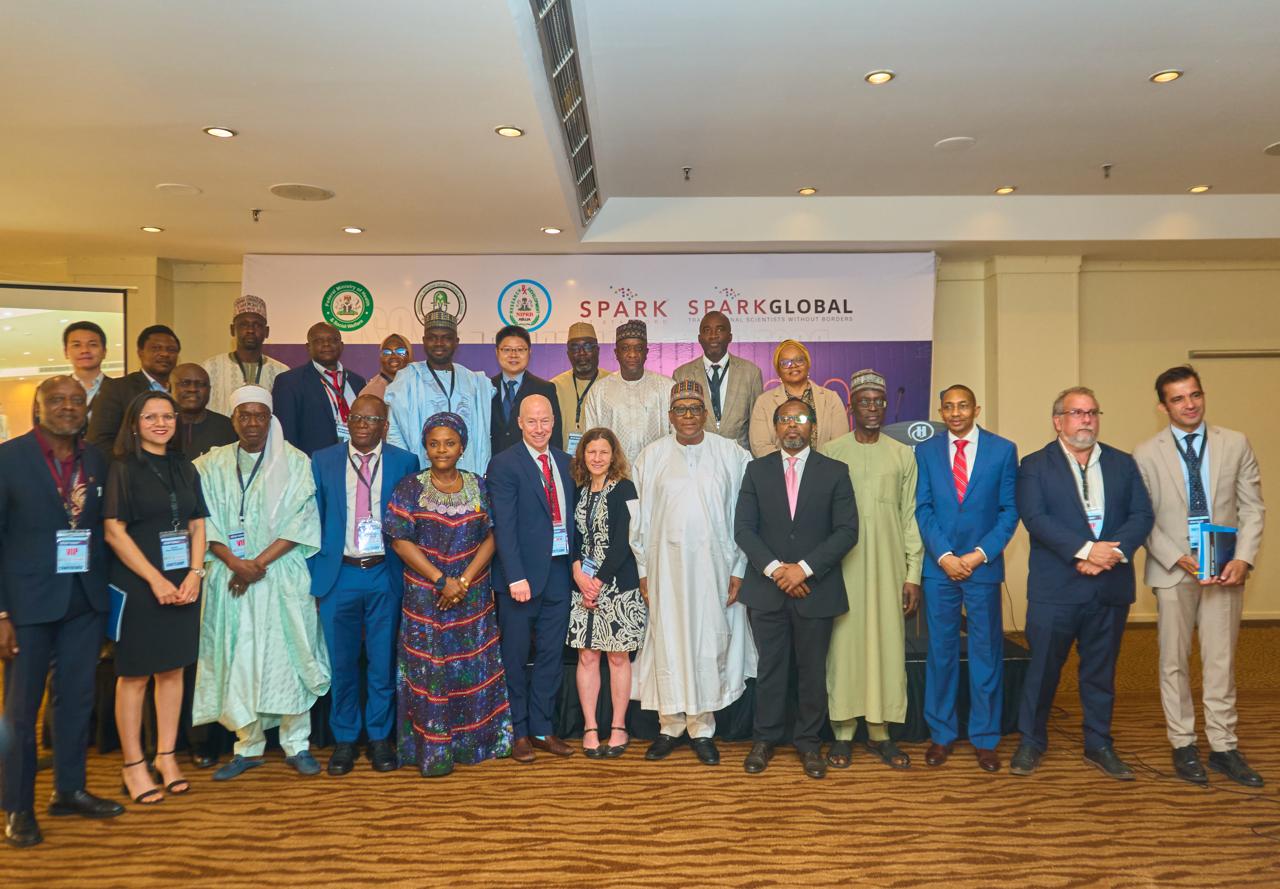
The Federal Government of Nigeria, in collaboration with global and local partners, has intensified efforts to strengthen translational research across Africa, urging the continent to move from being a source of extracted data to a driver of scientific innovation, healthcare solutions and economic development.
This call was made by the Coordinating Minister of Health and Social Welfare, Professor Muhammad Ali Pate, at the SPARK Translational Research Boot Camp and Conference 2026, held in Abuja on Monday.
The conference was jointly organised by the National Institute for Pharmaceutical Research and Development (NIPRD), SPARK Global at Stanford University, and the Presidential Initiative for Unlocking the Healthcare Value Chain (PVAC), under the Federal Ministry of Health and Social Welfare.
Delivering the keynote address, Professor Pate commended the organisers for months of coordination to bring the programme to Africa despite resource constraints, describing the gathering as timely amid global economic, health and technological challenges.
“We are living through an era of pandemics, economic shocks, technological disruption and demographic transitions. At such a moment, scientific inquiry and evidence-based policymaking are not optional, they are essential,” he said.
The Minister traced global gains in life expectancy and disease control to scientific research, but warned that such progress remains fragile. He noted that the COVID-19 pandemic exposed weaknesses in global systems, with lasting implications for development.
He identified rapid population growth, rising non-communicable diseases and technological changes as major challenges requiring research-driven solutions in Africa.
Professor Pate expressed concern that Africa still contributed only a small fraction of global research output and funding, with most studies externally driven.
“These risks position Africa as a perpetual extraction hub for data and knowledge,” he said, stressing the need for deliberate investment in local research systems, including clinical trials, regulatory frameworks and science governance.
He added that Nigeria’s health sector reforms under President Bola Ahmed Tinubu are anchored on scientific evidence, citing regulatory strengthening, healthcare expansion, research governance and health security as key pillars.
In his special remarks, Professor Kevin Grimes, Co-Director of SPARK at Stanford University and Vice President of SPARK Global, said the initiative aims to help African researchers translate quality science into products and services that benefit society.
“African scientists are as capable as any in the world. What they often lack is structured support and access to industry expertise. That is the gap SPARK is designed to fill,” he said.
Earlier, in his welcome address, the Director-General of NIPRD, Dr. Obi Adigwe, said the conference was designed to strengthen collaboration between science, policy and innovation.
“No matter how brilliant you are, if policy does not understand your work, you will not make an impact,” he said, stressing the importance of political will.
Dr. Adigwe disclosed that the conference, which attracted between 60 and 70 participants from across Africa, was the product of over 18 months of planning with Stanford University partners.
He warned that global science is facing pressure from funding cuts, misinformation and declining political commitment, urging researchers to remain resilient and socially engaged.
He also praised the current administration for prioritising research, describing Professor Pate as a global advocate for evidence-informed policymaking.
In recognition of his efforts, participants endorsed the Coordinating Minister as a Global Ambassador for Translational Research.
Also speaking, the National Coordinator of PVAC, Dr. Abdul Mukhtar, underscored the central role of research and development in Nigeria’s healthcare reform agenda.
He noted that Africa accounts for about two per cent of global R&D spending, stressing the need to link research with finance and commercialisation.
“When we talk about the healthcare value chain, the foundation is research and development,” he said. “You cannot move into manufacturing, discovery or care delivery without strong R&D.”
Dr. Mukhtar added that many scientific breakthroughs fail to move beyond academic journals, calling for stronger collaboration between researchers, investors and industry.
He explained that PVAC has adopted an ecosystem approach, strengthening clinical trials, human capital, supply chains and market access.
“Our ambition is to make Nigeria a hub for local manufacturing of essential medicines for Africa. To achieve this, we must also lead in basic science and research,” he said.
Stakeholders at the conference, including policymakers, researchers, industry players and development partners, agreed that strengthening translational research and science communication is critical to counter misinformation and ensure research delivers measurable health and economic benefits.
The boot camp was formally declared open with renewed commitment from the Federal Government and partners to support research, innovation and clinical trials as part of efforts to position Nigeria and Africa as active contributors to global scientific advancement.