
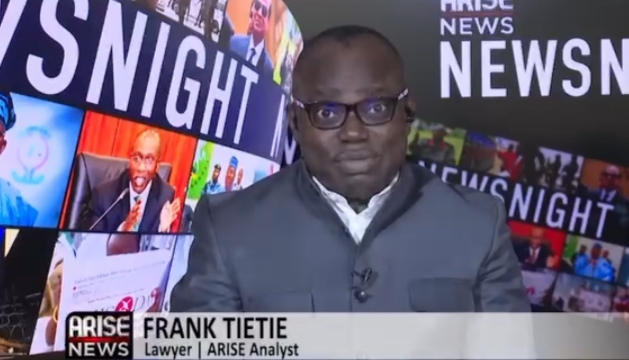
Human rights and development lawyer, Mr. Frank Tietie, has cautioned that the Nigerian military does not have the legal authority to try officers for treason or coup plotting under the Armed Forces Act, insisting that such cases must be handled by civilian courts.
Speaking during an interview on ARISE News on Monday, Tietie warned against the careless use of the term “coup” in relation to ongoing investigations involving some serving officers. He stressed that while allegations of attempts to overthrow a democratically elected government are extremely serious, only civil courts are constitutionally empowered to prosecute treason-related offences.
According to him, the Armed Forces Act allowed the military to try offences such as mutiny but does not confer jurisdiction over treason or attempted coup.
“When you say coup, you are referring to Section 37 of the Criminal Code. But the Armed Forces Act does not empower the military to try any officer for treason,” Tietie said. “At best, they can investigate and raise allegations of mutiny, but not prosecute treason.”
His comments followed confirmation by the Defence Headquarters (DHQ) that investigations had been concluded into alleged plans by some officers to overthrow President Bola Tinubu’s administration. The DHQ had announced plans to arraign the suspects before a military judicial panel.
Reacting to this development, Tietie praised intelligence agencies for uncovering the alleged plot early, describing it as a positive sign for Nigeria’s democratic stability.
“It shows that intelligence was gathered, analysed, and properly investigated before submission to the President as Commander-in-Chief. This is commendable and healthy for our democracy,” he noted.
He revealed that about 16 officers, ranging from the rank of captain to brigadier-general, were reportedly implicated, adding that the matter was still undergoing review.
“This report is not final. It will be subjected to legal scrutiny by the Attorney-General to determine whether it amounts to treason, treasonable felony, or another offence,” he said.
Tietie also warned against sensationalism, recalled Nigeria’s painful history of military coups and executions.
“A coup is one of the gravest offences in Nigeria. We are still a retentionist country where treason attracts the death penalty. That history is traumatic and should not be carelessly invoked,” he said.
He emphasised that in a democratic system, allegations of coup plotting must follow due process and be subjected to the full judicial system.
“If you are alleging a coup in a democracy, it cannot end in a court-martial. It must go before the Federal High Court and pass through the appellate process,” he stated.
On capital punishment, Tietie described the death penalty as outdated and ineffective, called for a more humane justice system focused on reform.
“The death penalty is barbaric. It does not solve crime; it only cheapens human life,” he said.
He further urged the government to respect the constitutional rights of the detained officers, noted that they remain innocent until proven guilty.
“You cannot keep people in detention indefinitely. If there is a case, charge them to court,” he said, echoing similar views expressed by human rights advocates.
Despite his concerns, Tietie commended the Tinubu administration for handling the matter with caution and restraint.
“There has been no rush, unlike in the military era. Investigations took time, and the supremacy of civilian authority is clearly evident,” he observed.
He concluded by reaffirming his support for democracy while condemning any attempt to subvert it.
“No matter the challenges, we must never condone any attempt to remove a democratically elected president. Democracy may stumble, but it has no alternative,” Tietie said.