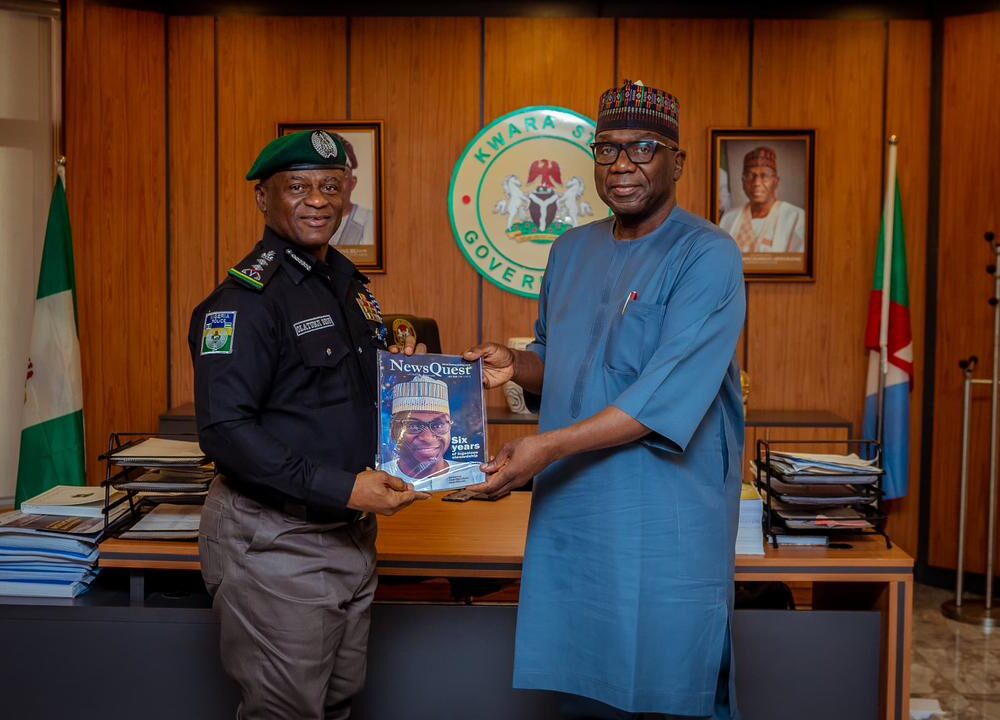


The Inspector-General of Police, Dr. Kayode Adeolu Egbetokun, has called for a renewed alliance between academic institutions and security agencies to tackle Nigeria’s evolving security challenges, stressed that the nation’s first line of defence is not its army, but its people educated, disciplined, and united by the rule of law.

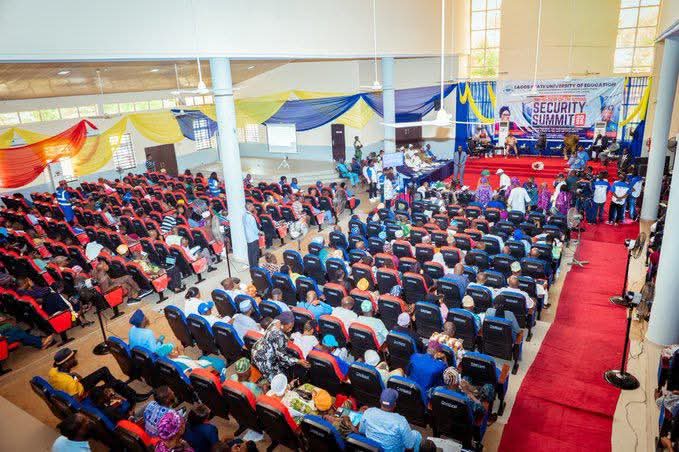
Speaking at the Strategic Conference on Security and Development held at the Lagos State University of Education (LASUED), Oto-Ijanikin, Egbetokun, in his keynote address titled “Securing Nigeria Through the Town–Gown Partnership,” described the gathering as an awakening a call for Nigerians to think differently, listen deeply, and act wisely in pursuit of lasting peace and progress.
The IGP noted that insecurity in Nigeria cannot be resolved by policing alone, but through the synergy of knowledge, morality, and community collaboration. He said safety is not merely the absence of crime but the presence of justice, knowledge, and trust. According to him, insecurity is not just a policing problem but a societal one rooted in the failure of values, education, and civic discipline.
Egbetokun commended LASUED for its vision in hosting the conference, describing universities as refineries of national conscience. He emphasized that the Town–Gown Partnership the collaboration between society and academia must evolve beyond dialogue into a national framework for peacebuilding, development, and innovation. He remarked that the patrol van and the classroom are fighting the same war: one battles ignorance, the other its consequences. “When the teacher and the officer walk together, crime loses shelter; when ideas and enforcement work together, peace begins to take shape,” he said.
The Police Chief urged stakeholders in government, business, academia, the media, and traditional institutions to form a united front against insecurity. He underscored the need to restore moral values as a foundation for national peace, noting that no security plan can succeed where the conscience of a nation is asleep.
“Our laws may punish crime, but only morality prevents it,” he said, adding that the classroom and the pulpit are our first police stations of the mind. He further stated that education and ethics must go hand in hand because every act of crime begins first as a thought.
Egbetokun also addressed the changing nature of crime, observing that the digital era has introduced new threats ranging from cybercrime to misinformation. He warned that modern criminals often hide behind firewalls rather than forests and that a single keystroke can inflict more damage than a bullet. He disclosed that the Nigeria Police Force is undergoing a comprehensive transformation into a technology-driven, intelligence-led, and community-focused service, with investments in cybercrime units, forensic labs, drones, data analytics, and personnel training. However, he cautioned that technology alone cannot guarantee peace, noting that real security is born out of relationships.
The IGP identified misinformation as one of the gravest threats to national security, lamenting how falsehoods online have eroded public trust in security institutions. He described misinformation as a silent bomb that destroys not buildings but trust, and urged citizens and civil society to promote digital literacy and responsible communication.
Concluding his address, Egbetokun appealed for a collective moral and intellectual revival across all sectors. “Nations are not secured by walls or weapons; they are secured by wisdom,” he said. “When knowledge stands guard, ignorance retreats. When communities unite, criminals scatter. And when truth takes the microphone, falsehood loses its audience.”
He called on Nigerians to see security as a shared responsibility, declared that if the Town–Gown partnership succeeds, history will record that when darkness threatened the land, it was not the sound of gunfire that answered, but the sound of understanding. The event, attended by academics, traditional rulers, security personnel, students, and media professionals, was aimed at deepening collaboration between the Nigeria Police Force and higher institutions toward building a safer and more just society.