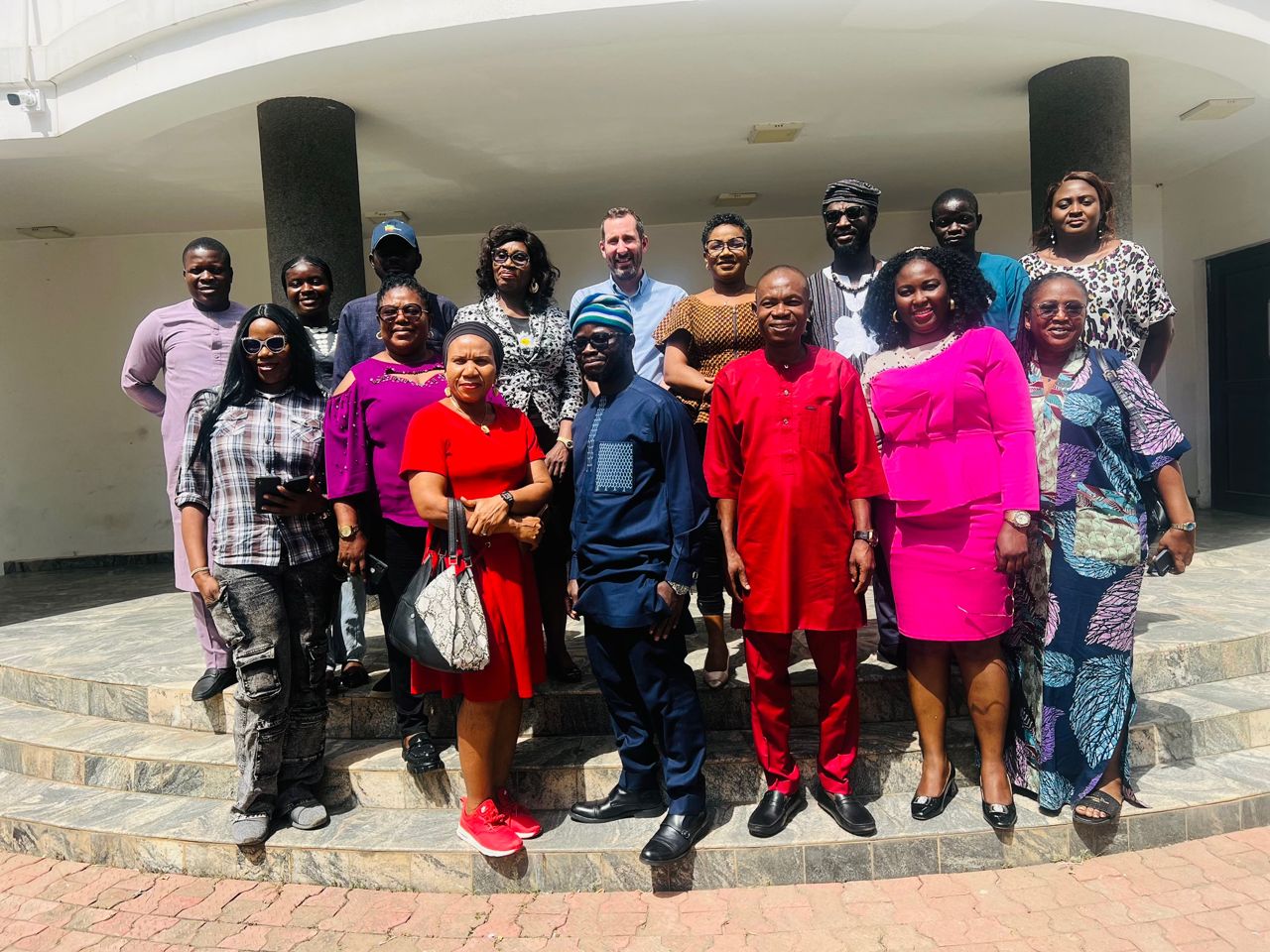
A delegation from Journalists for Human Rights (JHR), a Canada-based international media development organisation, on Thursday met with the leadership of the Nigeria Union of Journalists (NUJ), FCT Council, to discuss opportunities for collaboration and gain deeper insight into Nigeria’s media landscape.
The delegation included JHR Executive Director Bill Killorn, Director of Operations Amara Bangura, and Director of Africa Programme Mustapha Dumbuya.
Speaking at the meeting, Killorn explained that JHR operates across Sub-Saharan Africa, North Africa, the Middle East, Europe and Asia, with a mandate to support journalists in reporting human rights and community-focused stories. He stressed that the organisation’s visit to Nigeria was purely exploratory.
“We don’t design projects in Canada and impose them elsewhere. We come into countries, speak to journalists, understand realities on the ground and co-create solutions,” he said, adding that JHR—funded largely by the Canadian government—has identified Nigeria as a priority for potential expansion.
Killorn highlighted that nearly half of JHR’s global programming focuses on gender equality, reflecting the priorities of its major funder. He also noted that JHR runs a story bursary scheme that supports journalists and editors to pursue in-depth human rights and gender-focused reporting that many newsrooms cannot fund on their own.
On policy impact, he cited the Democratic Republic of Congo, where JHR-backed advocacy led to reforms eliminating fees that previously hindered survivors of gender-based violence from accessing police and medical services.
Speaking on the organisation’s Africa programmes, Dumbuya outlined JHR initiatives in Kenya, Uganda, South Sudan, Mali and the DRC, noted that media inclusiveness and women’s rights remain core priorities. He referenced research in Kenya showing that sexual harassment and gender-based violence continue to push many young female journalists out of the profession.
To address this, he said, JHR partnered with the Kenya Editors’ Guild, Kenya Women in Media and the journalists’ union to introduce an anti-sexual harassment policy now being adopted by major newsrooms. He added that JHR trains journalists on gender-sensitive reporting, including during elections, and works with media houses to ensure accurate and stereotype-free representation of women.
Also speaking, Ms. Bangura disclosed that JHR is expanding into new regions, including North Africa and Asia, and is in the process of setting up an office in the Philippines.
In her remarks, NUJ FCT Council Chairperson Comrade Grace Ike commended JHR for its interventions, noting that Nigeria still lags in promoting women’s leadership and ensuring a safe work environment for female journalists. She described her election as Council Chairperson as a breakthrough moment, highlighting how women rallied behind her candidacy despite cultural pressures and attempts to delegitimise her based on marital status.
She identified major challenges confronting journalists particularly women including poor remuneration, sexual harassment, inadequate operational resources, and rising threats both online and offline. She also highlighted restrictive laws such as the Cybercrime Act, noting that arbitrary arrests, intimidation, and detentions continue to undermine press freedom.
“Welfare is critical. You cannot talk about ethics to a journalist who cannot afford transportation or basic needs,” she said, emphasising her administration’s commitment to transparency and members’ welfare.
Chairperson of the Nigeria Association of Women Journalists (NAWOJ), FCT Chapter, Comrade Bassey Ita-Ikpang, called for deliberate efforts to spotlight women leaders and experts in media reports. She warned against the persistent tendency to portray women only through lenses of vulnerability, saying this reinforces harmful stereotypes and impedes gender equality.
Participants also proposed the creation of a Women Journalists’ Situation Room, in collaboration with JHR, to document cases of harassment, threats and workplace discrimination, and to serve as a safe reporting channel for female media professionals. They further called for stronger gender-inclusive newsroom policies and improved institutional support for women’s career advancement.
Responding, JHR officials expressed readiness to partner with NUJ FCT on capacity building, media safety initiatives, policy development and investigative reporting support. They noted that successful intervention models in other African countries could be customised to strengthen journalism practice and women’s representation in Nigeria.
Both parties agreed to sustain engagement and pursue collaborative initiatives aimed at improving human rights reporting, enhancing journalists’ welfare, and amplifying women’s voices across the Nigerian media landscape.
The meeting was attended by members of the NUJ FCT Council Executive and NAWOJ FCT leadership, including Vice Chairman Yahaya Ndambabo, Secretary Comrade Jide Oyekunle, Treasurer Sandra Udeike, Auditor Rose Ikoko-Tega, Financial Secretary Henry Daniel, NAWOJ Vice Chairperson Bolanle Ukpevo, Secretary Nkiruka Okeke, Ex-Officio Princess Ekwi Ajide and Treasurer Chinasa Udeze.