
The Commander of the Mining Marshals, ACC Attah John Onoja, has urged Nigerian journalists to partner with law enforcement agencies in the fight against illegal mining, warning against biased or compromised reportage that could undermine the national campaign.
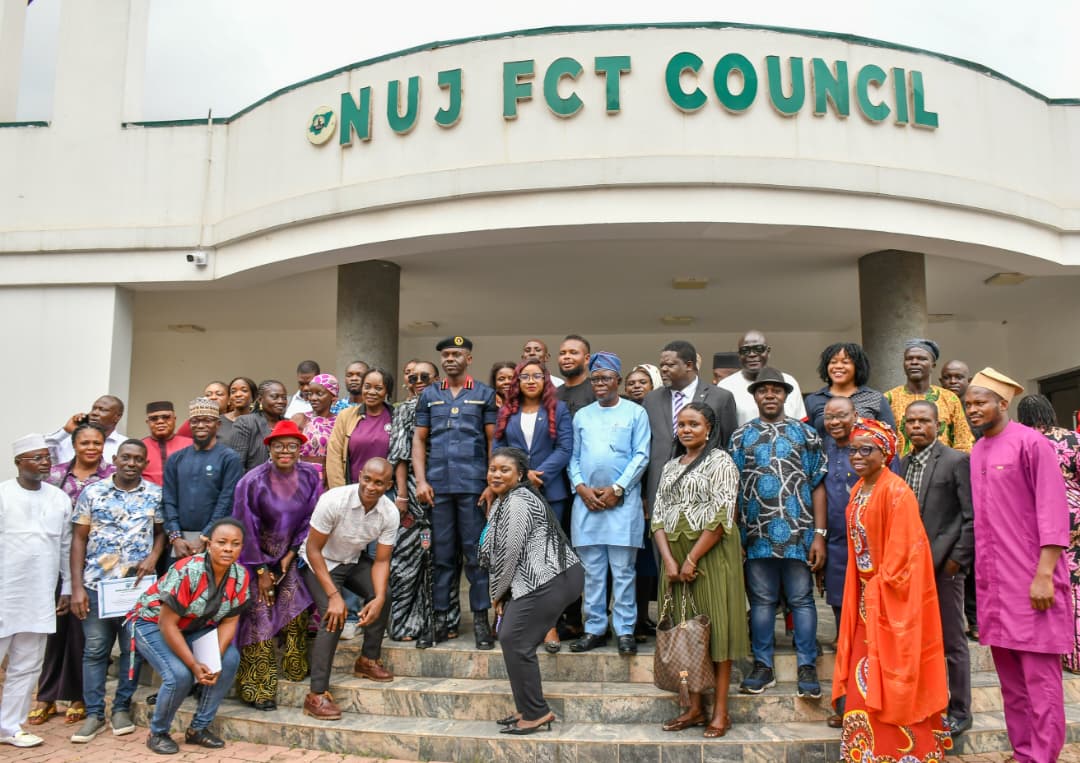
Onoja made the call in Abuja during a media parley organised by the Nigeria Union of Journalists (NUJ) FCT Council, where he revealed that illegal mining cartels were sponsoring what he described as “rogue journalism” aimed at discrediting enforcement operations.
“We will not cave to any blackmail designed to weaken our resolve,” Onoja stated. “Illegal mining cannot be defeated by enforcement agencies alone, and that is why we are calling on the media to be partners in this fight.”
The Mining Marshals, established under the Tinubu administration as a special enforcement arm of the Nigeria Security and Civil Defence Corps (NSCDC), have since its creation dismantled illegal camps, prosecuted offenders, and restored order in volatile mining corridors nationwide.
Despite challenges including entrenched interests and logistical constraints, Onoja maintained that the campaign is critical to Nigeria’s survival, stressing that the country’s mineral wealth must benefit all citizens, not a select few.
The media parley also heard from the FCT Commissioner of Police, CP Ajao Adewale, who described illegal mining as a cartel-driven enterprise fueling insecurity. He disclosed that Nigeria loses an estimated $9 billion (₦13.7 trillion) annually to illegal mining and gold smuggling.
Statistics from joint operations involving the NSCDC, Police, and EFCC shown that more than 72 suspects were arrested in Abuja alone between 2023 and 2024 for involvement in illegal mining.
Supporting Onoja’s position, the National President of the Miners Association of Nigeria (MAN), Dele Ayanleke, noted that illegal mining is driven by corruption, poverty, and weak governance, with devastating consequences such as child labour in Nasarawa’s lithium fields and mercury poisoning in Zamfara’s gold belts.
On her part, NUJ FCT Council Chairperson, Ms Grace Ike, challenged journalists to go beyond superficial reportage and engage in investigative journalism that unmask the financiers of illegal mining, amplify the voices of affected communities, and hold policymakers accountable.
“As gatekeepers of truth, we must investigate, expose, and educate the public on the devastating effects of illegal mining on communities and natural resources,” she said.
The NUJ FCT Council pledged continuous support for the campaign, while reaffirming the role of the press in promoting transparency, regulatory accountability, and environmental justice.