
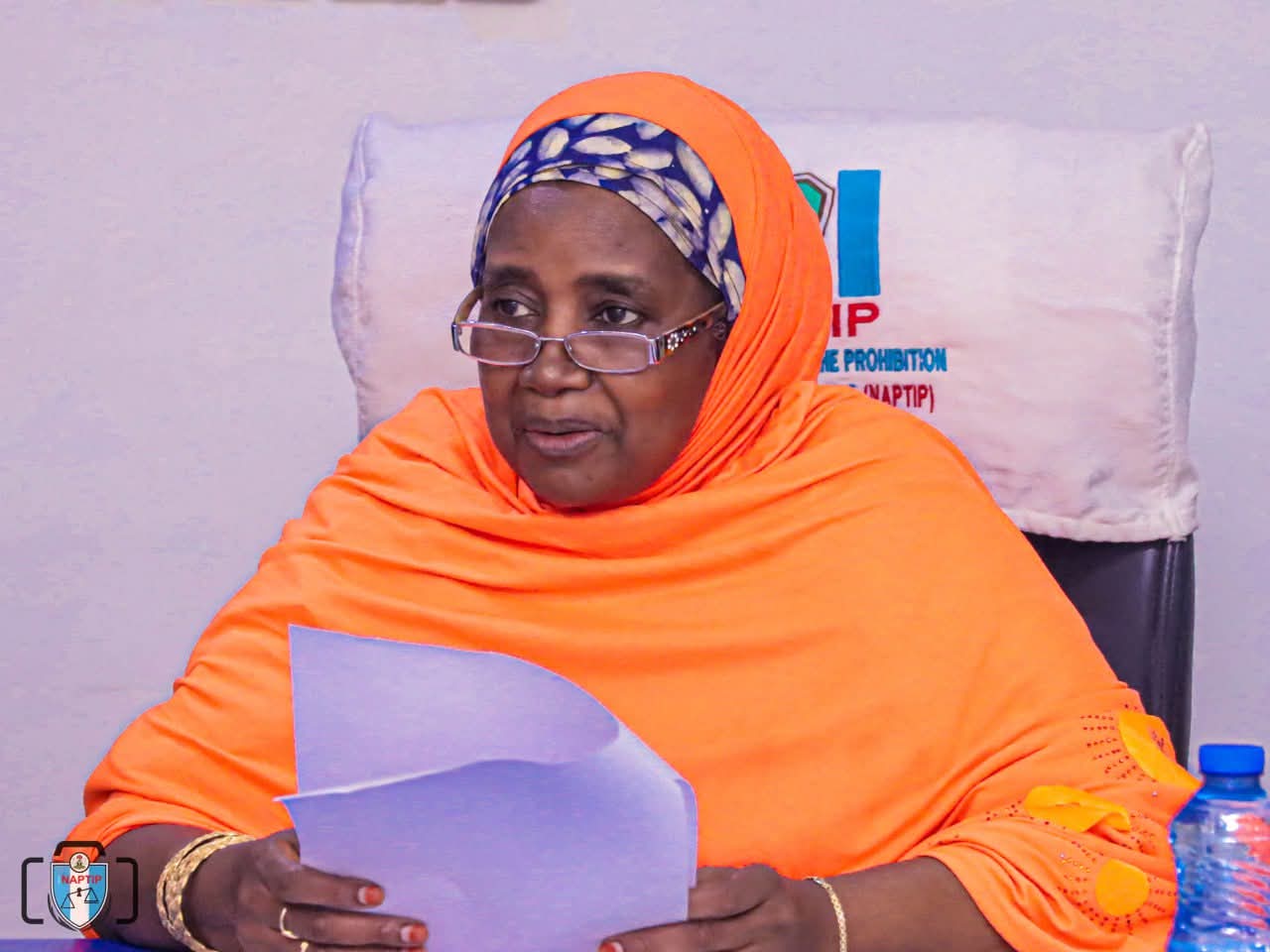
The Director-General of the National Agency for the Prohibition of Trafficking in Persons (NAPTIP), Binta Adamu Bello, has flagged off activities to mark the 2025 World Day Against Human Trafficking with a renewed call for collective action to dismantle organized criminal networks responsible for human trafficking across Nigeria and beyond.
Addressing journalists and stakeholders at a press conference in Abuja on Wednesday, Bello emphasized that human trafficking is not a random act of violence but a well-coordinated organized crime that exploits vulnerable populations, especially women, children, the elderly, and persons with disabilities.
She said the theme of this year’s commemoration, “Human Trafficking is Organized Crime – End the Exploitation,” underscored the urgent need to deepen understanding of the complex web of transnational crimes driving human trafficking and adopt a multi-sectoral, victim-centered approach to combating it.
“This day is not just symbolic; it is a time for deep reflection, renewed commitment, and coordinated action. Organized criminal networks are using migration flows, global supply chains, legal and economic loopholes, and digital platforms to facilitate trafficking on a massive scale,” she stated.
Bello unveiled a line-up of activities to mark the awareness week, including a sensitization walk across the FCT and NAPTIP state offices, a livestreamed stakeholder conversation session, and the 28th National Stakeholders’ Consultative Forum scheduled for July 30 the flagship event of the week.
She also raised alarm over emerging disturbing trends in trafficking, such as the lure of fake job and scholarship offers, deceptive recruitment of youths into cybercrime rings in Nigeria and neighbouring countries, increasing cases of sextortion and revenge pornography, the continued operation of baby factories and organ harvesting rings, as well as the use of predatory online loan schemes to force victims into prostitution.
Despite the evolving nature of the crime, Bello noted that NAPTIP continue to record significant progress through its five-pronged strategy of prevention, partnership, policy, protection, and prosecution. She stated that the agency has intensified awareness campaigns, strengthened stakeholder collaboration, developed counter-trafficking policies, rescued and rehabilitated victims, and prosecuted offenders.
The NAPTIP Boss expressed gratitude to the Federal Government, the Office of the First Lady of Nigeria, Senator Oluremi Tinubu, the Office of the National Security Adviser (ONSA), the National Assembly, development partners, sister law enforcement agencies, and civil society organizations for their continued support.
She specially acknowledged the contributions of the United Nations Office on Drugs and Crime (UNODC), International Organization for Migration (IOM), International Centre for Migration Policy Development (ICMPD), the European Union, United Nations High Commissioner for Refugees (UNHCR), Leadway Assurance, and the Swiss Department of Foreign Affairs.
Bello disclosed that NAPTIP has enhanced the capacity of its Cybercrime Squad and aligned it with the Federal Ministry of Justice’s Joint Case Team on Cybercrime in order to better tackle online recruitment and exploitation. She added that the Agency has also strengthened collaboration with other law enforcement and intelligence agencies to ensure the surveillance, interception, and prosecution of traffickers.
Reiterating the Agency’s unwavering resolve, she warned that the coming months would be increasingly challenging for human traffickers operating in the country. She emphasized that human trafficking poses a real threat to national development and urged all stakeholders to unite in safeguarding the most vulnerable members of society.
“Together, let us kick human traffickers out of Nigeria,” she concluded.