The National Human Rights Commission (NHRC) and the United Nations have urged Nigerian politicians to end hate speech, vote buying, and divisive rhetoric, warned that toxic politics is eroding public trust and weakening democracy.
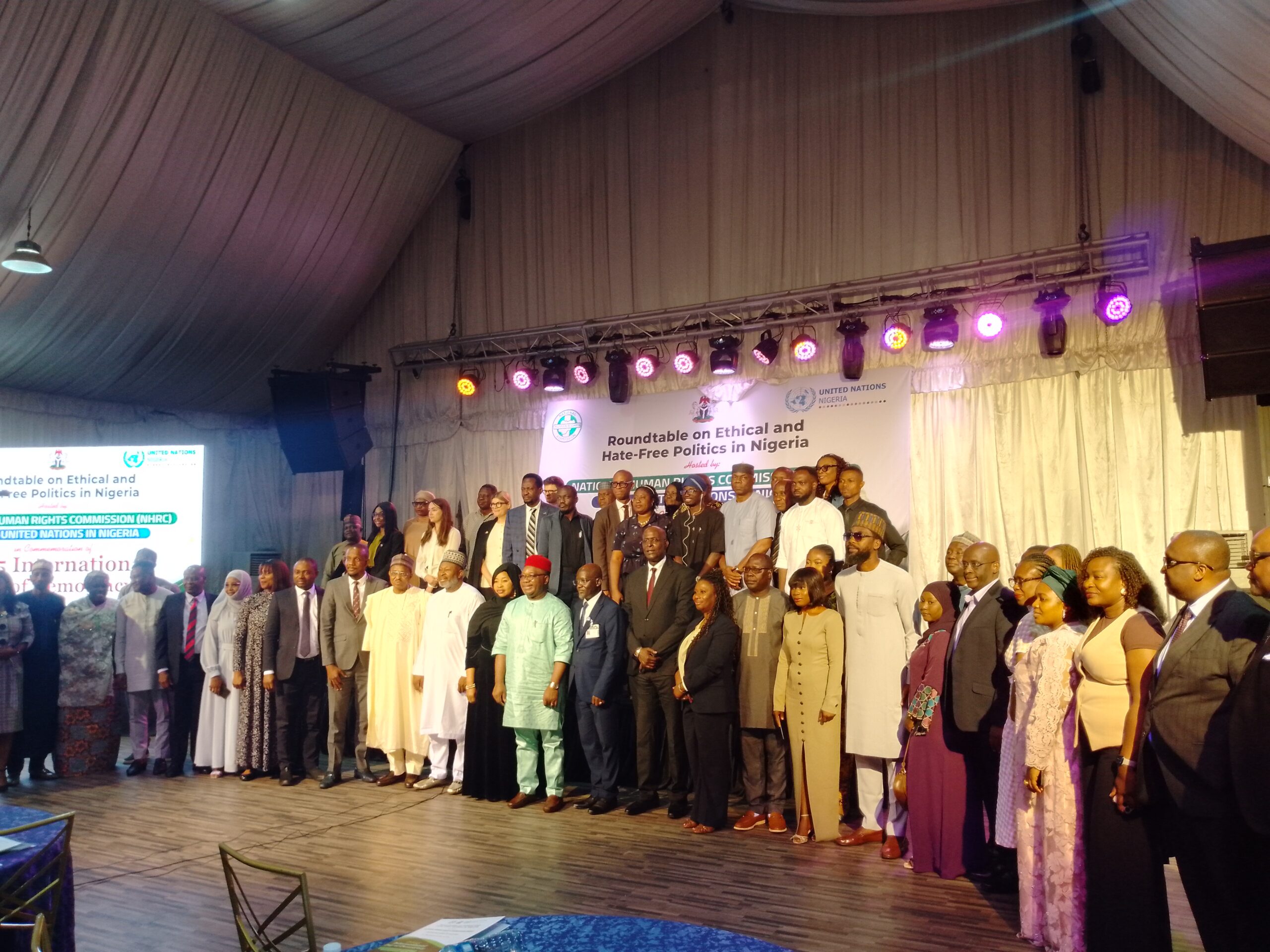
The call was made at a roundtable on Ethical and Hate-Free Politics in Nigeria organized to mark the 2025 International Day for Democracy. NHRC Executive Secretary, Dr. Tony Ojukwu in his welcome address announced that the Commission will soon unveil a Charter on Ethical and Hate-Free Politics, which will bind political actors to cleaner, issue-based and inclusive engagement.
Ojukwu admitted that monitoring human rights violations in politics remained a “dirty and tactless job,” but stressed that the Commission has the structure to confront the challenge.
“We have a monitoring department, but beyond that we have 36 state offices. We have teams across the country that monitor, document, and report on human rights in real-time. Some of these are reflected in our monthly dashboard, of which we are presenting the one for August tomorrow. Why we are taking this preemptive step now is because we do not want to monitor hate speech during the elections. If politicians can stop it now, then 2027 will be hate-free, ethical, peaceful and transparent,” he said.
In his speech,the UN Resident and Humanitarian Coordinator in Nigeria, Mr. Mohamed Malick Fall, emphasized that democracy thrives only when political debates are anchored on truth, tolerance and information integrity. “Hate speech strips people of dignity and undermines democracy,” he noted.
Delivering goodwill messages, the Independent National Electoral Commission (INEC) Chairman, Prof. Mahmood Yakubu, represented by Ibrahim Sulaiman , reminded politicians that the Electoral Act 2022 prohibited hate campaigns and prescribed sanctions for offenders. The Inter-Party Advisory Council (IPAC) Chairman Alhaji Yusuf Dantali also urged political actors to shun toxic rhetoric and embrace issue-based politics, while the Nigerian Bar Association (NBA) represented by Zainab Aminu Garba cautioned that divisive campaigns could destabilize peace and unity in the country.
The first session of the presentation at the event, moderated by Adwoa Kuffor, Senior Human Rights Adviser in the Office of the UN Resident/Humanitarian Coordinator, featured a presentation by Hillary Ogbonna, Senior Human Rights Adviser to the NHRC Executive Secretary, who provided context for discussions. Responding to participants’ questions, panelists acknowledged that prosecutions for hate speech exist but are often lopsided with ordinary citizens quickly targeted while influential political actors are spared. They stressed that Nigeria already has sufficient legal frameworks, citing the Penal Code, Criminal Code, Cybercrimes Act, Violence Against Persons Prohibition Act, and the Child Rights Act, but lamented selective enforcement and weak political will.
Panelists also explored the thin line between free speech and hate speech, noting that vague provisions in the law complicate enforcement. They cautioned that truth can sometimes serve as a defense in hate speech cases, a grey area frequently exploited by politicians.
The second session presentation, moderated by Prof. Vivian Madu, a visiting professor with NHRC, shifted focus to political communications. A representative of the All Progressives Congress (APC) admitted that many billboard violations are linked to overzealous supporters rather than political parties themselves, making regulation difficult. He endorsed the proposal for each political party to establish a hate speech desk and called on INEC to strictly enforce campaign timelines. Panelists also agreed that while card-carrying members can be regulated, the actions of political supporters and online groups are far more difficult to control.
The conversations further touched on the growing dangers of online hate speech and artificial intelligence. Panelists urged NHRC to establish a working group on AI and human rights to develop guidelines against deepfakes, disinformation, and manipulative online content.
The roundtable had in attendance members of the diplomatic community, spokespersons of political parties, party members, civil society organizations (CSOs), and media practitioners, many of whom also served as panelists.
The event concluded with the presentation of a roundtable summary and a draft Charter on Ethical and Hate-Free Politics by Mr. Hillary Ogbonna.
The NHRC pledged to circulate the charter to all political parties and ensure they sign the document at a later event.