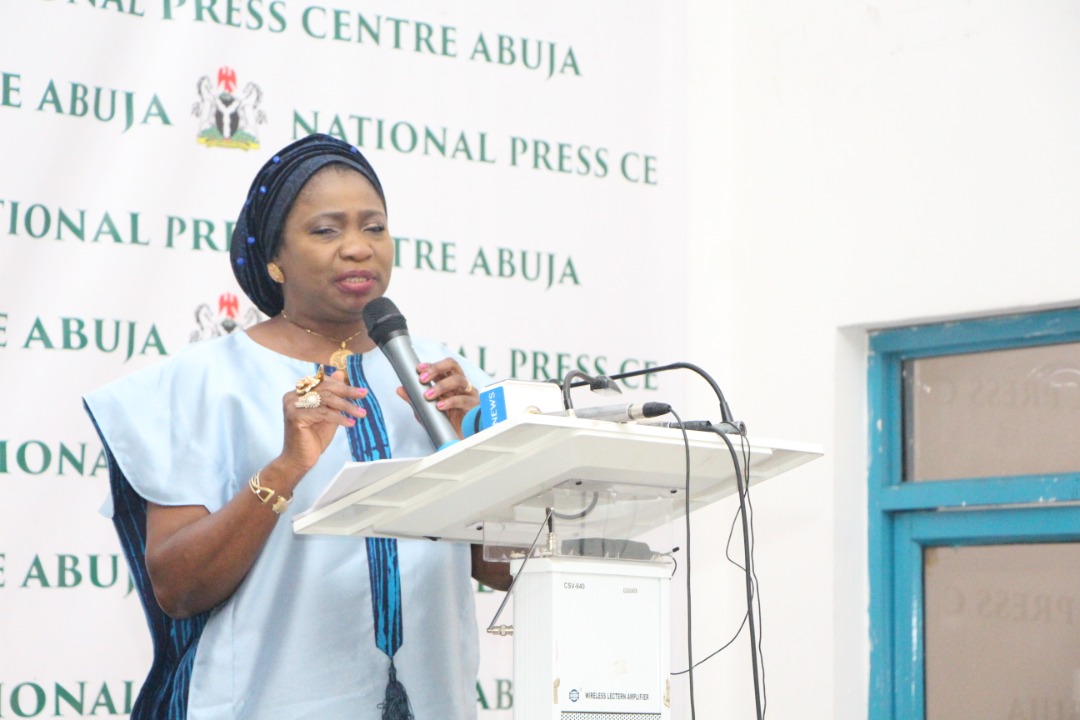
The Nigerians in Diaspora Commission (NiDCOM) has dismissed allegations of ethnic bias leveled against its Chairman/CEO, Hon. Abike Dabiri-Erewa, by journalist Ike Abonyi, described them as misleading and based on half-truths.
In a statement issued on Thursday in Abuja, Abdur-Rahman Balogun, Director of Media, Public Relations and Protocols at NiDCOM, said Abonyi’s attempt to portray Dabiri-Erewa as an ethnic bigot was both unfair and malicious, given her long-standing record of national service and bridge-building.
Balogun clarified that the widely circulated claim that Dabiri-Erewa once referred to Igbos as monkeys was “completely unfounded.” He explained that the controversy originated from an X (formerly Twitter) exchange in which an anonymous user insulted her by calling her “Mother Ape.” Another user replied mockingly to the handle, and Dabiri-Erewa merely reacted with smiling emojis. “It is mischievous to twist this into an ethnic slur. How could a woman of her exposure and refinement reduce herself to such conduct?” Balogun queried.
He also rejected Abonyi’s revival of the Sudan evacuation controversy, recalling that Dabiri-Erewa and her team worked tirelessly to ensure the safety of Nigerians during the conflict, including many from the South East. “At the peak of the crisis, she publicly declared that ‘Every Nigerian is our responsibility regardless of state or tribe. No life is more important than another.’ That was the spirit that guided the evacuation,” he noted.
On Nigerians facing trial in Indonesia, Balogun recalled that the late Foreign Affairs Minister, Amb. Ojo Maduekwe, had first revealed that 20 of the 21 inmates on death row were from one state. He stressed that Dabiri-Erewa has consistently advocated clemency for the convicts, insisting that leadership required confronting uncomfortable truths while seeking solutions.
He further cited her interventions in Ghana, where Nigerian traders many of them Igbos faced harassment. “She engaged Ghanaian authorities repeatedly, ensuring relief for traders. The Nigerian Union of Traders Association in Ghana publicly commended her in 2020 for standing boldly with them at a time when livelihoods were under threat,” Balogun said.
The statement also highlighted her efforts during the xenophobic attacks in South Africa in 2019, evacuations in Ukraine, Libya, Sudan, and her role in securing the return of two young Nigerians—Abia Alexandro Uchenna and Eboh Kenneth Chinedu from Bosnia-Herzegovina.
“To attempt to reduce such a consistent and pan-Nigerian voice to an ethnic bigot is not only unjust but also dangerous. What Nigeria needs now are leaders who unite, not divisive narratives that fuel suspicion and hatred,” Balogun emphasized.
He concluded that Dabiri-Erewa’s reputation remained intact, stressed that Nigerians recognize her for her decades of service, not for “caricatures created by social media mobs.”