
The Nigeria Customs Service (NCS) has restated its unwavering commitment to transparency, accountability, and institutional integrity as part of ongoing national anti-corruption reforms.
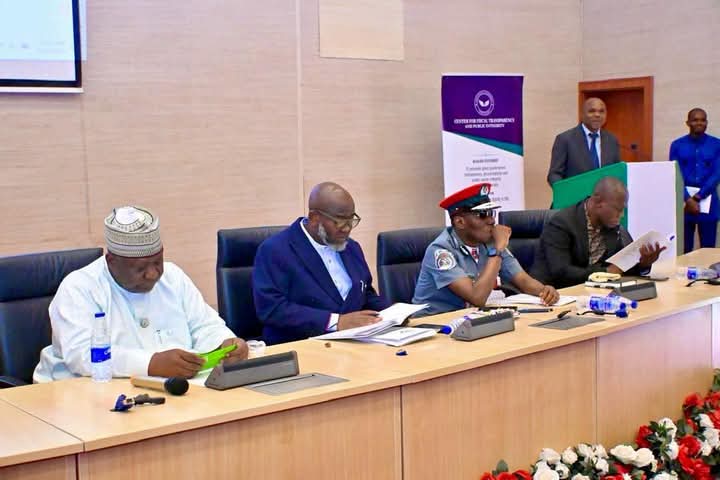
This was highlighted during a high-level Stakeholders’ Meeting on Governance and Anti-Corruption Frameworks, held on Saturday, 25 May 2025, at the auditorium of the Federal Ministry of Finance, Abuja, where the 2025 Transparency and Integrity Index (TII) Methodology Handbook was officially launched.
The Comptroller-General of Customs (CGC), Adewale Adeniyi, was represented by Comptroller Sanni Yahaya, Provost Marshal of the Nigeria Customs Police Unit, who reiterated the Service’s readiness to align with globally accepted governance standards.
Speaking on behalf of the CGC, Comptroller Yahaya stated; “The Nigeria Customs Service is fully committed to adopting the TII framework as a strategic tool for strengthening transparency, curbing illicit practices, and enhancing public confidence in customs operations.”
The event attracted key stakeholders, including the Secretary to the Government of the Federation (SGF), Senator George Akume, represented by Dr Maurice Mbaeri, Permanent Secretary in the Office of the SGF; Director-General of the Bureau of Public Service Reforms (BPSR), Dr Dasuki Arabi; and Executive Chairman of the Fiscal Responsibility Commission, Victor Muruako.
In his remarks, Dr Mbaeri stressed the importance of the TII in enhancing service delivery and improving governance structures across public institutions. He noted that the TII provides a robust and standardised methodology for evaluating and strengthening performance across various governance areas.
Now in its fifth edition, the Transparency and Integrity Index assesses over 500 public institutions and all 36 state governments using six core indicators: fiscal transparency, open procurement, control of corruption, human resources and inclusion, citizen engagement, and website integrity.
Anchored in legal frameworks such as the Freedom of Information Act and international conventions like the United Nations Convention Against Corruption, the TII serves as a critical instrument for reform and public accountability.
As a lead agency in trade facilitation, border security, and revenue generation, the NCS was identified as a key institution whose embrace of the TII benchmarks is essential to deepening transparency and institutional reforms.