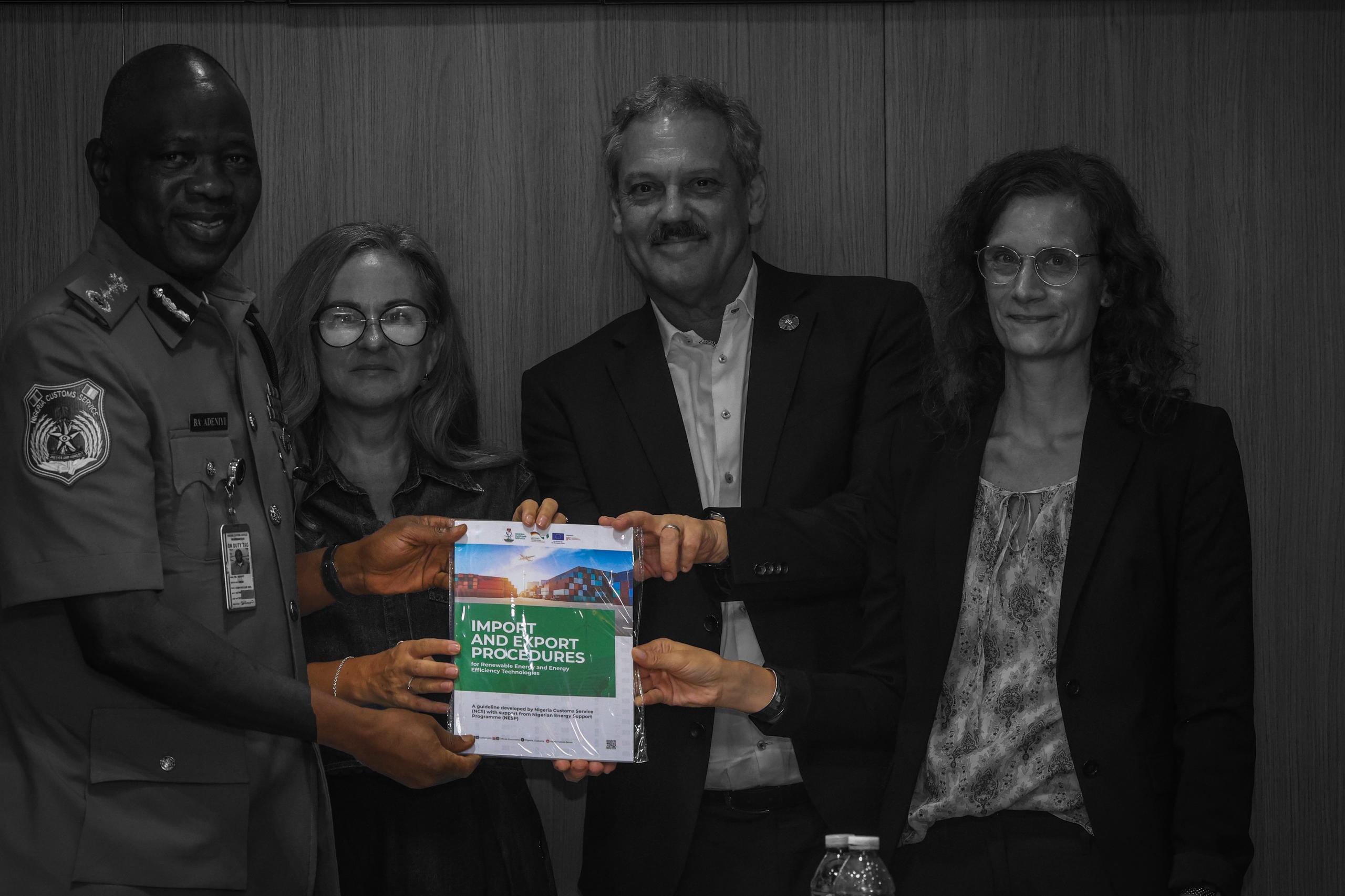
The Nigeria Customs Service (NCS) has launched a Handbook on Import and Export Procedures for Renewable Energy Equipment, in a move to simplify trade processes and enhance compliance in Nigeria’s fast-growing clean energy sector.
The official launch, which took place on Tuesday , July 29, 2025, at the Customs Headquarters in Abuja, was the result of a strategic partnership involving the European Union (EU), the German Embassy, and the Deutsche Gesellschaft für Internationale Zusammenarbeit (GIZ).

Comptroller-General of Customs, Bashir Adewale Adeniyi, described the document as a “living guide” that will be regularly updated to reflect evolving technologies, international best practices, and national policies.
“With Nigeria’s increasing investment in renewable energy infrastructure, Customs has a responsibility to ensure that legitimate trade in this sector is facilitated efficiently and securely,” he said.
The CGC emphasized that the handbook addressed long-standing classification and clearance challenges and supports Nigeria’s Energy Transition Plan (ETP), which targets net-zero emissions by 2060.
“This is more than a Customs document; it’s a strategic tool for economic transformation,” Adeniyi added, while acknowledging the technical and financial contributions of international partners. He hailed the collaboration as a model of institutional synergy that strengthens both trade and environmental goals.
Representing the EU Delegation to Nigeria, Inga Stefanowicz, Head of the Green and Digital Economy section, commended the Customs Service for its reform-driven leadership and inclusivity.
“We are especially encouraged by the rising involvement of women in the Nigeria Customs Service, which strengthens institutional resilience,” she said.
Karin Jansen, Head of Cooperation at the German Embassy, said Germany remains committed to supporting Nigeria’s green transition and trade facilitation efforts.
Also speaking, Marcus Wagner, GIZ Country Director for Nigeria and ECOWAS, congratulated Adeniyi on his recent election as Chairperson of the World Customs Organization (WCO) Council, describing it as a global acknowledgment of Nigeria’s leadership in Customs reform.
The handbook is expected to serve as a vital reference for Customs officers, freight forwarders, renewable energy companies, and other stakeholders. It contains step-by-step procedures, tariff classifications, documentation guidelines, exemptions, and valuation details for solar panels, batteries, inverters, wind turbines, and other clean energy equipment.
The initiative aligned with global goals under the Paris Agreement and the African Continental Free Trade Area (AfCFTA), reinforcing Nigeria’s ambition to become a regional hub for sustainable trade and logistics.