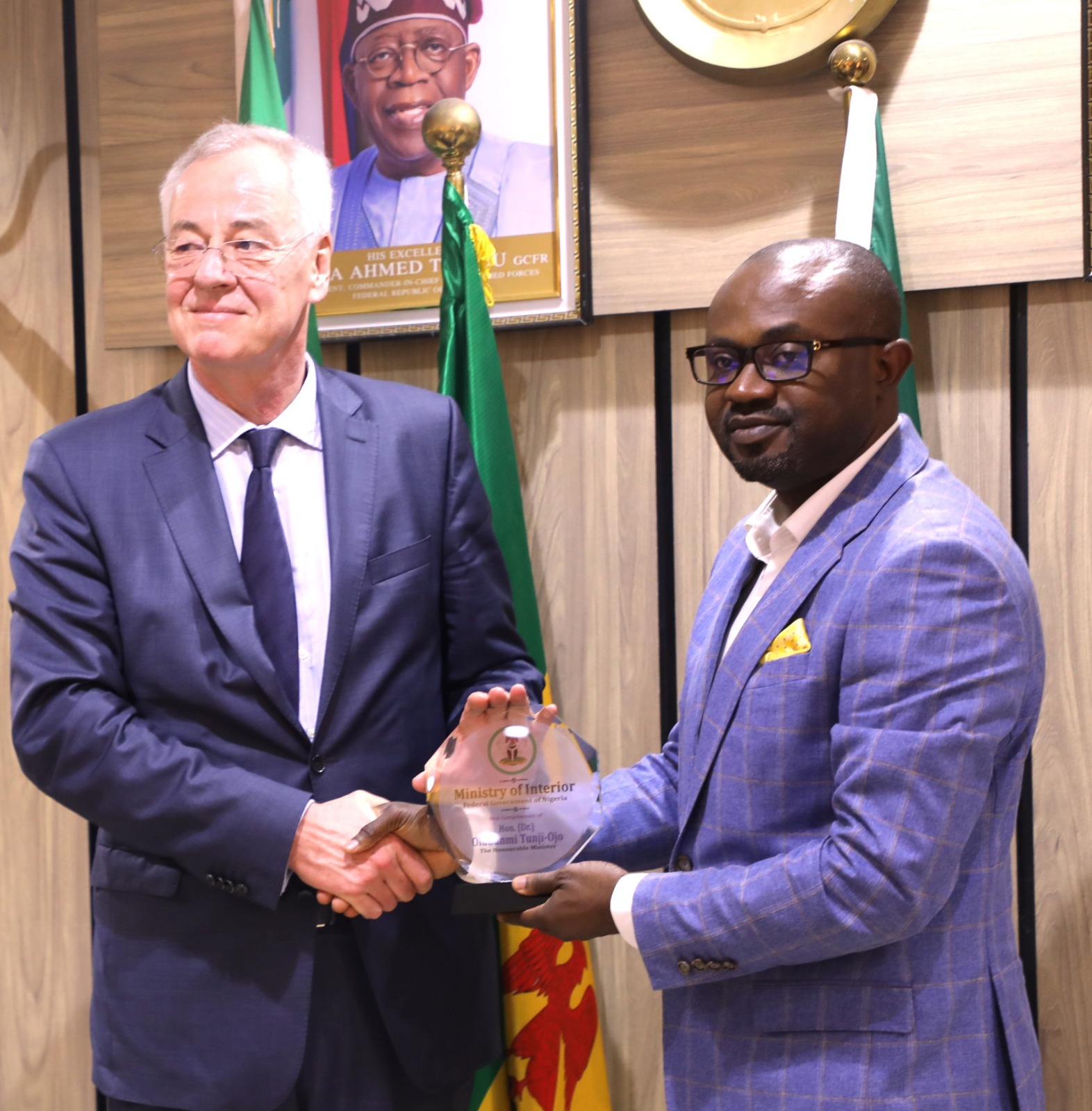
The Federal Government has reaffirmed its commitment to strengthening border security, curbing irregular migration, and enhancing cooperation with the European Union.
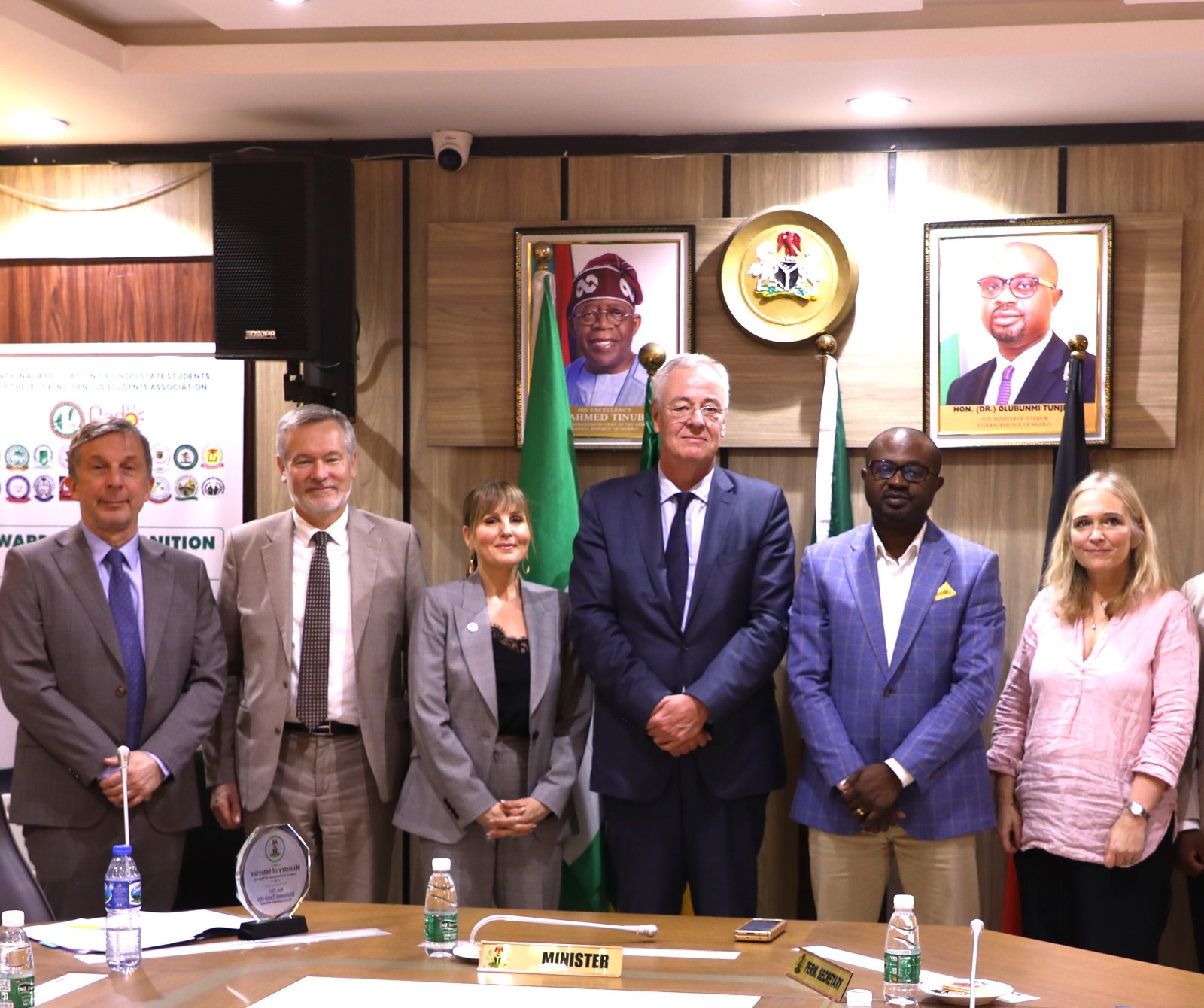
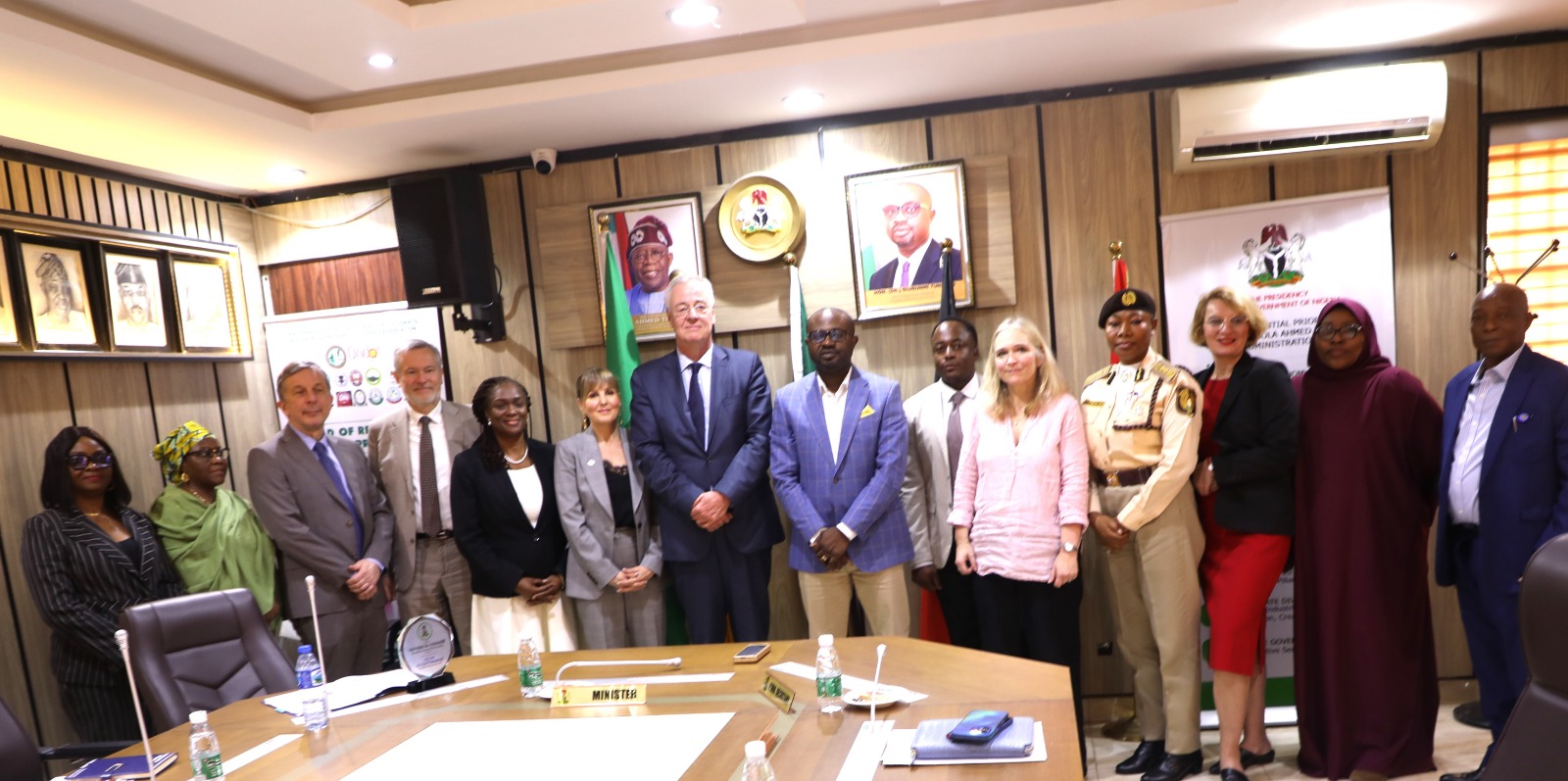
The Minister of Interior, Dr. Olubunmi Tunji-Ojo, made this known during a courtesy visit by the Deputy Director of the Directorate-General for Migration and Home Affairs, Mr. Johannes Luchner, and the Head of the European Union Delegation to Nigeria and ECOWAS, Ambassador Gautier Mignot, alongside their delegation.
Speaking at the meeting, Dr. Tunji-Ojo emphasized Nigeria’s resolve to shift from reactive migration management to a preventive, technology-driven approach. He noted that irregular migration posed risks to Nigeria’s international reputation and partner countries, stressed the government’s determination to promote orderly, regular, and lawful migration.
The Minister highlighted major reforms in border management, particularly in air, land, and maritime domains. He disclosed that airport security has been strengthened through the deployment of the Advanced Passenger Information System (APIS), integration with MIDAS, and other digital platforms, described the development as the most significant improvement in over a decade.
On land border operations, he revealed that the President has approved the recruitment of about 10,000 additional personnel. Seven fully equipped border control posts, powered by solar energy and supported with water and internet connectivity, are already operational, while plans are underway to establish seven more. According to him, the national e-border system now covered over 60 percent of Nigeria’s land borders and several island territories.
Dr. Tunji-Ojo also disclosed that the government has constructed the country’s largest public-sector data centre with an 8.3-petabyte capacity, powered by off-grid solar energy. The facility supports a modern command and control centre for real-time surveillance and intelligence analysis. He added that aerial surveillance has been expanded and about 55 high-intensity patrol vehicles deployed nationwide.
Recognising Nigeria’s strategic role within the ECOWAS region, the Minister said the government has ensured the availability and recognition of the ECOWAS biometric ID card to enhance traveller identification. He also announced the introduction of the Single Travel Emergency Passport (STEP), which enables Nigerians with lost or expired passports to return home through a secure, biometric-verified digital system.
Earlier, the Comptroller General of the Nigerian Immigration Service, Mrs. Kemi Nana Nandap, briefed the delegation on strengthened screening measures that have led to a significant reduction in irregular migration. She explained that the measures focus on preventing human smuggling and trafficking, especially among vulnerable travellers without proper documentation or clear travel purposes.
In his remarks, Mr. Johannes Luchner commended Nigeria’s progress, noted a measurable decline in irregular arrivals from Nigeria into the European Union. He described Nigeria as one of the EU’s most important partners in Africa and expressed optimism that the partnership framework would receive positive consideration from EU member states and the European Parliament.
He also identified opportunities to deepen cooperation with agencies such as Europol and Frontex in tackling human trafficking, smuggling, and transnational organised crime.
Reaffirming Nigeria’s commitment, Dr. Tunji-Ojo described the partnership as enduring and mutually beneficial.
“A stable Nigeria contributes to a stable European Union, just as a stable EU supports a stable Nigeria. Our futures are interconnected, and together we must build stronger political and economic ties for generations to come,” he said.
The Minister reiterated that Nigeria remained open and fully engaged in advancing shared solutions that promote security, development, and dignity in migration governance.