

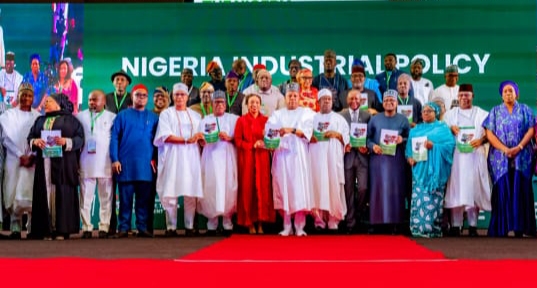
President Bola Ahmed Tinubu on Tuesday formally launched the Nigeria Industrial Policy (NIP) 2025, signalling what the Federal Government described as a major shift from a consumption-driven economy to one focused on production, value addition and global competitiveness.
Represented at the unveiling by Vice President Kashim Shettima, the President said the policy fulfils a key promise of the administration to move Nigeria “from potential to productivity,” stressing that industrialisation remains central to sustainable economic growth and job creation.
According to him, the Nigeria Industrial Policy 2025 is designed as a practical roadmap to rebuild the country’s industrial base, strengthen value chains and enhance competitiveness while placing employment generation at the heart of national economic planning. He noted that successful industrialisation requires coordinated action across energy supply, infrastructure, trade, finance, skills development and innovation, backed by strong collaboration between government and the private sector.
The President emphasised that the policy prioritises sectors where Nigeria holds comparative advantages, promotes deeper local value addition, integrates micro, small and medium enterprises into industrial expansion and establishes a clear implementation framework with measurable outcomes.
In his welcome address, Minister of State for Industry, Senator John Owan Enoh described the launch as a defining national moment, stating that industrialisation has now become a structured and disciplined government priority.
He explained that the policy reflected lessons from previous industrial initiatives and extensive consultations with manufacturers, investors and development partners. Enoh highlighted a shift from fragmented industrial interventions toward coordinated execution, citing reforms in the shea value chain as an example of policy-driven industrial growth that boosted domestic processing capacity and farmer incomes.
The minister added that the policy focuses on improving power supply, infrastructure, access to finance, skills development and regulatory stability to create an enabling environment for producers and investors.
Opening remarks delivered on behalf of the Permanent Secretary of the Federal Ministry of Industry, Trade and Investment, Ambassador Nura Abba Rimi, reaffirmed alignment of the policy with the administration’s Renewed Hope Agenda and Nigeria’s broader goal of building a diversified and resilient economy.
Stakeholders and industrial leaders at the event called for sustained policy consistency, reliable electricity supply and stronger public-private collaboration to deepen domestic production, reduce import dependence and expand Nigeria’s industrial presence across Africa.
The policy outlines priority sectors including agro-processing, textiles and garments, petrochemicals, pharmaceuticals, light manufacturing, metals and technology-enabled industries. It also integrates energy, logistics, finance, skills and trade policies into a unified implementation framework with defined institutional responsibilities and performance indicators.
With the implementation of the African Continental Free Trade Area reshaping regional markets, the Federal Government said the initiative positions Nigeria to serve both its domestic market and emerge as a manufacturing hub for West Africa.
President Tinubu affirmed that implementation of the policy begins immediately, expressing confidence that expanded manufacturing output, stronger value chains and increased non-oil exports will drive inclusive economic growth and prosperity for Nigerians.