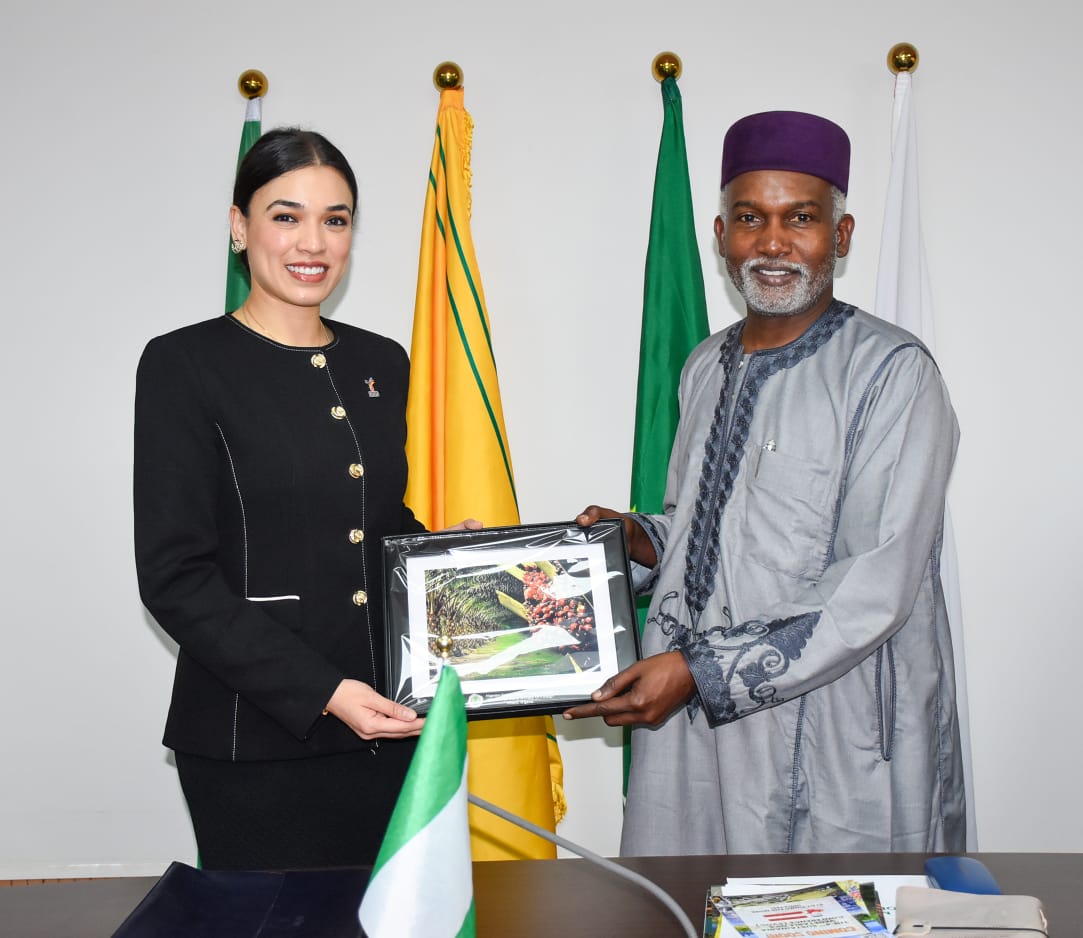
Nigeria has taken steps toward becoming a full member of the Council of Palm Oil Producing Countries (CPOPC) following a high-level meeting between the Minister of Foreign Affairs, Ambassador Yusuf Maitama Tuggar, and the Council’s Secretary-General, Izzana Salleh, in Abuja on Friday.
The strategic engagement, held at the Ministry of Foreign Affairs headquarters, Tafawa Balewa House, focused on Nigeria’s possible transition from observer status to full membership of the intergovernmental organisation, as the country seeks to strengthen its position in global agricultural diplomacy and commodity trade.
Speaking during the meeting, Secretary-General Izzana Salleh described the visit as both a courtesy call and a policy engagement aimed at deepening institutional cooperation. She noted that Nigeria’s observer status with the Council expires at the end of the year, stressing the need for early consultations to ensure a seamless transition to full membership.
Salleh explained that the CPOPC represents major palm oil-producing countries, including Indonesia, Malaysia, Papua New Guinea, Honduras, and the Democratic Republic of Congo, and plays a diplomatic and advocacy role in addressing trade barriers, sustainability concerns, and regulatory challenges affecting palm oil globally. She added that the Council provides a unified platform for member states to engage multilateral institutions such as the United Nations and the World Bank on issues shaping the global vegetable oil market.
Highlighting recent engagements with the European Union over the EU Deforestation Regulation, she said coordinated diplomacy through joint technical negotiations had enabled producing countries to articulate shared interests and counter misconceptions surrounding palm oil production. According to her, science-based advocacy and collective engagement are essential to protecting producer nations from unfavourable global narratives.
In a gesture aimed at encouraging Nigeria’s accession, the Secretary-General announced that the Council’s ministerial leadership had approved a two-year waiver of membership fees should Nigeria attain full membership status.
She further outlined the Council’s sustainability initiatives, including knowledge-sharing frameworks derived from Indonesia’s and Malaysia’s certification systems, designed to improve traceability, compliance standards, and market access while empowering smallholder farmers.
Also speaking, CPOPC Director for Smallholders and Sustainability, Tony Siew Lee, emphasised that palm oil accounts for about 60 per cent of global vegetable oil supply and remains critical to food security, poverty reduction, and rural development. He noted that capacity-building programmes across Africa aim to strengthen smallholder productivity and long-term sector resilience.
In his remarks, Ambassador Tuggar welcomed the delegation and reaffirmed Nigeria’s recognition of palm oil as a strategic economic commodity. He noted that beyond agriculture, palm oil supports industries ranging from food production to pharmaceuticals and cosmetics, adding that criticisms of the sector in some global quarters often overlook historical and economic realities.
The minister said palm oil remains central to Nigeria’s food security agenda, rural livelihoods, and economic diversification efforts. He disclosed that Nigeria currently produces about 1.4 million metric tonnes annually against domestic consumption estimated at three million tonnes, underscoring the need to scale up production capacity.
Tuggar described potential membership of the CPOPC as consistent with the Federal Government’s priorities on food security, economic growth, and youth employment, noting that participation would strengthen Nigeria’s voice in global commodity diplomacy and enhance access to technical cooperation and sustainability frameworks.
The meeting ended with an agreement to commence inter-ministerial consultations, particularly with the Federal Ministry of Agriculture and Food Security, to formalise Nigeria’s pathway toward full membership.
Officials at the meeting noted that growing global debates around sustainability, trade regulation, and food systems have elevated palm oil diplomacy as a key element of international economic relations, with Nigeria positioning itself to play a more active role in shaping the future of sustainable palm oil production.