The Director-General of the National Orientation Agency (NOA), Mallam Lanre Issa-Onilu, has reaffirmed the agency’s statutory mandate as the Federal Government’s principal public communication institution, highlighting its extensive grassroots presence and direct engagement with citizens nationwide.
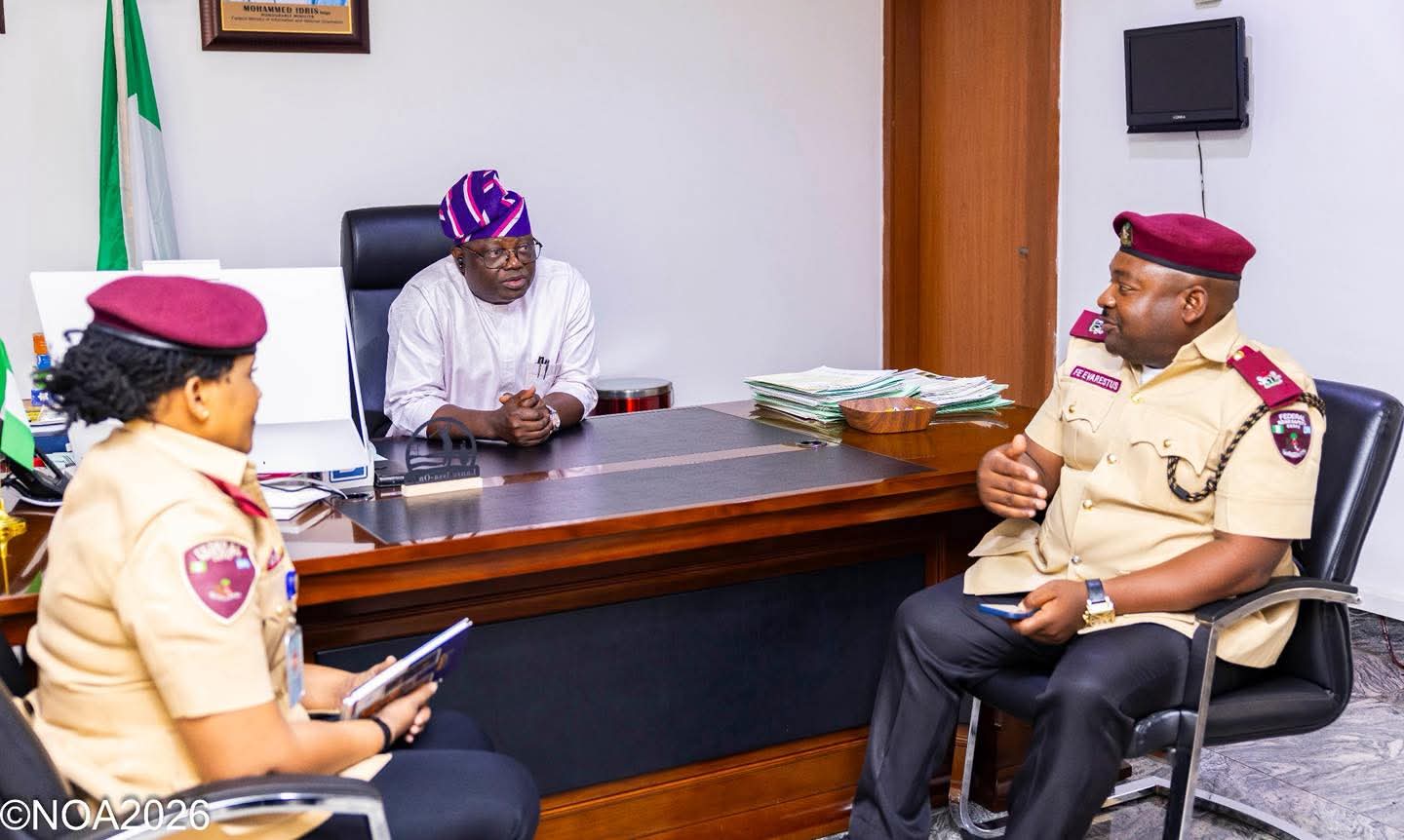
Issa-Onilu made this known during an interview session with officials of the Federal Road Safety Corps (FRSC) at the agency’s headquarters in Abuja. The media interaction was conducted by members of FRSC’s Safe Wheel Nigeria Magazine team, led by Mr Festus Everistus, alongside Miss Chioma Amajor Love and RC Amaka.
Speaking during the session, the NOA Director-General explained that the agency’s communication strategy extends beyond conventional media platforms such as radio, television and social media. According to him, NOA officers maintain daily physical engagement with citizens at the grassroots level through visits to motor parks, markets, traditional institutions and community town hall meetings across the country.
He noted that many of these sensitisation activities are carried out in collaboration with FRSC at state level but often receive limited publicity despite being routine nationwide efforts aimed at promoting government policies and civic responsibility.
Issa-Onilu emphasised that NOA was established by law to function as the government’s central communication bridge with citizens, stressing that partnerships with agencies like FRSC represent the discharge of its statutory duty rather than institutional support rendered as a favour. He added that with 818 offices dedicated primarily to communication nationwide, NOA possesses a structure unmatched by most government agencies, which typically operate only a single communications department.
Addressing public concerns over delayed government responses to citizens’ feedback, the NOA boss called for a fair assessment of Nigeria’s economic realities. He explained that limited national revenue remains a major constraint, noting that a population estimated at about 240 million people places enormous demand on available resources.
Drawing a comparison with Brazil, which has a similar population size but operates a significantly larger national budget, Issa-Onilu said government must balance competing priorities including minimum wage implementation, debt servicing, infrastructure development and security obligations. He added that gradual improvements in crude oil production and trade balance are expected to contribute to economic stabilisation over time.
The Director-General also highlighted the rapid transformation of the media ecosystem, observing that audiences are now dispersed across numerous digital platforms. In response, NOA has adopted a multi-platform communication approach combining traditional media, social media engagement, influencers and specialised publications targeted at reading audiences.
He further disclosed that the agency has introduced its own Artificial Intelligence platform, making it the first government institution in Nigeria to deploy such technology as part of its public communication strategy.
Issa-Onilu concluded by urging motorists to prioritise personal safety on the roads, advising drivers to obey traffic regulations not merely to avoid enforcement but out of a genuine commitment to preserving their lives.
According to him, when individuals place the highest value on their own safety, safer roads will naturally be achieved.