

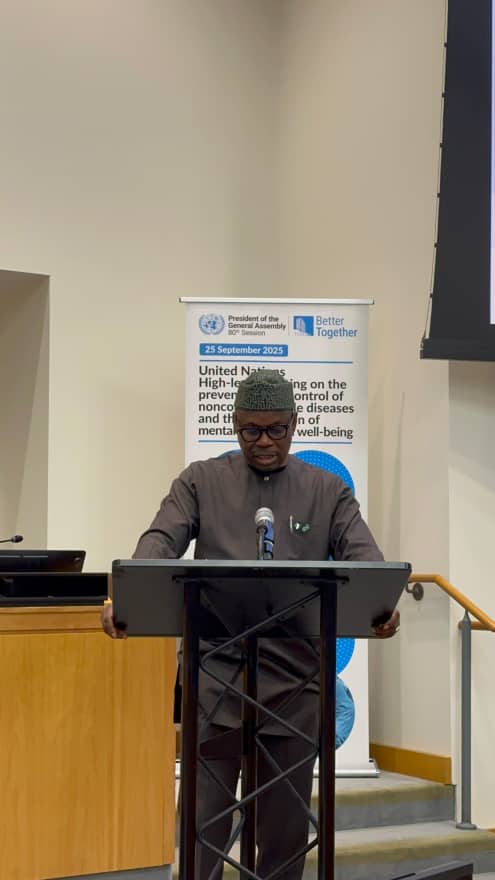
President Bola Ahmed Tinubu has urged the international community to intensify investments and forge stronger partnerships in addressing the growing burden of non-communicable diseases (NCDs) and mental health challenges, warned that both threaten productivity, economic stability, and social cohesion across developing nations.
Delivering Nigeria’s national statement at the Fourth High-Level Meeting on the Prevention and Control of NCDs and the Promotion of Mental Health and Well-Being during the 80th Session of the United Nations General Assembly (UNGA) in New York, Tinubu represented by the Minister of State for Health and Social Welfare, Dr. Iziaq Adekunle Salako said Nigeria stand with the African Group on the urgent need for accelerated global action.
“Particularly troubling is the growing prevalence of NCDs among the young, leading to the loss of productive years and negative economic impacts,” Tinubu noted, stressing that NCDs now account for nearly 29 percent of all deaths in Nigeria.
The President highlighted Nigeria’s policy strides, including the National NCD Policy, a Multisectoral Action Plan, prevention and treatment guidelines, and laws to address risk factors. He added that health insurance has been expanded to cover catastrophic diseases, while primary healthcare and professional capacity have been strengthened.
According to him, Nigeria has also established six cancer centres of excellence and immunised over 14 million adolescent girls 96 percent of the target population against HPV to prevent cervical cancer.
On mental health, Tinubu cited the 2023 Mental Health Act, which integrates mental health into primary care and safeguards patients’ rights, as well as a suicide prevention strategy focused on decriminalisation, destigmatisation, and support for vulnerable groups.
While acknowledging these efforts, Tinubu admitted that Nigeria still grapples with funding gaps, weak infrastructure, and limited data collection. He therefore appealed for stronger global partnerships to close gaps in access to medicines, technologies, and public health infrastructure.
He also called for greater visibility and action on sickle cell disease, which disproportionately affects Africa.
“Looking forward, Nigeria is committed to strengthening health systems, prioritising prevention, and ensuring mental health receives the prominence it deserves within our national agenda,” Tinubu said. “With global solidarity and renewed investments, we can reduce premature mortality from NCDs by 2030 and promote mental health and well-being for all.”