

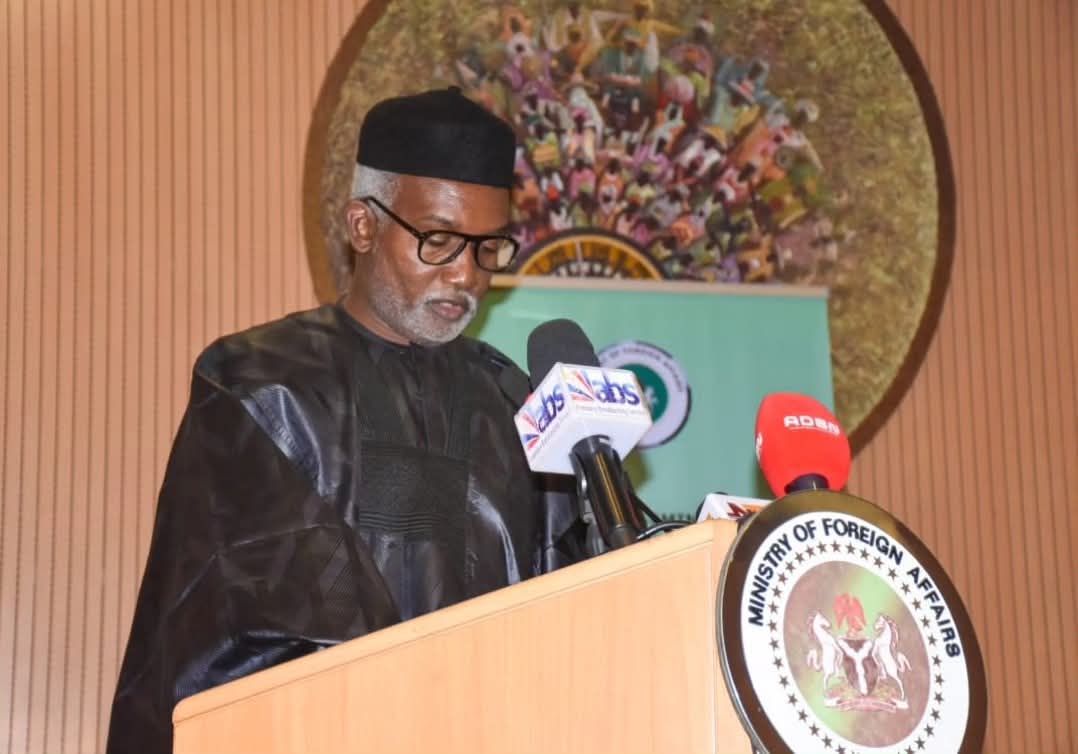
Nigeria’s Minister of Foreign Affairs, H.E. Yusuf Maitama Tugga, has called for a more pragmatic and independent approach to the country’s foreign policy in the face of shifting global dynamics.
Delivering a lecture titled “Navigating Realities: Aligning Nigeria’s Foreign Policy Practice with Emerging Global Dynamics” at the Nigerian Institute of International Affairs (NIIA), Lagos, Tuggar emphasised the need to balance Nigeria’s moral values with national interests while deepening collaboration between policymakers and foreign policy scholars.
The Minister said the world is experiencing rapid transformations, citing climate change, desertification in the Sahel, artificial intelligence, terrorism, widening inequality, and the emergence of a multipolar order as major factors reshaping global relations. He warned that pressures from global powers to align ideologically could undermine Nigeria’s sovereignty if not carefully managed.
Reflecting on history, Tuggar recalled Nigeria’s decisive roles in the recognition of the MPLA in Angola, the World Conference for Action Against Apartheid, and its diplomatic stance during the Ogaden War, credited the NIIA for providing intellectual support that guided Nigeria through those complex times.
He explained that the Tinubu administration has adopted a foreign policy framework rooted in Strategic Autonomy, anchored on the pillars of Democracy, Demography, Development, and Diaspora (4Ds). This, he noted, would enable Nigeria to preserve flexibility, avoid entangling alliances, and build issue-based partnerships of mutual benefit, particularly within Africa.
“Strategic Autonomy is not duplicity; it is pragmatism,” Tuggar stated. “While Nigeria’s foreign policy will continue to be guided by moral and ethical considerations, we must also ensure that our national interests remain at the centre of our external engagements.”
The Minister also underscored Africa’s need to redefine democracy in line with its cultural and historical realities, disclosing that the Ministry of Foreign Affairs has developed a Regional Partnership for Democracy (RPD) in collaboration with the UNDP to strengthen democratic institutions and regional cooperation.