In the Name of Allah, The Entirely Merciful, the Especially Merciful
Praise is due to Allah, Lord of the worlds, may the blessings and peace be upon our master Muhammad, the last of Prophets, on his family, and all his companions.
Inna lillahi wa inna ilaihi raaji’uun: Verily we belong to Allah, and verily to Him do we return!
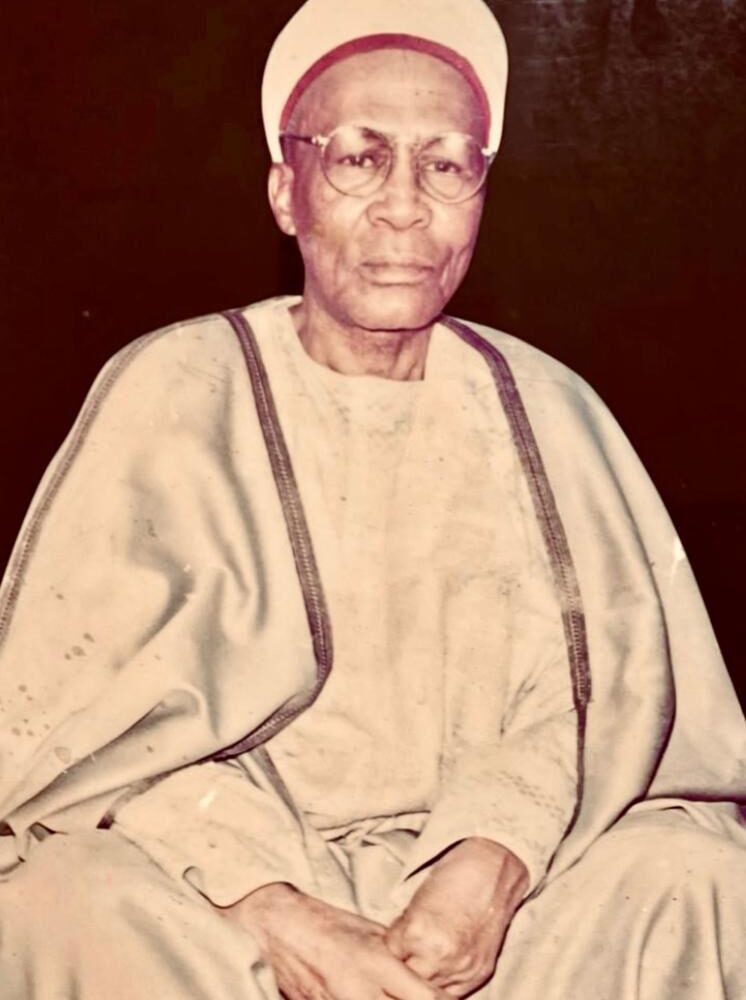
Malam Mouftah Baba-Ahmad died yesterday, Wednesday, September 17, 2025 in Madinah, Saudi Arabia.
Surely, Allah takes what is His, and what He gives is His, and to all things He has appointed a time… so have patience and be rewarded. May Allah magnify your reward, and make perfect your bereavement, and forgive your departed.
Dear brothers and sisters! Know that, death is an irrefutable fact we can’t deny. Time and again, we lose ourselves in this transient world thinking that we are going to live here forever. As a result, Allah reminds us and shows us signs with the loss of a loved one to show us that everything in this world is just temporary.
Losing a loved one is undeniably a grief-stricken and devastating moment, especially for the family, close friends and associates. Although according to Qur’an, 2:156, that a soul belongs to Allah and will return to Him in time, still it is a painful moment seeing our loved one passed away. Only those people who have experienced it can truly know the depth of pain it brings when it strikes. It hurts deep down in the core that sometimes you feel numb with emotion. The Muslim Ummah has a prescribed way in Islam on how to deal with such inconsolable loss—without violating Islamic values.
Respected brothers and sisters! It is common knowledge that life is temporary and the biggest sign is the death we see in our lifetime. It is a reminder that Allah sends to humans for them to realise that one day their time will come as well.
“Every soul will taste death.” [Qur’an, 3:185]
Although we know the experience of loss is bound to occur, it is only human nature to grieve. For those that do not believe in an afterlife, the experience may be even more painful. Muslims know that this separation from their loved ones is only temporary as they will reunite in the hereafter In Shaa Allah. That being said, even with this knowledge it is okay to grieve as long as it follows the prescribed way that Allah and his Prophet Muhammad (Peace be upon him) instructed us to. Now let us look into the Qur’an and Sunnah to learn more about loss and how to make the most of it in this world.
“Verily from Allah we came and to Him is our return.” [Qur’an, 2:156]
Respected brothers and sisters! Calamities such as the loss of a loved one can appear as a test. It is important to understand that Allah knows best and this death was by the command of Allah. Allah’s decision is always the best decision and putting trust in Him will allow one to increase in faith. For example, the story in Surah Kahf relays the loss of a child from a righteous family:
“So they proceeded until they came across a boy, and the man killed him. Musa protested, “Have you killed an innocent soul, who killed no one? You have certainly done a horrible thing.” [Qur’an, 18:74]
In this story, Prophet Musa (AS) went on a journey with a knowledgeable man guided by Allah. During this journey, this man kills a child, and Prophet Musa (AS) understandably is upset by his action. The parents of this child will most likely grieve over this incident. We later find out the reason for this murder.
“And as for the boy, his parents were ˹true˺ believers, and we feared that he would pressure them into defiance and disbelief. So we hoped that their Lord would give them another, more virtuous and caring in his place.” [Qur’an, 18:81]
Here we get a look into the reason why this child was killed. Something only Allah would know and allowed for this man to have some of that knowledge. This child would have caused more trouble for the parents and misguide them away from Allah, so Allah saves the child (since an innocent soul goes to heaven) and blesses them with another. A verse from Surah Al-Baqarah displays how ignorant humans are in the face of Allah’s knowledge:
“And it may be that you dislike a thing which is good for you and that you like a thing which is bad for you. Allah knows but you do not know.” [Qurʾan, 2:216]
So keep in mind that Allah is the one who decides when anything dies. It will allow for peace of mind when a loss occurs.
Fellow brothers and sisters! Before the Day of Judgement, humans that are dead will stay in an area that is referred to as the Barzakh. Humans that have passed cannot do anything for themselves in regards to bettering their position during Judgement Day. All is not lost though as those that are alive can do various deeds to help their loved ones and all Muslims that have passed.
One of the most powerful deeds a Muslim can do is make Du’a (supplication). One can make supplications to ask Allah to forgive our loved ones that have passed and to ease the burdens that they could be facing in the grave. There are many Du’as that Prophet Muhammad (Peace be upon him) made for the deceased, here is one of them:
“O Allah, forgive him and have mercy on him and give him strength and pardon him. Be generous to him and cause his entrance to be wide and wash him with water and snow and hail. Cleanse him of his transgressions as white cloth is cleansed of stains. Give him an abode better than his home, and a family better than his family and a wife better than his wife. Take him into Paradise and protect him from the punishment of the grave [and from the punishment of Hell-fire].” [Muslim]
Giving sadaqah or charity for the sake of Allah is one of the best deeds a person can do. In Islam, a believer is allowed to give charity on behalf of someone else, so that they obtain the rewards. In a way, it’s allowing for two good deeds to happen at once. The person who is donating the money gains the reward of being kind to their dead loved one, while the deceased receive rewards in a time they can’t do anything. Below shows the Sunnah that allows for this action to occur:
“O Messenger of Allah, my mother has died and I am away from her. Will it benefit her anything if I give in charity on her behalf?” He said, “Yes.” He said, “Then I ask you to be my witness that I am giving my garden al-Mikhraf (so called because it bore so many dates) in charity on her behalf.” [Al-Bukhari]
Although one may have lost a loved one, that person could have been closer with other people and surely has others that are grieving at the same time. It is a beautiful deed to take care of those relationships that the deceased person would have taken care of. Visit their relatives, pray for them, help them, and be kind to them. When Prophet Muhammad’s wife died, he made sure to visit her other loved ones and encouraged others to do the same well after her death:
“When the Prophet (Peace be upon him) was given something, he would say, “Go to such person, for they were a friend of Khadijah. Go to the house of such person, for they were loved by Khadijah.” [al-Adabul-Mufrad]
Staying connected with those your loved one cared for shows sincerity!
Anyone that has gone through the pain of losing someone understands the sorrow that follows. Although grieving is allowed, it is important that Allah has set limits on how one should react. Prophet Muhammad (Peace be upon him) explains it in the following Hadith:
“Weep, but avoid the crying of the Devil. Whatever comes from eye and heart is from Allah and is a sign of mercy, and whatever comes from hand and tongue is from the Devil.” [Ahmad]
Here he (Peace be upon him) explains that it is okay to cry and also feel sad, but one should not scream, wail, or cause physical harm due to losing a loved one. This is common as many might even commit suicide, start taking drugs, yell or scream in this society. This shows a lack of trust in Allah and weakness in faith. One could say if the latter shows a distrust in Allah, then wouldn’t weeping be considered the same? The Hadith above clearly states that tears and internal sorrow is a sign of mercy from Allah, so we should accept it. Even the Prophet Muhammad (Peace be upon him) cried when he lost his loved ones:
“The Prophet took Abdur-Rahman Bin Awf by the hand and went with him to his son Ibrahim. He found him in his last breaths, so he took him and put him on his lap and cried. Abdur-Rahman said to him: ‘You cry? Didn’t you prohibit (your followers) from crying?’ He said: ‘No. But I prohibited two foolish immoral voices: A voice during a calamity while clawing at one’s calf and tearing one’s clothes, and Satan’s scream.’” [Tirmidhi]
This Hadith covers similar points as the previous except that the Prophet (Peace be upon him) himself is going through the experience.
Losing a loved one is a reminder to those who are still alive at the time. Understanding and embracing death is one of the best ways to value life as one knows that their time could be up sooner than later. Remembering death pushes people to work harder and reevaluate the life they have lived. Have I done enough? What could I be doing better? There are many stories of people who are living with a terminal illness. This means that the doctor has told them their time in this world is coming to an end soon. Many of these people spend their last days not caring about the material objects in this world but amending relationships and trying to live a meaningful life with the short time they have left. For example, the documentary “My Last Days,” follows such people. Many of these people are not Muslims, yet they focus on non-material aspects of life.
There is a saying that many might have heard to obtain more focus during prayer:
“Pray as if this is your last prayer.”
When one realises this is their last prayer, they will immediately increase in focus. Humans value what they have less of. When one sees their loved one perish, take it as a blessing and use it to grow in faith!
The loss of a loved one is of course a sad event, but do not dwell on only the loss itself, but how it has happened. The soul will be returning to Allah and preparing for questioning of the grave. Allah the All-Knowing has taken this soul for a reason and one of them is surely to remind those affected by this loss of their eventual return. Use it as a drive to ask for forgiveness for your loved one, increase in good deeds, and continue to reflect on the life that you have lived yourself. May Allah give us a death worthy of His servant! Ameen.
Inna lillahi wa inna ilaihi raaji’uun: Verily we belong to Allah, and verily to Him do we return. May Allah envelope Malam Mouftah Baba-Ahmad in mercy and forgiveness. May Allah grant ease to the hearts of his family, friends and associates, and all those who grieve about his loss. May Allah reunite us with him in Jannah.
Hasbunallah Wa Ni’mal-Wakil: Sufficient for us is Allah, and [He is] the best Disposer of affairs.
O Allah forgive our living and our dead, those who are with us and those who are absent, our young and our old, our menfolk and our womenfolk. O Allah, whomever you give life from among us give him life in Islam, and whomever you take way from us take him away in Faith. O Allah, do not forbid us their reward and do not send us astray after them.
O Allah, forgive Malam Mouftah Baba-Ahmad and have mercy on him and give him strength and pardon him. Be generous to him and cause his entrance to be wide and wash him with water and snow and hail. Cleanse him of his transgressions as white cloth is cleansed of stains. Give him an abode better than his home, and a family better than his family and a spouse better than his spouse. Take him into Paradise and protect him from the punishment of the grave [and from the punishment of Hell-fire].
O Allah, forgive Malam Mouftah Baba-Ahmad and elevate his station among those who are guided. Send him along the path of those who came before, and forgive us and him, O Lord of the worlds. Enlarge for him his grave and shed light upon him in it.
May Allah have mercy on all our loved ones that have passed and reunite us with them in Jannah, Ameen.
All praise is due to Allah, the Lord of the worlds. Prayers, peace and mercy are upon our beloved master, Muhammad, the son of Abdullah (Peace be upon him), his family and Companions.
Murtadha Muhammad Gusau is the Chief Imam of Nagazi-Uvete Jumu’ah and the late Alhaji Abdur-Rahman Okene’s Mosques, Okene, Kogi State, Nigeria. He can be reached via: gusauimam@gmail.com or +2348038289761 or +2348024192217.