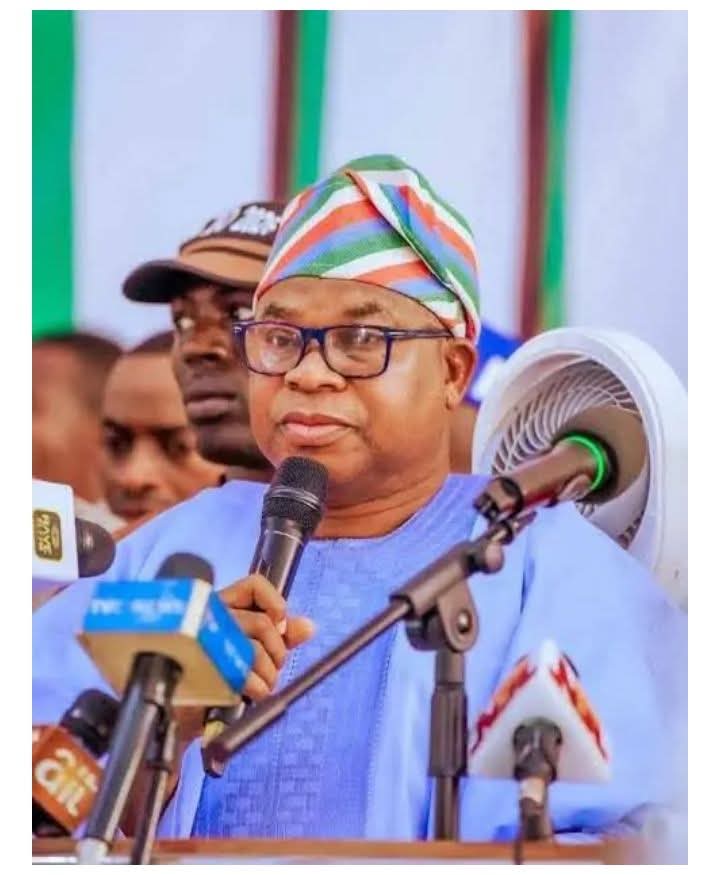
As Eze Ogbunechendo of Ezema Olo Kingdom in Enugu state, Lawrence Agubuzu, stood before him last week, President Bola Tinubu must be fascinated by his bravery. He had been there before. Igwe Agubuzu was delivering a goodwill message at the 2026 National Traditional and Religious Leaders Summit on Health. It held at the State House Conference Centre in Abuja. The president sat, cosseted by a panoply of power and no-smiling spies and operatives.
Standing confidently before the microphone, the Igwe asked Tinubu to release Nnamdi Kanu, leader of the proscribed Indigenous People of Biafra (IPOB). He offered alternatives. He could return him to Kenya, where his predecessor, Muhammadu Buhari, arrested and interdicted him to Nigeria. According to the Igwe, Kanu’s continued detention is stoking the fire of quarrellous agitations among youths in the south-east. Though he didn’t say as much, Igbo tend to see the Nigerian state as a reincarnate of British overlords whom his people fought to a standstill. It was along this narrative that Igwe Agubuzu accused Yoruba’s revered monarch, the Ooni of Ife, of hypocrisy. “This same Imperial Majesty is arranging to confer a very high honour on Sunday Igboho, who, in my own part of Nigeria and the South-East, we see him as a counterpart of Nnamdi Kanu,” Agubuzu said.
Tinubu himself possesses such Agubuzu bravery. I once witnessed it. In January, 2013, power surge had turned some sections of the palace of Oba Lamidi Adeyemi 111, the Alaafin of Oyo, into smouldering ruins. Leaders after leaders came to commiserate with the foremost monarch remarkable for his brilliance. A few days after, leaders of the Action Congress of Nigeria (ACN) were in the palace. They were led by its then National Chairman, Chief Bisi Akande; National Leader, Tinubu; Governor Abiola Ajimobi and many others.
When Tinubu was handed the microphone, just like the Igwe, he spoke the unthinkable and the unpleasant. While what the world saw reported the second day in the media was Tinubu’s statement that “The most unfortunate thing has happened, and we are here to sympathize with our history. We sympathize with the people of Oyo as the custodian of the great history of the Yoruba race,” Tinubu broke the calabash of dried corn (Igba yangan) into unrecognizable pieces. He said, in Yoruba, “Kabiyesi, we are here as your children. We know that no palace got burnt. You just wanted to see your children and we are here.” There was pin drop silence. Such huge words in the presence of the Son of Death, who Death was not at liberty to kill; the Son of Disease who Disease would strike at its peril? What was Tinubu insinuating!? Kabiyesi merely looked at him with superfluous wonderment. He who begets a murderous child will have to back the child.
Chinua Achebe was one of the first post-colonial Nigerian writers to open the curtains for a global peep into the heroism of the Igbo race. In his 1958 famous book, Things Fall Apart, Achebe didn’t only portray pre-colonial Igbo society as sophisticated, the book became a canvas with which he painted a people’s structured culture, complete with their tradition, dignity and laws. Essentially, the book redrew the map of British invaders’ stereotypes of a savage African tribe. With the same paint brush, Achebe portrayed the white man as a destructive force which came to dismantle Igbo culture through its strange religion, economic systems and god, divisive government, and how its imposition of its ways succeeded in breaking centuries-old communal living and destruction of a noble culture. Achebe’s defining quote which captures the white man’s destruction, was, “He (the white man) has put a knife on the things that held us together and we have fallen apart”.
In his picture of the Igbo society before the advent of the white man, Achebe put at the core of this portrayal the heroism of his people. In the Igbo’s resistance to British colonialism, he revealed the vulnerability of the Umuofia clan. Through the lens of Okonkwo, a warrior, farmer and traditional title holder, Things Fall Apart deployed Okonkwo’s tragic heroism to signpost the strength of Igbo people.
Pre-colonial Igbo society indeed had heroes. Though it didn’t operate, for instance, the Yoruba war model of a standing army with centralized military command, Igbo autonomous communities and village groups dictated warfare. They had local heroes, age groups who defended trade routes, their land and autonomy. Ohafia and Abam had warriors. They were renowned for their skills and bravery in battle and dreaded across Igboland. Their wars were prosecuted by mercenaries. With a war dance called the Ikpirikpi ogu, they brought home heads of their enemies, a bravery that qualified them for the highly regarded Ogbu-Isi society.
Apart from the Ohafia warriors, there were also the Ekumeku Warriors. They operated in the Anioma area of Igboland and were remarkable for their formidable bravery. As warriors’ secret society, their guerrilla tactic of night raids and hit-and-runs came to the fore during their 31-year fight against British colonial expansion that lasted from 1893 to1914. This is not to forget the Ezza warriors whose war prowess consisted in usage of frightening charms known as Owaka and Evuma. Lastly are the Aro fighters who, with their intelligence network, fought a war of resistance against the British in the famous 1901 to 1902 Aro-British War.
Last Wednesday, in Igwe Agubuzu, there was a re-enactment of those Igbo acts of bravery. The internet immediately went abuzz with a viral video of the traditional ruler. The Igwe had looked at Tinubu in the face and delivered what he said was the candid voice of his Igbo people. It was a refreshing departure from the familiar face of Igbo leadership which kow-towed before power for a morsel to fill its stomach. Co-incidentally, I was in the Southeast about this time. From every nook and cranny of Igboland last week, Agubuzu was garlanded as an archetypal hero of his people who, unlike other leaders, spoke truth to power unfazed.
However, there are two kernels of the Igwe’s submissions that needed interrogation. While the first is his comparison of Nnamdi Kanu’s agitations with Sunday Igboho’s, the second is the general call for Kanu’s release which, I confirm, is an agitation that has gained currency in Igboland.
Nnamdi Okwu Kanu and Sunday Adeniyi Adeyemo, famously known as Sunday Igboho, have points of convergence. Both born during and immediately after post-war period Nigeria of 1967 and 1972, they are products of the long-held acrimony of their people against the skewed foundation of the Nigerian state. They are both self-determination activists who believe in the advocacy for an independent Yoruba and Igbo nations and freedom from the manacles of the fiefdom of the Nigerian state.
Kanu, British-born, through his advocacy for the independence of Biafra from Nigeria, founded the Indigenous People of Biafra, (IPOB), which has now been proscribed. Igboho, on the other side, a barely literate thug of politicians who equally terrorized the people of Oyo State by snatching their lands, morphed into his current activism during the tyranny of Fulani herders who made life miserable for the people of the northern part of the state. His notoriety had earlier been established during the Ife-Modakeke war, in which he fought as a mercenary.
Igboho’s fame made a meteoric rise in January 2021 when, upon the brutal murder of one Dr. Aborode, he gave an ultimatum to Fulani herdsmen to vacate Ibarapa area of the state. He enforced this decree. Full stop. While both Igboho and Kanu preach violent seizure of power from oppressors of their people, their modus operandi differ. Igboho’s anger and violence were directed solely at the oppressors of his people. Kanu’s are not. While in the southeast, I stumbled on baffling statistics of Kanu’s Igbo people who have been violently unalived, either directly by his orders or through his body language.
There are obvious systemic wrongs done Nnamdi Kanu and his Igbo people by the Nigerian state. It is obvious that the state hasn’t forgiven Igbo for the “sins” of the civil war. If not, why would it have the least of the states in the regions that make up Nigeria? His ancestral home in Afaraukwu Ibeku, Umuahia, Abia State, was raided by the Nigerian military on multiple occasions, most notably on n September 2017, in what the Nigerian Army described as “Operation Python Dance II”. The invasion followed widely circulated images of the IPOB leader inspecting members of the Biafra Security Service (BSS) dressed in combat uniforms, which his followers celebrated as a counterweight to the State Security Service (SSS). This was a blatant affront to Nigeria’s sovereignty.
During this period, a violent clash occurred between IPOB members and soldiers, resulting in numerous casualties that remain unaccounted for. There were also allegations of disappearance of some individuals which included traditional rulers. Again, in February 2020, soldiers surrounded Kanu’s family home as he prepared to bury his parents, leading to renewed tension in the area. There were alleged killings on that occasion.
Since 2012 when Kanu began his violent advocacy, thousands of his own brothers and sisters have been killed and sources of livelihood castrated. A pathetic case of an Lagos-based businessman from Enugu who came home in 2021 is always recalled with dread running down spines. He had gone to the Amechi Road, Awkunanaw Enugu area on a Monday and was shot dead by Kanu’s bloodthirsty IPOB/ESN hounds. Igbo policemen killed within the period must be in their hundreds. His five-year Sit-At-Home order has led to tremendous economic asphyxiation of his people. On the sixth day of assumption of office, precisely on June 5, 2923, the Enugu government, under Governor Peter Mbah, mowed heavily IPOB and Simon Ekpa-led IPOB faction known as Auto Pilot, resulting in the rout of that malady in the Coal City. Till today, a substantial part of the Southeast is still under the excruciating hold of that Kanu pronouncement.
At various times, Kanu breathed fire, proclaimed violence and killing like a psychopath. In September 2015, in a heated address he delivered to the World Igbo Congress in Los Angeles, he thundered, “we need guns and we need bullets” to prosecute war against Nigeria. In same 2015, shortly after Dr. William Kumuyi, General Superintendent of the Deeper Christian Life Ministry, like all clergies, proclaimed the continued unity of Nigeria, Kanu threatened the old man’s life for what he said was his audacity. “Pastor Kumuyi should be stoned and dealt with thoroughly if he comes to Aba for his planned crusade,” he said.
In another instance in 2017, a video of his blowing hot and proclaiming open death threat to ex-Nigerian president, Olusegun Obasanjo, went viral. This same Obasanjo had received threats from his own people for his Igbo-centric persuasion. Reacting to growing threat that Kanu’s IPOB posed to Nigeria, Obasanjo had told a gathering in Abuja that everything humanly possible must be done to stop IPOB. In a reply to the ex-president, as he talked to a gathering of supporters in his Afaraukwu Ibeku home, Kanu asked IPOB to eliminate Obasanjo and his lineage if any harm comes to him. In another viral video, he was seen boasting to his followers that he was ready to march to Abuja and return with President Buhari’s head, as they cheered him on.
On some other documented occasions, this same Kanu had said, “Nigeria should prepare for war, we are coming to annihilate you, my secret service are already studying the zoo and strategising” and “If you find anybody in your village asking after Radio Biafra, kill the baboon Hausa, Fulani or Yoruba bastard. Let them keep searching as we keep tweeting for #Biafra.” Other ethnic groups, even his own Igbo people of Enugu, received his deathly rhetoric. “Niger Deltans,” he once said, “are cowards; we know what to do to them. Akwa Ibom, Bayelsa, Delta, Rivers, Edo, and Cross Rivers states are our territory, and anybody who tries to oppose us will be crushed.”
So also are rhetoric such as, “Yoruba Pentecostalism is the reason why Fulanis are invading us today” and “Any army they (the Federal Government) send to Biafraland will die there. None will return alive. even if it require sacrificing my people I will do it”. On several occasions, Kanu called for attacks and killing of Yoruba people and destruction of their properties and businesses in Lagos. Its height was during the EndSARS riots when he was specifically had on tape ordering the burning and destruction of key infrastructure in Lagos. In 2020, he announced the creation of a non-state sanctioned paramilitary organization called the Eastern Security Network (ESN) which essentially coordinated the killing of his own Igbo people.
In April 2021, Ikonso, an ESN Commander, was killed by a tactical team of the Nigeria Police, Nigerian Army, and Department of State Services (DSS), in a joint operation. His body, festooned with charms and cowries, was paraded to the world. Few days after, on a Radio Biafra broadcast where he threatened retaliation, Kanu praised and eulogized him and ordered that, as a warrior, 2000 heads must be buried with him. An arrested ESN member later on told the court during Kanu’s trial that the group had recorded 20 heads already. A top investigative officer told me in the southeast last week that the charges the federal government leveled against Kanu were slap-on-the-wrists. According to him, if government had contacted state criminal investigation units in Igbo land, it would have had more harrowing charges against him. Kanu’s conduct was so beastly that no responsible government could stand by and watch the level of his animalism.
Apart from Igbo politicians who capitalize on herd support for Kanu among the people for votes, respected Igbo elders avoid him like a plague. While some think he is on drugs, others question his sanity. Ike Ekweremadu, as Deputy Senate President, was a strong supporter of the effort to secure the release of Kanu. At the risk of his office, with a Buhari who had rank hatred for the Igbo, Ekweremadu was reported to have met the then president repeatedly to canvass for his freedom. In August 2019, Kanu organised his IPOB residents in Nuremberg, Germany, to embarrass Ekweremadu.
A pathetic video of a traumatised Ekweremadu running for dear life even as the bloodhounds tore his clothes and hit him endlessly, trended. Enyinnaya Abaribe, who today is at the fore of Kanu’s advocacy, had issued a release lamenting that “it was un-Igbo” for IPOB to have thus maltreated Ekweremadu. “Obviously this is not how to repay a man, an outstanding leader of men, an unpretentious Igbo leader” who gave “all, even going as far as deploying his means to arrange for the bail of Kanu, not minding the repercussion to his illustrious political career,” he said. Former Minister of Aviation, Osita Chidoka, also condemned it, extolling Ekweremadu for fighting for the release of Kanu. In his reaction, not only did he ask IPOB to “give (Nyesom) Wike the Ekweremadu treatment if he travels abroad,” Kanu said the treatment Ekweremadu got was a lesson to Igbo leaders.
The hurtful truth that may be bitter on the tongue of Southeast leaders is that Nnamdi Kanu is a threat to human peaceful living and no human society would allow his kind to roam free. Tinubu’s challenge wouldn’t be releasing Kanu. The message that will be sent out by doing so and his nil redemptive spirit to abandon a life of pursuit of violence are the main challenge.
Sunday Igboho indeed sowed tears into the lives of his people during his land-grabbing pursuit. I am a living witness. He however never killed his own people, nor did he go overboard like Kanu in threatening the Nigerian state. Unless Kanu turns a new leaf and government is convinced that he is now genuinely an apostate of his blood-sucking views, the Sokoto gulag should continue to house his kind.