
The Nigeria Customs Service (NCS) has intensified its modernisation drive with the rollout of a fully automated system for the acquisition and renewal of licences and permits, a reform aimed at improving ease of doing business, boosting revenue generation, and eliminating bottlenecks in trade processes.
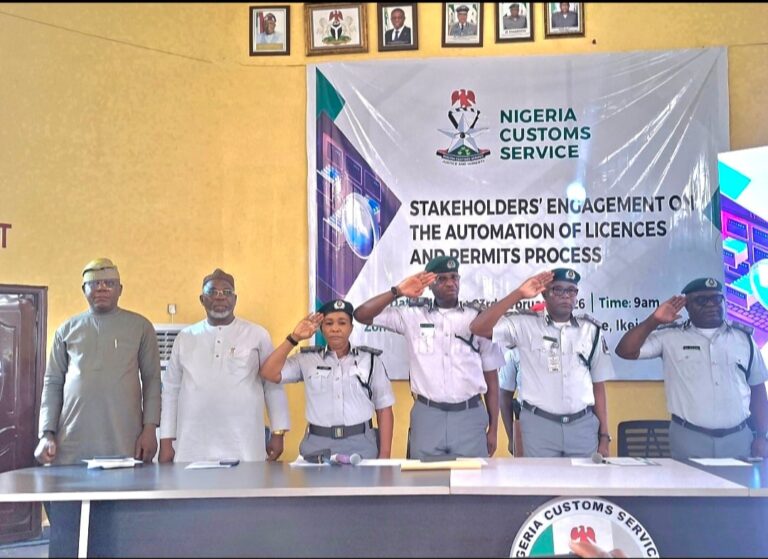
The initiative was highlighted during a zonal sensitisation programme on the automation of licences and permits held at the Customs Training College Auditorium, Ikeja, Lagos, where Comptroller NJ Anozie delivered an opening statement outlining the objectives and benefits of the reform.
Speaking on behalf of the Comptroller-General of Customs, Bashir Adewale Adeniyi, Anozie described the automation programme as another milestone in the Service’s innovation-driven modernisation agenda.
The event had the Deputy Comptroller-General of Customs in charge of Tariff and Trade, CK Niagwan, represented by the Zonal Coordinator, Zone ‘A’, Assistant Comptroller-General of Customs Mohammed Babandede, alongside senior customs officers, stakeholders, and members of the media.
Anozie noted that the reform aligns with the Comptroller-General’s three-point agenda of consolidation, collaboration, and innovation, stressing that automation of customs procedures reflects global best practices and Nigeria’s commitment to building an efficient and technology-driven customs administration.
He explained that the automation of licences and permits would simplify processes for importers, clearing and forwarding agents by enabling them to initiate and complete applications remotely from their offices or homes, eliminating the need for physical visits to Customs headquarters.
According to him, the digital platform would significantly reduce operational stress for stakeholders and officers by replacing manual file handling with electronic processing, while also cutting the cost of doing business by removing expenses associated with travel, accommodation, and prolonged processing timelines.
Anozie further stated that the automated system would strengthen transparency and accountability, as uploaded documents would undergo automatic verification capable of rejecting fraudulent submissions while accepting genuine ones. The system also enabled officers to monitor outstanding assessments linked to companies applying for licences or renewals.
He added that automation would save valuable time for stakeholders, improve productivity among customs officers, and enhance statutory revenue generation through faster processing and improved compliance.
Appealing to officers whose responsibilities interface with the Licences and Permits Unit, Anozie urged full adoption of the new system, describing its success as a collective achievement for the Service. He also called on stakeholders and the media to support awareness efforts to ensure widespread understanding of the innovation.
In his keynote address, the Zonal Coordinator, Assistant Comptroller-General Mohammed Babandede, described the sensitisation programme as the beginning of a new chapter in how the Nigeria Customs Service delivers licences and permits to stakeholders.
Babandede explained that automation would end longstanding challenges associated with paperwork, long queues, and uncertainty linked to manual processing, noting that stakeholders would now be able to apply for and renew licences online while tracking application status in real time.
He said the reform would ensure fairness, consistency, and transparency in processing, while enabling better record keeping, improved supervision, and the ability of the Service to serve more stakeholders simultaneously without increasing pressure on personnel.
Describing Lagos as the commercial hub of Nigeria and Zone ‘A’ as the most economically active customs zone, Babandede emphasised the importance of successful implementation in the region, given the high volume of trade activities handled there.
He encouraged stakeholders to actively engage during the sensitisation sessions, ask questions, and share feedback to support continuous improvement of the system, adding that similar programmes would be conducted across all customs zones nationwide.
The Customs Service assured participants that bond seat officers across Customs Area Commands had already undergone training, while stakeholders would receive handbooks and instructional materials detailing step-by-step procedures to ensure seamless adoption of the automated platform.
Officials expressed confidence that the automation initiative would transform service delivery, strengthen trade facilitation, and position the Nigeria Customs Service as a leading example of innovative customs administration.