

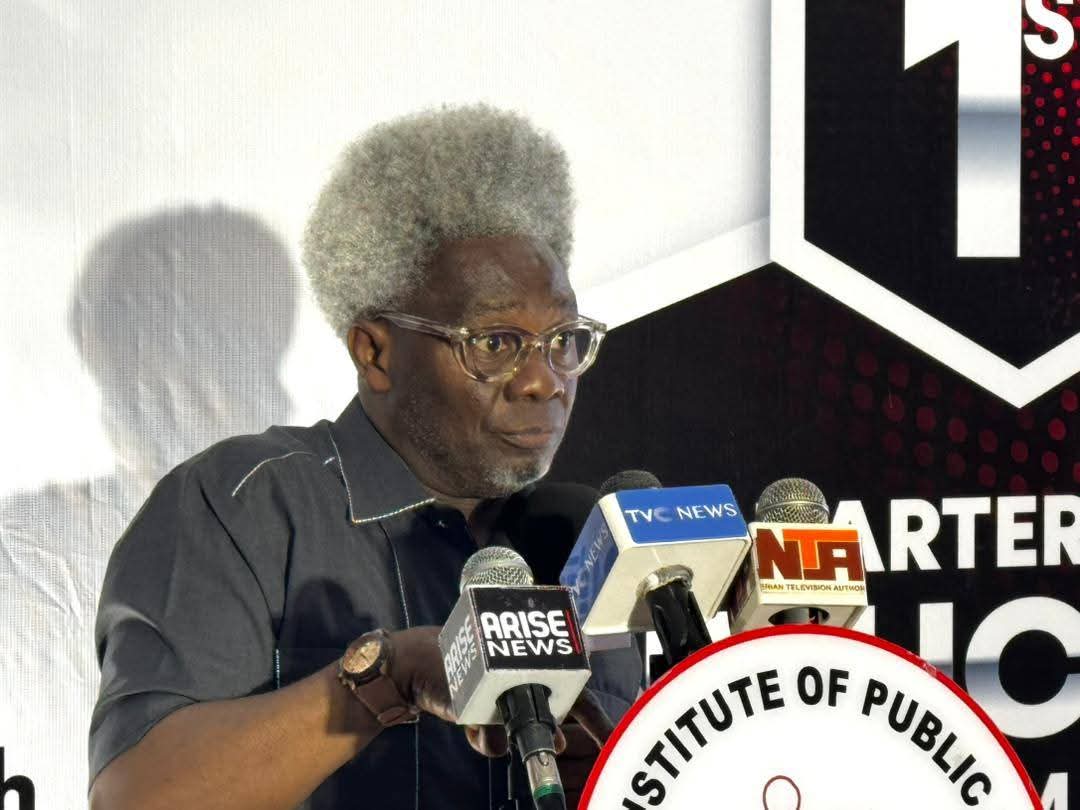
A Communications expert,Dr. Omoniyi Ibietan has called on public relations professionals in Nigeria to rethink communication in an era where attention has become a scarce commodity, stressing that it can no longer be reduced to the mere transfer of information.
He made this known while delivering his speech at the first-quarter 2026 induction ceremony of the Nigerian Institute of Public Relations (NIPR), held at Bolingo Xperia Hotel, where about 500 new members were formally admitted into the Institute.
Speaking extemporaneously after an orientation lecture by former Akwa Ibom State Commissioner for Information and NIPR Council member, Ini Ememobong, Ibietan congratulated the inductees and reminded them of the rich institutional heritage they were inheriting.
He noted that although the NIPR was established in 1963, it became chartered in 1990, making it the world’s first chartered institute of public relations predating similar recognition granted to its UK counterpart.
The communication scholar argued that the long-standing definition of communication as mere information sharing, popularised in earlier academic traditions, is now inadequate and “unimaginative” in the face of contemporary realities shaped by an evolving attention economy.
According to him, communication is fundamentally about the sharing of meaning, rooted in what he described as “shared intentionality,” expressed through joint attention, mutual understanding, and shared goals. He drew insights from notable thinkers such as Martin Buber, Michael Tomasello, and Paul Watzlawick to reinforce his position.
Ibietan stressed that communication is inherently cooperative and central to human survival, urging the new professionals to discover their mission and contribute meaningfully to addressing the crisis of communication in contemporary society, exacerbated by disruptions in the “ecology of attention.”
He further emphasised that every action including silence communicates meaning, noting that “non-messages” are still messages capable of shaping perception and relationships.
Advising the inductees on professional conduct, he urged them to approach every interaction with empathy, reminding them that people desire to be “loved, respected, valued and confirmed.” He also highlighted the importance of personal presentation, noting that even casual public behaviour reflects one’s communicative identity and professional reputation.
On a lighter note, he cautioned against indecent dressing in public spaces, stressing that such actions, however trivial they may seem, could send the wrong signals and undermine credibility.
Ibietan underscored the importance of collaborative communication, saying it promotes dialogue, builds trust, strengthens relationships, and fosters stability and progress. He warned that society would continue to face communication breakdowns unless a more humanising and cooperative approach is embraced.
He further charged public relations practitioners to serve as custodians of ethical, empathetic, and data-driven communication, capable of addressing misinformation, the distortions of artificial intelligence-driven messaging, and the erosion of dignity in public discourse.
He also urged professionals to position communication as a core leadership responsibility within organisations, rather than a peripheral management function.
The event brought together key stakeholders in the communication sector, including the President and Chairman of Council of the Nigerian Institute of Public Relations, Ike Neliaku; Council member, Ahmed Sajoh, who delivered the welcome address; and Ismaila Isah, Special Adviser on Media to the Governor of Kogi State, alongside other professionals and stakeholders.
The induction ceremony formed part of ongoing efforts by the Institute to strengthen professionalism and reposition public relations practice in Nigeria.