
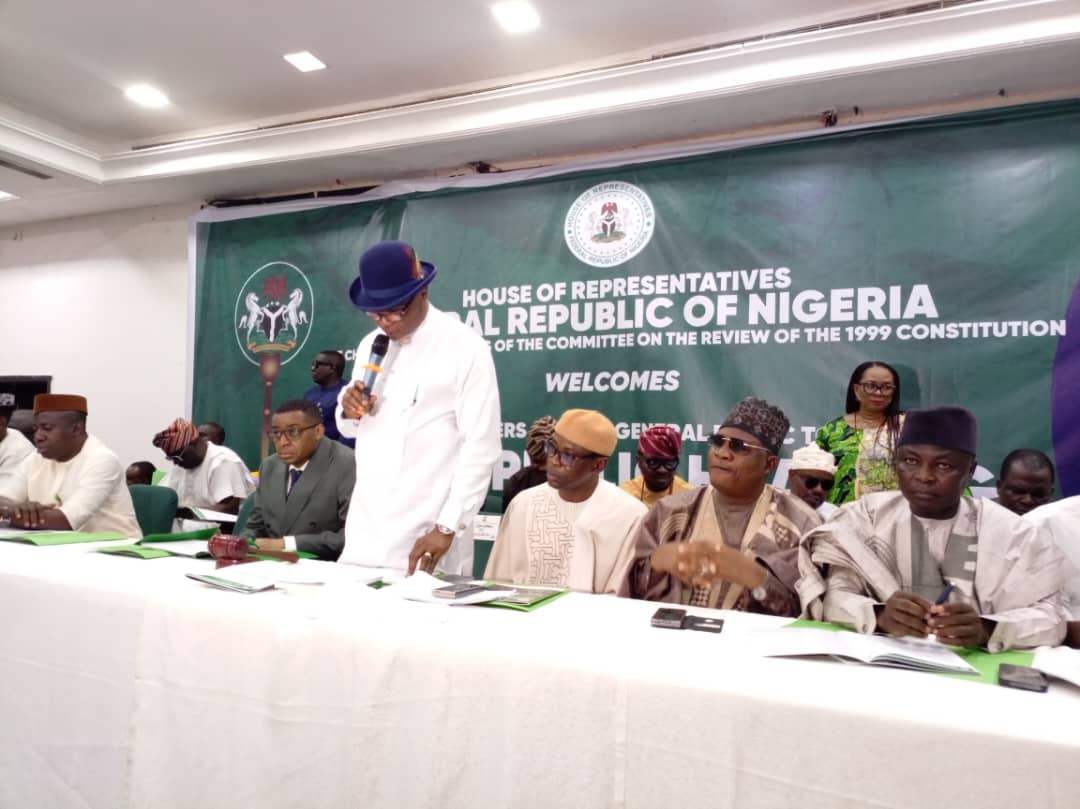
The House of Representatives Ad Hoc Committee on the Review of the 1999 Constitution has commenced its zonal public hearing in Calabar, the Cross River State capital, as part of the nationwide constitutional review process.
The Calabar sitting covers Zone A of the South-South region, comprising Cross River, Akwa Ibom, and Rivers States, while Zone B encompassing Edo, Delta, and Bayelsa States is scheduled to hold its hearing in Yenagoa, Bayelsa State.
Upon arrival in Calabar, the leader of the Constitution Review Committee and Minority Leader of the House of Representatives, Rt. Hon. Kingsley Chinda, who represents Obio/Akpor Federal Constituency, led the delegation on a courtesy visit to the Obong of Calabar, His Eminence Edidem Ekpo Okon Abasi Otu V. The revered monarch urged the lawmakers to reflect the true aspirations of Nigerians in the amendment process and pledged to mobilize his people to actively participate through written and oral submissions.
The committee also visited the Cross River State Government House, where they were received by the Deputy Governor, Rt. Hon. Peter Odey. While expressing support for the constitutional review, Odey raised concerns over the limitations imposed on state governments particularly regarding mineral resource control, which remains under the exclusive legislative list. He called for constitutional reforms to grant states the right to explore and manage mineral resources within their territories to drive grassroots development.
At the public hearing, citizens submitted a wide range of memoranda touching on critical issues such as state and local government creation, boundary realignment, and integration with ethnic kin. Proposals for new states included Bori, Ogoja, and Atlantic States, while local government restructuring requests came from Etung, Odukpani, and Akpabuyo LGAs in Cross River State, with calls for each to be split into multiple councils.
A notable submission came from the Igede people of Benue State, who sought reintegration with their kith and kin in Cross River, particularly in anticipation of the proposed Ogoja State. Meanwhile, the people of Eastern Obollo expressed divergent views on the proposed Obollo State but submitted their memo nonetheless.
A recurring justification across state creation requests was the presentation of population figures, expansive landmass, cultural unity, and the presence of both human and natural resources as indicators of viability.
Women’s groups at the hearing advocated for constitutionally guaranteed special seats for women, while civil society organizations proposed electoral reforms, including unbundling the Independent National Electoral Commission (INEC), ensuring the resolution of electoral disputes before swearing-in, and establishing local government election tribunals. They also demanded the creation of the Office of the Auditor-General for local government councils and Area Councils of the Federal Capital Territory (FCT).
Labour unions and the Nigeria Union of Teachers (NUT) called for their retention on the Exclusive Legislative List, while judicial support staff including customary and magistrate court workers urged for recognition as judicial officers under the constitution.
The Constitution Review Committee is expected to continue its engagements across various zones of the country as part of efforts to build an inclusive and responsive legal framework for national development.