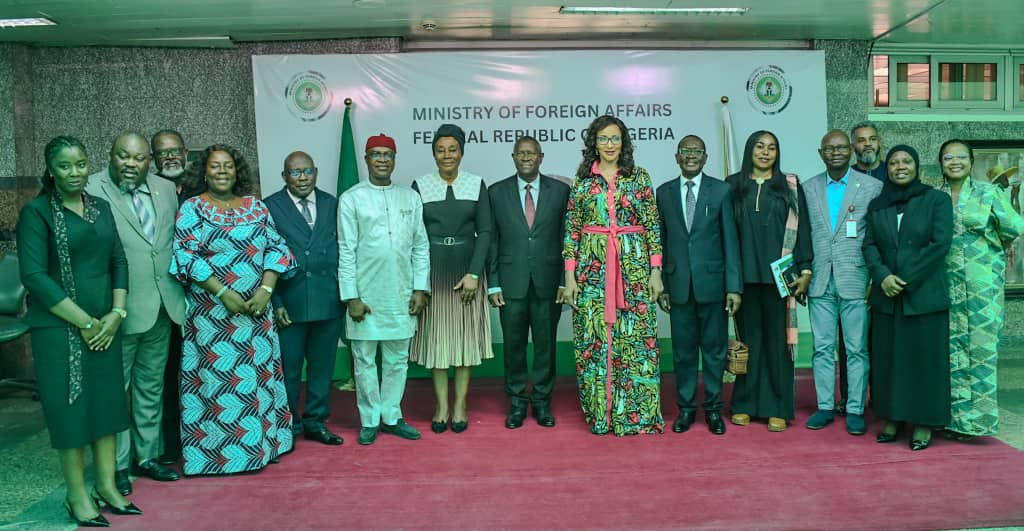
Nigeria has outlined its foreign policy priorities for 2026, with a focus on strategic autonomy, regional stability, and responsible global partnership, during the New Year Reception for Ambassadors and Heads of Mission to Nigeria.
Delivering the keynote address, His Excellency, Amb. Yusuf Maitama Tuggar, OON, Minister of Foreign Affairs, welcomed members of the diplomatic corps and highlighted Nigeria’s commitment to principled and constructive diplomacy. He also extended gratitude to departing ambassadors for their service and welcomed new ambassadors-designate from Qatar, Lebanon, Namibia, Sudan, and Saudi Arabia.
Amb. Tuggar explained a recent refinement in diplomatic procedures, allowing ambassadors-designate to commence official duties after presenting letters of credence to the Chief of Protocol, improving efficiency while maintaining formal engagement protocols with the President and Vice President.
Reflecting on 2025, the Minister noted that Nigeria intensified its economic diplomacy through investment outreach, bilateral engagements in infrastructure, energy, agriculture, digital connectivity, and industrial development. The country also convened the inaugural West Africa Economic Summit (WAES) alongside the ECOWAS @ 50 Summit to boost regional trade, investment, and employment opportunities.
Highlighting security concerns, Amb. Tuggar reaffirmed Nigeria’s commitment to regional stability, particularly in the Sahel, citing the need for recalibrated diplomatic and security frameworks to address terrorism and insecurity. The Minister emphasized the continuation of the Regional Partnership for Democracy (RPD), in collaboration with the UNDP, to strengthen democratic institutions, electoral integrity, and inclusive governance in West Africa.
On the economic front, Nigeria’s robust capital market, unified foreign exchange regime, and modernized tax laws position the country as an attractive destination for global investment. Amb. Tuggar encouraged sustained engagement with the Global South while deepening longstanding trade and investment ties with Europe, North America, and Asia.
With elections approaching, the Minister reiterated the importance of constructive diplomatic partnerships in capacity-building, electoral observation, and knowledge exchange to strengthen credible democratic processes.
Amb. Tuggar further emphasized Nigeria’s commitment to multilateralism, inclusive institutions, and rules-based global cooperation. He sought diplomatic support for Nigeria’s international candidatures, including seats on the Committee on the Elimination of Discrimination Against Women, the Human Rights Council, the UN Security Council (non-permanent, 2030), and the World Heritage Committee (2029).
Amb. Tuggar reaffirmed that the Ministry of Foreign Affairs remained the official channel of communication between diplomatic missions and the Nigerian government, underscored the importance of protocol in fostering effective relations. He also invited attendees to engage in cultural diplomacy at The Atrium, which remains open for artistic collaboration throughout the year.
Nigeria’s 2026 foreign policy signaled a balanced approach, combining economic growth, democratic resilience, regional stability, and active engagement on the global stage.