
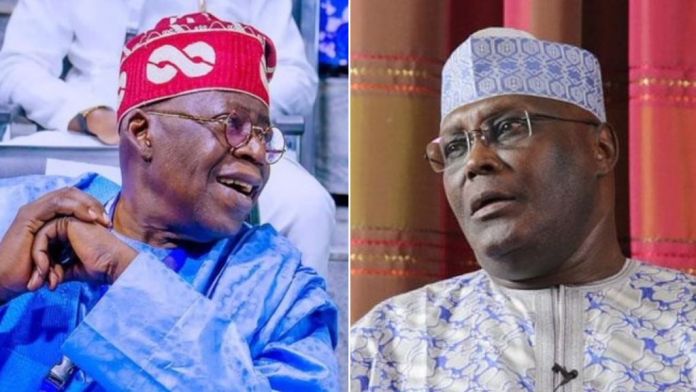
The Democratic Front (TDF) has dismissed former Vice President Atiku Abubakar’s criticism of the Federal Government’s borrowing policy, describing his comments as mischievous and politically motivated.
In a statement signed by its Chairman, Mallam Danjuma Muhammad, and Secretary, Chief Wale Adedayo, the group argued that the administration of President Bola Ahmed Tinubu was borrowing to address Nigeria’s huge infrastructural deficit and stimulate economic productivity.
According to the group, recent economic analysis by the Independent Media and Policy Initiative (IMPI) showed that Nigeria requires at least $14.2 billion annually over a 10-year period to bridge the country’s infrastructure gap.
The TDF questioned how Nigeria could generate such huge funding internally without imposing massive taxes on citizens, insisting that the Tinubu administration’s borrowing strategy was aimed at financing critical infrastructure projects capable of boosting economic growth and employment.
The group stated that inadequate infrastructure and rapid population growth had contributed significantly to poverty, unemployment, and low productivity in the country, adding that Atiku failed to acknowledge these realities in his criticism of government borrowing.
It further noted that many of the foreign loans were tied to major projects including the Lagos-Calabar Coastal Highway, Sokoto-Badagry Super Highway, Phase 1A of the Lagos Green Line, Kano State Metro City Rail, and Kaduna State Light Rail System.
According to TDF, the projects are expected to generate returns that would eventually repay the loans while easing pressure on government revenue and fiscal obligations.
The group also accused Atiku of lacking the moral authority to criticise the current administration, recalling that during his tenure as Vice President, annual capital spending stood at about $3.5 billion despite rising crude oil revenues.
It argued that the period witnessed worsening infrastructure deficits, persistent power outages, deteriorating roads, and underperforming sectors of the economy.
The organisation referenced IMPI Policy Statement 037, which it said described the Tinubu administration as the highest spender on infrastructure among Nigerian governments since 1999.
TDF maintained that no administration in the last 25 years had spent up to $8 billion annually on infrastructure projects as allegedly being done under the current government.
The group added that savings from fuel subsidy removal alone could not adequately finance Nigeria’s infrastructural needs, thereby justifying the recourse to foreign borrowing.
It also accused Atiku of using “unprintable and intemperate words” against President Tinubu out of frustration over what it described as the administration’s success in resetting the nation’s economy.
The TDF further alleged that the administration in which Atiku served supported the spending of $18 billion on Paris Club debt relief and another $16 billion on power projects that failed to deliver expected results.
The group urged Nigerians to disregard Atiku’s criticisms and continue supporting the Tinubu administration’s economic and infrastructure policies.