

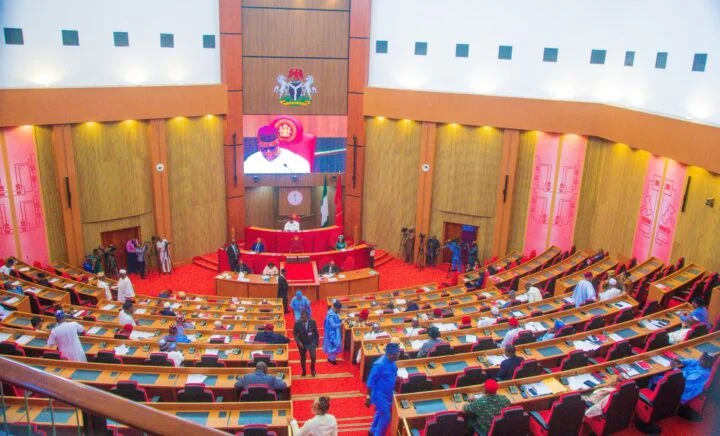
The controversy surrounding the recent amendment to the Senate Standing Rules has generated more heat than light. Unfortunately, much of the public conversation has been framed around personalities rather than principles, and emotions rather than institutional logic. Yet the real issue before the Senate is neither about Senator Godswill Akpabio nor Senator Adams Oshiomhole. It is about whether legislative institutions should evolve, strengthen themselves, and create continuity mechanisms that deepen parliamentary stability.
Every serious institution in the world periodically reviews its rules, procedures, and qualifications in response to emerging realities. Legislatures are not exempted from this process of institutional self-correction and growth. In fact, the refusal to review procedures in the face of experience is often a sign of stagnation, not democracy.
The recent amendment requiring senators seeking certain presiding and principal offices to possess a minimum level of legislative experience should therefore be viewed through the broader prism of institutional development rather than through narrow political calculations.
Parliamentary leadership is not merely ceremonial. The office of Senate President is one of the most sensitive and technically demanding constitutional offices in Nigeria. It requires not only political popularity but also deep familiarity with parliamentary traditions, legislative procedures, negotiation dynamics, committee systems, constitutional interpretation, and intergovernmental relations. Experience matters.
Around the world, mature legislatures often evolve unwritten and written traditions that favour institutional memory and legislative continuity. Such measures are not necessarily designed to exclude people; they are often intended to preserve stability, reduce avoidable turbulence, and ensure that those entrusted with managing highly sensitive parliamentary processes possess sufficient procedural grounding.
Critics who fear that experience requirements create a closed, self perpetuating oligarchy are not entirely without reason. Many legislatures have, at various points, used procedural thresholds to entrench incumbents rather than protect institutional wisdom. But the answer to that legitimate concern is not to abandon minimum standards altogether. It is to ensure that the bar is set at a reasonable, not prohibitive, level. A requirement of, say, one full term or demonstrated committee leadership is a safeguard against chaos, not a moat against renewal. The Senate must therefore commit to reviewing this threshold periodically, lest a tool of stability calcify into a ceiling on ambition.
Experience without openness becomes arrogance; openness without experience becomes amateurism. The amendment under scrutiny tilts toward the latter’s correction, but it must not be understood as a final word. What truly elevates an institution is not a single rule change but a culture that values both seasoned judgment and fresh perspective. That means pairing experience requirements with transparent mechanisms for advancement, seniority systems that reward competence, not mere longevity, and leadership elections that remain genuinely contested, not coronations.
Seen from this perspective, the amendment is neither unusual nor inherently anti democratic. Rather, it reflects the Senate’s attempt to refine its internal processes based on accumulated experience.
It is therefore inaccurate to reduce the issue to the suggestion that the amendment was crafted merely to “shrink competition” or protect personal interests. Institutions do not become stronger by permanently freezing their rules in time. They grow by learning from experience and adjusting procedures where necessary to protect efficiency, order, and continuity.
Even more problematic is the argument suggesting that because the new qualification threshold did not exist when Senator Godswill Akpabio emerged as Senate President, he should now resign if the new rule is adopted. Such reasoning fundamentally misunderstands one of the oldest principles of jurisprudence and democratic governance: laws are generally prospective, not retroactive.
A law or rule takes effect from the point of enactment forward unless expressly stated otherwise. The amendment cannot logically invalidate a mandate that was legitimately acquired under previously existing rules. Senator Akpabio contested and emerged as Senate President under the constitutional and procedural framework that existed at the time. To argue otherwise would amount to applying today’s standards to yesterday’s circumstances, which is neither legally sustainable nor institutionally rational.
Following that logic, every constitutional amendment would invalidate previous actions taken under earlier provisions, thereby throwing governance into perpetual instability.
What should matter now is whether the amendment serves the long term interest of the institution. That is the proper question, not whether it benefits or disadvantages any single individual in the immediate moment.
Interestingly, many of the world’s strongest democratic institutions evolved precisely through incremental procedural reforms. Rules governing tenure, committee leadership, succession, seniority, and qualification standards were not static from inception; they emerged through continuous refinement driven by practical governance realities.
It is also important to note that continuity in leadership structures is not necessarily an enemy of democracy. Stability can strengthen democracy when balanced with fairness and openness. A legislature perpetually trapped in leadership uncertainty, procedural inexperience, and internal volatility weakens not only itself but the democratic process as a whole.
Every rule amendment asks the same underlying question: whom does the institution trust to lead it? When a legislature decides that a Senate President should have served a minimum period as a legislator, it is making a quiet but profound statement about the nature of political authority. It is saying that raw popularity or executive favour is not enough, that the stewardship of a co equal branch requires earned familiarity with its rhythms and restraints. That is not elitism. It is institutional self respect. And in a democracy, institutions that do not respect themselves are unlikely to be respected by the public they serve.
This is why the current debate should rise above personal disagreements or chamber theatrics. Nigerians expect lawmakers to approach institutional reforms with intellectual honesty and statesmanship rather than framing every procedural amendment through the lens of political rivalry.
Senator Adams Oshiomhole is entitled to his views, as every senator is. Debate is healthy in democracy. Dissent is legitimate. However, the conversation should be anchored on whether the amendment strengthens the Senate as an enduring institution, not whether it immediately advances or obstructs the ambitions of specific politicians.
Ultimately, institutions outlive individuals. Senate Presidents will come and go. Senators will rise and fall. But the rules and traditions established today may shape legislative stability for decades to come.
That is why this matter deserves to be viewed not through the narrow window of self interest, but through the wider lens of institutional maturity, continuity, and the long term health of Nigeria’s parliamentary democracy.
Experience matters.
Rt Hon Eseme Eyiboh, mnipr, is a former member and spokesperson of the House of Representatives and currently Special Adviser on Media/Publicity and Official Spokesperson to the President of the Senate.