
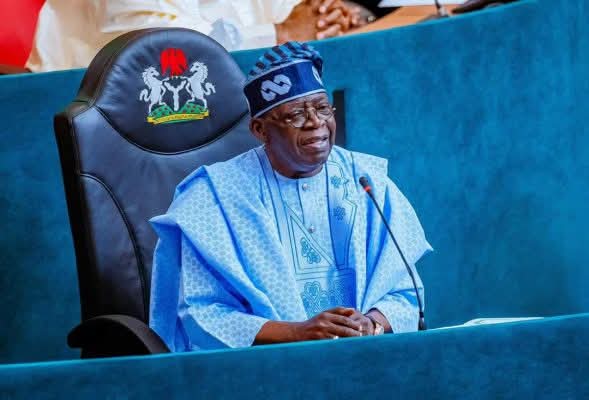
President Bola Ahmed Tinubu on Friday declared that Nigeria is gradually overcoming its economic difficulties and regaining stability, saying the bold reforms introduced by his administration over the past three years are beginning to produce visible results across key sectors of the economy.
Speaking in a nationwide broadcast to commemorate the third anniversary of his administration, Tinubu acknowledged the hardship experienced by millions of Nigerians since the removal of fuel subsidy and the unification of the foreign exchange market but maintained that the difficult decisions were necessary to save the country from fiscal collapse.
The President said when his administration assumed office in May 2023, Nigeria was burdened by crippling fuel subsidy payments, declining revenues, exchange-rate distortions, mounting debt obligations, insecurity, weak infrastructure, and low investor confidence.
According to him, the country spent as much as ₦18.4 billion daily on petrol subsidy at the peak of the subsidy regime, amounting to over ₦4 trillion in 2022 alone, while forex arbitrage and multiple exchange rate windows cost the nation more than ₦8 trillion in three years.
“The situation demanded urgent and courageous action. Difficult but necessary decisions had to be taken to stabilise the economy and prevent a deeper national crisis,” Tinubu stated.
He said although the reforms triggered inflationary pressures and rising living costs, his administration remained focused on long-term recovery rather than temporary political convenience.
“The easy choices would have been politically convenient. But leadership demands courage, especially when the right decisions are difficult,” he said.
Tinubu assured Nigerians that their sacrifices were not in vain, insisting that signs of economic recovery and national progress are becoming increasingly evident.
He noted that investor confidence is returning, public finances are improving, and states and local governments now have more resources to invest in infrastructure and social services.
The President highlighted the remarkable growth recorded in the capital market, revealing that the Nigerian Stock Exchange All Share Index rose from 53,000 points in 2023 to 250,000 points in 2026, while market capitalisation increased from ₦30 trillion to ₦160 trillion.
Tinubu also pointed to ongoing infrastructure projects nationwide, saying over 2,700 kilometres of highways and major roads are currently under construction, rehabilitation, or reconstruction.
Among the flagship projects mentioned were the Lagos-Calabar Coastal Highway, Sokoto-Badagry Super Highway, Abuja-Kaduna-Zaria-Kano Road, East-West Road, and several rural access roads aimed at boosting trade, improving transportation, and creating jobs.
He added that rail modernisation projects are also progressing to strengthen connectivity and economic integration across the federation.
In the oil and gas sector, Tinubu said reforms introduced by his administration had attracted billions of dollars in fresh investment from international oil companies, while local refining capacity and domestic gas utilisation were improving energy security and reducing dependence on imported petroleum products.
He disclosed that the $5 billion NLNG Train 7 project is nearing completion and is expected to significantly increase Nigeria’s liquefied natural gas production and export capacity.
On electricity supply, the President admitted that the power sector had suffered years of debt, underinvestment, and uncertainty, but said his administration was now addressing those challenges through investments in transmission infrastructure, renewable energy, and grid stability.
“We are determined to power Nigeria into a new era of industrial growth and economic opportunity,” he declared.
Tinubu further highlighted interventions in agriculture, saying government programmes had supported millions of farmers with improved seedlings, fertilisers, mechanisation, irrigation, access to finance, and market opportunities.
According to him, the administration is also opening new agricultural corridors to strengthen supply chains and reduce food inflation.
In education, the President revealed that the Nigerian Education Loan Fund has already provided more than 1.5 million students with access to higher education through disbursements exceeding ₦282 billion.
He also highlighted progress under the Renewed Hope Housing Programme, which he said is delivering over 10,000 housing units across 14 states and the Federal Capital Territory while creating more than 300,000 jobs.
The President noted that healthcare delivery is also improving through the revitalisation of primary healthcare centres and the expansion of health insurance coverage for vulnerable Nigerians.
Tinubu said the telecommunications sector was gradually recovering from years of declining investment and operational pressures, adding that telecom operators are now expanding networks, investing in infrastructure, and recruiting more Nigerian talent.
He stressed that digital infrastructure remains central to economic growth, innovation, and productivity.
Addressing young Nigerians directly, Tinubu said the government is investing in digital skills, technical education, entrepreneurship, and innovation to create opportunities for the country’s growing youth population.
“To our young people, I want you to know this nation believes in you. You are not a problem to be managed. You are the engine of Nigeria’s future,” he said.
On security, the President reaffirmed his administration’s commitment to combating terrorism, banditry, kidnapping, oil theft, and other forms of criminality.
He said security agencies have intensified operations nationwide and that many communities and highways are becoming safer and more economically active.
While admitting that challenges still remain, Tinubu assured Nigerians that his government would continue investing in intelligence, surveillance, logistics, and inter-agency coordination to restore peace and stability.
The President urged Nigerians to remain united and hopeful despite the challenges facing the country, stressing that nation-building required sacrifice, resilience, and collective purpose.
“We must choose hope over despair, unity over division, and nation-building over narrow interests,” he said.
Tinubu expressed optimism that Nigeria would emerge stronger, fairer, and more prosperous, noting that confidence in the country is gradually returning globally.
“History tests nations before it elevates them. Nigeria is passing through such a test. But I believe with all my heart that we shall emerge stronger, fairer, more united, and more prosperous than ever before,” the President added.