
The Universal Basic Education Commission (UBEC) has disclosed that it has mobilised more than ₦100 billion in previously unaccessed matching grants, deploying the funds to improve infrastructure, strengthen teacher capacity, and expand digital learning across Nigeria’s basic education sector.
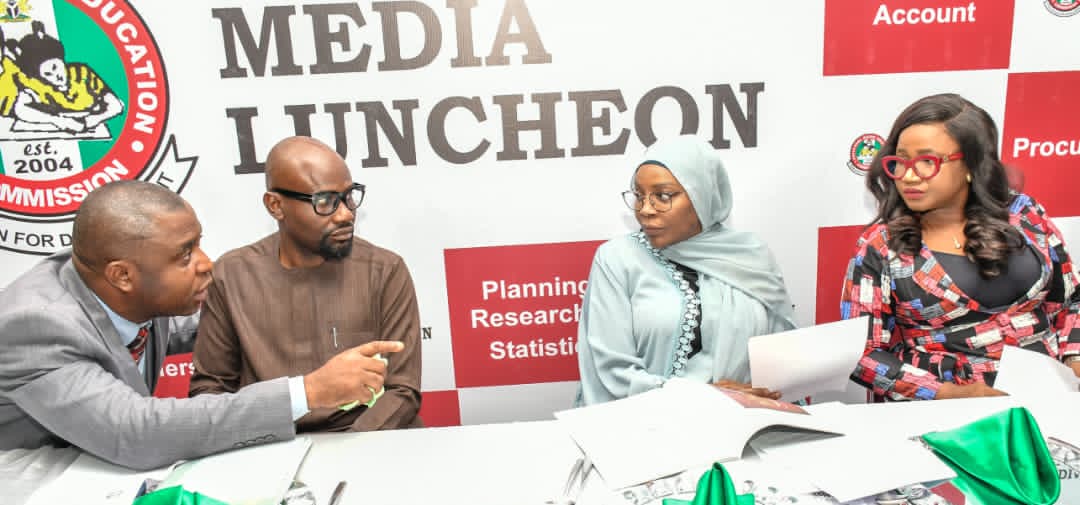
Speaking at a media luncheon with education correspondents in Abuja on Thursday, the Executive Secretary of UBEC, Dr Aisha Garba, said the Commission’s interventions are being driven by its 2025–2031 Strategic Blueprint, which aligns with the Federal Government’s Renewed Hope Agenda.
According to her, UBEC is focused on delivering measurable results through strategic investments in education.
“We are moving beyond reforms to delivering measurable results,” she said, highlighting key achievements recorded through collaboration with state governments and the Federal Capital Territory Administration.
Dr Garba revealed that the Commission has constructed more than 4,600 classrooms, renovated over 6,100 classrooms, provided 2,780 toilets, sunk 678 boreholes, and supplied more than 334,000 pieces of school furniture nationwide. She added that UBEC has also supported the establishment of over 2,300 Early Childhood Care Development and Education (ECCDE) Centres.
On teacher development, the UBEC boss said the Commission has invested over ₦20.4 billion in professional development programmes to improve teaching quality and school management.
She explained that the investment supports initiatives such as the Effective Schools Programme and the strengthening of School-Based Management Committees (SBMCs) to enhance classroom practice, school leadership, and accountability.
Dr Garba also outlined UBEC’s efforts to promote digital education, noting that the Commission is expanding Digital Literacy Centres, strengthening Smart Schools, and introducing training in artificial intelligence, coding, and robotics to prepare pupils for the future workforce.
She disclosed that more than 7.8 million instructional materials have been distributed nationwide to improve literacy, numeracy, and foundational learning outcomes.
Beyond infrastructure, the Executive Secretary said UBEC is broadening access to education through Open Schooling, integration of Qur’anic and Tsangaya education, as well as girl-child and inclusive education programmes.
She added that institutional reforms are also being implemented to improve transparency, project monitoring, and data-driven decision-making to ensure value for every investment in basic education.
In her goodwill message, the Chairman of the Nigeria Union of Journalists (NUJ), FCT Council, Comrade Grace Ike, described journalists as critical partners in promoting transparency, accountability, and public awareness in the education sector.
She called for sustained collaboration between UBEC and education correspondents through regular briefings, field visits, and capacity-building initiatives.
Grace Ike also advocated quarterly or biannual media briefings, training workshops on education data and child-friendly reporting, organised visits to UBEC-funded projects, collaborative public awareness campaigns, greater transparency in project implementation and procurement, investigative journalism grants, and effective feedback mechanisms.
She urged government, communities, teachers, development partners, and the media to work together to guarantee every Nigerian child access to safe, inclusive, and quality basic education.
“Together, we can ensure the story of every Nigerian child’s right to quality basic education is told with accuracy, context, and urgency,” she said.
Also speaking, Chairman of the Education Correspondents Association of Nigeria (ECAN), Chux Ukwuatu, appealed to UBEC to deepen engagement with education journalists by including selected correspondents in project inspection visits across the country.
He also requested improved logistical support for journalists covering the Commission’s activities, noting that firsthand access to projects would enable more balanced and comprehensive reporting.
“If journalists see projects on the ground, their stories will better reflect successes and gaps alike, informing the public, improving scrutiny, and ultimately strengthening programmes,” Ukwuatu said.
The meeting marked UBEC’s first major stakeholders’ engagement with education correspondents in over nine years, signalling a renewed commitment to transparency and collaboration.
The partnership has gained further momentum since the appointment of Mr Ikharo Attah as Special Adviser on Media and Communications to the Minister of Education. Under the leadership of Dr Aisha Garba, UBEC says it is determined to reposition basic education and improve access to quality learning for every Nigerian child.