
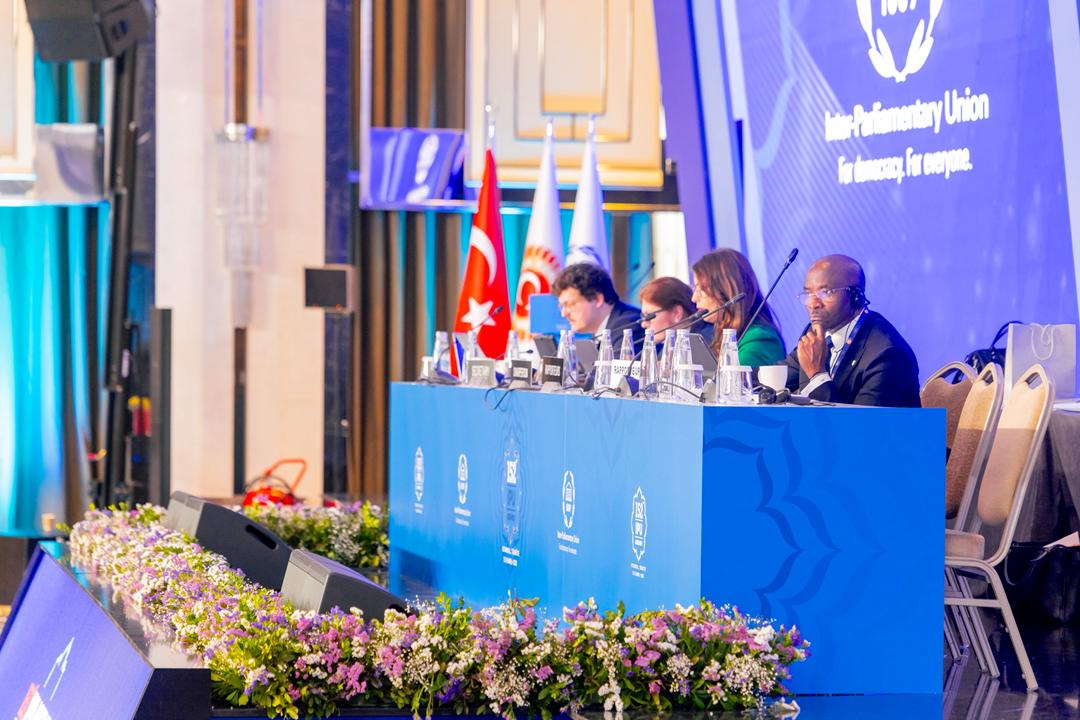
Nigeria’s Deputy Speaker of the House of Representatives, Benjamin Okezie Kalu, has spearheaded the adoption of a landmark global resolution on post-conflict recovery at the 152nd Assembly of the Inter-Parliamentary Union (IPU) in Istanbul, Turkey.
The resolution, titled “The Role of Parliaments in Establishing Robust Post-Conflict Management Mechanisms and Restoring a Just and Lasting Peace,” places national parliaments at the centre of global peacebuilding efforts, emphasizing inclusive governance, institutional strength, and sustainable recovery strategies.
Kalu, who served as co-rapporteur alongside Mr. A. Al-Zu’bi of Jordan and Ms. F. Belhirch of the Netherlands, presented the draft to the Assembly, earning broad international support for its adoption.
The newly adopted framework outlines five critical pillars for post-conflict recovery: strengthening institutions, equitable economic reconstruction, social reconciliation, inclusive political systems, and sustained international support. It underscores human security and common security as essential principles for achieving enduring peace.
Addressing delegates, Kalu stressed that post-conflict recovery must be nationally driven, urging parliaments to lead inclusive consultations and ensure that reconstruction strategies and legal reforms reflect domestic priorities. He also emphasized that external assistance should align with national frameworks and remain subject to democratic oversight.
The resolution calls on parliaments to give full legal backing to peace agreements by incorporating them into national legislation and establishing cross-party mechanisms to monitor implementation. It further encourages regular engagement with civil society groups, including women, youth, and affected communities, to ensure accountability and continuity.
A key feature of the framework is the promotion of transitional justice systems, including truth-seeking processes, victim-centred reparations, and transparent amnesty or vetting procedures. These measures, according to the resolution, are vital for addressing the legacies of conflict and fostering long-term stability.
Additionally, the document urges lawmakers to prioritise peacebuilding in national budgets, strengthen anti-corruption safeguards in recovery funds, and support reconciliation initiatives through inclusive dialogue and trauma-informed approaches.
It also advocates the full participation of women and youth in peace processes, in line with global commitments such as United Nations Security Council resolutions 1325 and 2250, and calls for stronger collaboration between parliaments, governments, regional bodies, the IPU, and the United Nations.
The resolution further proposed innovative financing mechanisms for reconstruction, including lawful utilisation of frozen or immobilised assets, while tasking the IPU with providing technical support, capacity-building, and mediation assistance to parliaments engaged in post-conflict recovery.
The adoption of the resolution marked a significant step in global efforts to institutionalise parliamentary leadership in peacebuilding, reinforcing the role of democratic governance in achieving just and lasting peace worldwide.