
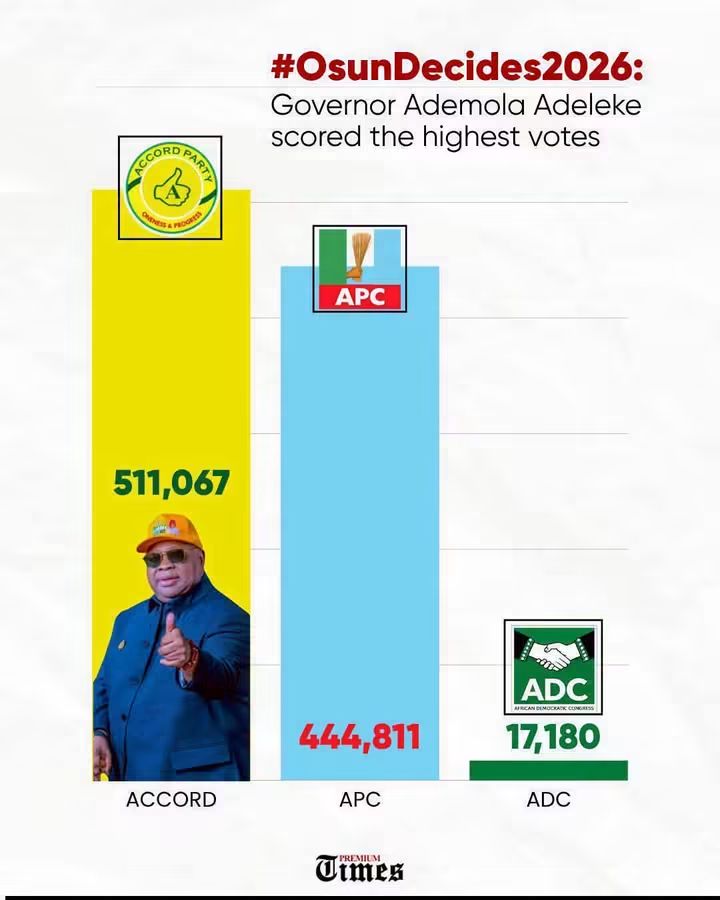
The Osun governorship election has been won and lost. Governor Ademola Adeleke of the Accord Party has been declared re elected with 511,067 votes, defeating our candidate, Bola Oyebamiji, who received 444,815 votes. That margin is substantial enough to demand honest reflection, not excuses, blame shifting or the familiar ritual of assembling another committee whose report may never change how we campaign.
As painful as the outcome is for members of our party, particularly those who invested their time, resources and emotions in the campaign, democracy requires that we respect the decision of the electorate. I congratulate Governor Adeleke and the people of Osun State. I also commend our candidate, our members, agents and volunteers who worked for the APC under difficult circumstances.
But congratulations must not become a substitute for introspection. There are bitter truths our party must confront before the 2027 general election.
In my considered view, three personalities emerged as the defining figures of this election.
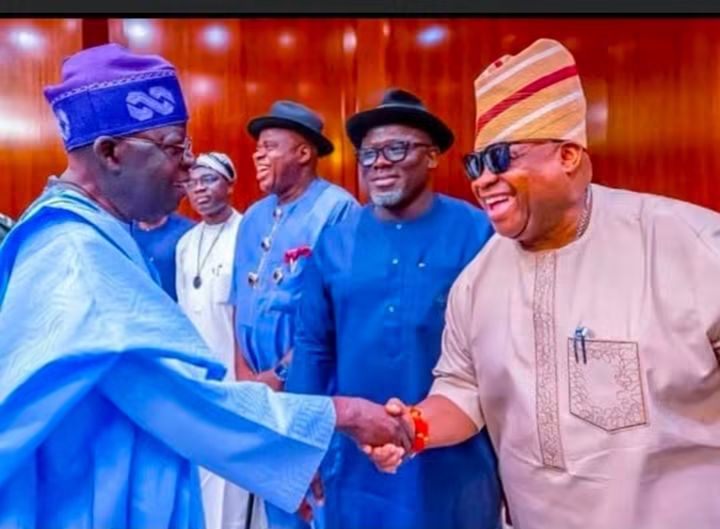
The first is President Bola Ahmed Tinubu.
President Tinubu deserves commendation for allowing the people of Osun to make their choice without turning the enormous powers of the Presidency into partisan weapons. A President determined to capture Osun at all costs had many levers available to him. State institutions could have been weaponised, security forces could have overwhelmed the atmosphere, and federal might could have been deployed in a manner that distorted the contest.
That did not happen.
This restraint is consistent with the President’s conduct in other off cycle elections under his administration, including Anambra and Bayelsa, where opposition parties retained power. President Tinubu has demonstrated that his commitment to democracy is not limited to elections that favour the APC. That is statesmanship, and it should be acknowledged even when the result is painful for our party.
President Tinubu may have lost Osun for the APC, but he won something larger for Nigeria: another opportunity to demonstrate that the vote of the Nigerian people must matter.
The second defining figure is Governor Ademola Adeleke.
For years, some members of the political elite have reduced Governor Adeleke to his dancing. That assessment has always underestimated both the man and the nature of Osun politics. Osun is deeply rooted in its communities, traditions, faith and local culture. Its politics cannot be understood solely through elite conversations, social media commentary or the calculations of Abuja.
Governor Adeleke’s dancing was never a weakness. It was a political language. It humanised him, made him accessible, and created emotional proximity with ordinary voters. His singing, dancing, accessibility and public worship built a bond that many technocratic analyses failed to capture.
Chief Bisi Akande and Ogbeni Rauf Aregbesola also understood, in their own ways, the power of cultural identification. Aregbesola sang, spoke the language of the streets and built a political identity that resonated deeply with his base. Governor Nyesom Wike, in a different context, has also shown how performance, presence and cultural familiarity can become instruments of political communication.
Politics is not only policy. It is emotion, identity, presence and belonging. Governor Adeleke stayed close to his grassroots while some opponents dismissed the very traits that strengthened his connection with the people.
Our party must therefore stop confusing sophistication with electoral value. A candidate may dominate elite discourse and still fail to move a ward. Another may be mocked in elite spaces and still command overwhelming loyalty on the ground. Elections are not won by approval ratings in Abuja. They are won by understanding people as they are.
The third defining figure is David Adeleke, popularly known as Davido.
Davido did not treat his role as symbolic. He was placed at the centre of youth mobilisation and used his influence, networks, music, digital reach and personal credibility to connect the campaign to a generation. He brought artistes, influencers and young voices into the process. Alongside emerging political and professional actors such as Pelumi Olajengbesi, he helped give the campaign a youthful, energetic and culturally resonant face.
While the opposition deliberately activated its most recognisable young figures, our party largely relied on a structure dominated by governors, senators and former office holders. These leaders are important, but we must ask a hard question: how many young Nigerians do they genuinely inspire, mobilise or emotionally connect with?
Who are the Davidos in the APC?
Who are the young men and women within our movement who are willing to put their influence, creativity, reputation and networks visibly on the line for the party? And when we find them, do we empower them, or only remember them at election time?
I raise these questions from experience, not hindsight.
During the 2022 Osun governorship election, I travelled across communities and engaged stakeholders across divides. I met Alhaji Moshood Adeoti in Iwo, as well as other former party leaders who broke away, and worked through reconciliation efforts that were not optional but essential.
When an emergency meeting of the National Working Committee was convened during that campaign, the then National Women Leader, her deputy and I travelled to Abuja and returned immediately by our personally funded chartered flight to continue field operations. We spent weeks engaging stakeholders and mobilising communities.
On election day, I was in the situation room at the Government House. We received real time reports from agents across polling units. By midday, it was already clear from field intelligence that the contest was slipping away, driven by a combination of inducement reports, local tensions and structural weaknesses in mobilisation.
We did not lose 2022 because there was no effort. We lost because division, weak reconciliation and fragmented mobilisation overwhelmed that effort.
Four years later, some of those lessons remain unlearned.
I understand that some individuals had reportedly been working for months before this election. Yet the constitutionally recognised National Youth Wing was not meaningfully engaged. Even when I personally reached out and offered support, I was referred to an individual who was promised to call me. I reached out again but That call never came.
This is not about individuals. It is about an institutional culture that sidelines its own structures while relying on ad hoc arrangements during elections. No organisation that disregards its own constitutional organs can consistently win complex statewide contests.
It is also important to state a difficult but necessary truth: since the inauguration of the campaign council, the National Working Committee did not meet to formally review progress, assess strategy or recalibrate direction. In any serious political organisation, that absence of structured oversight is not a minor administrative gap. It is a strategic weakness.
The National Youth Wing should not be activated only to fill stadiums or sidelined for support groups. A Women’s Wing should not be reduced to decoration at rallies. These are political structures with constituencies that must be organised, engaged and deployed as part of a deliberate strategy.
Our rallies must also evolve.
In earlier cycles, the National Women Leader and National Youth Leader had defined roles in energising crowds and speaking directly to their constituencies at our rallies. Today, many rallies have become sequences of speeches by political elites, with little structured engagement of the constituencies that actually determine turnout and enthusiasm.
The people who understand the language, emotion and culture of the crowd are often absent from the centre of the programme.
At the Osun rally, even cultural figures such as King Wasiu Ayinde Marshal were reportedly confined largely to pre programme performances, while youth and women voices were not sufficiently integrated into the main political messaging. Local leaders who could have spoken directly to their communities in familiar idioms were not adequately elevated.
Leaders such as Senator Babajide Omoworare, Senator Iyiola Omisore, Honourable Ayo Omidiran, Mrs Titi Laoye Tomori and many others carry deep local political histories that cannot be replaced by visiting dignitaries. Campaigns must integrate labour leaders, community organisers, women mobilisers, youth coordinators and respected grassroots figures who actually move voters.
A rally is not a ceremony. It is a mobilisation tool.
Bringing governors and national figures from outside Osun may create optics, but elections are won by those who understand the streets, compounds, markets, campuses, motor parks, churches, mosques and communities. Local people must lead the local campaign and complemented by voices of national influencers who can also energise the base.
The deeper challenge remains internal division. No amount of campaign technology can compensate for a fractured political family. We cannot continue with a “to your tents, O Israel” approach and expect victory. Politics is addition. Sometimes it requires humility, accommodation and strategic reconciliation.
Our party has shown this pragmatism elsewhere (Akwa Ibom, Plateau etc) by absorbing opposition governors and expanding its coalition. Osun should not be an exception.
We should also be bold enough to open a sincere political conversation with Governor Adeleke. In politics, yesterday’s opponent is sometimes tomorrow’s ally. Osun’s history is full of such realignments.
We must also end the practice of assembling campaign councils weeks before elections and expecting miracles. A campaign council must be formed early, properly funded, given clear deliverables and held accountable. Anything less is theatre, not strategy.
As we look toward 2027, we must deliberately identify and empower our best young communicators, creatives, professionals, digital voices, campus leaders, community organisers and women mobilisers. They must be brought to the front, not kept in the background.
We must rebuild respect for party institutions. We must reconcile our internal divisions. We must replace ceremonial structures with working organisations. And we must stop mistaking elite presence for grassroots mobilisation.
President Tinubu gave us a democratic contest. Governor Adeleke understood his people. Davido understood his generation.
The question is whether the APC understands its own lesson.
This is not a call for blame. It is a call for renewal. Silence will not win 2027.
Osun has spoken.
The APC must now listen.
*Dr. Dayo Israel,is National Youth Leader, All Progressives Congress