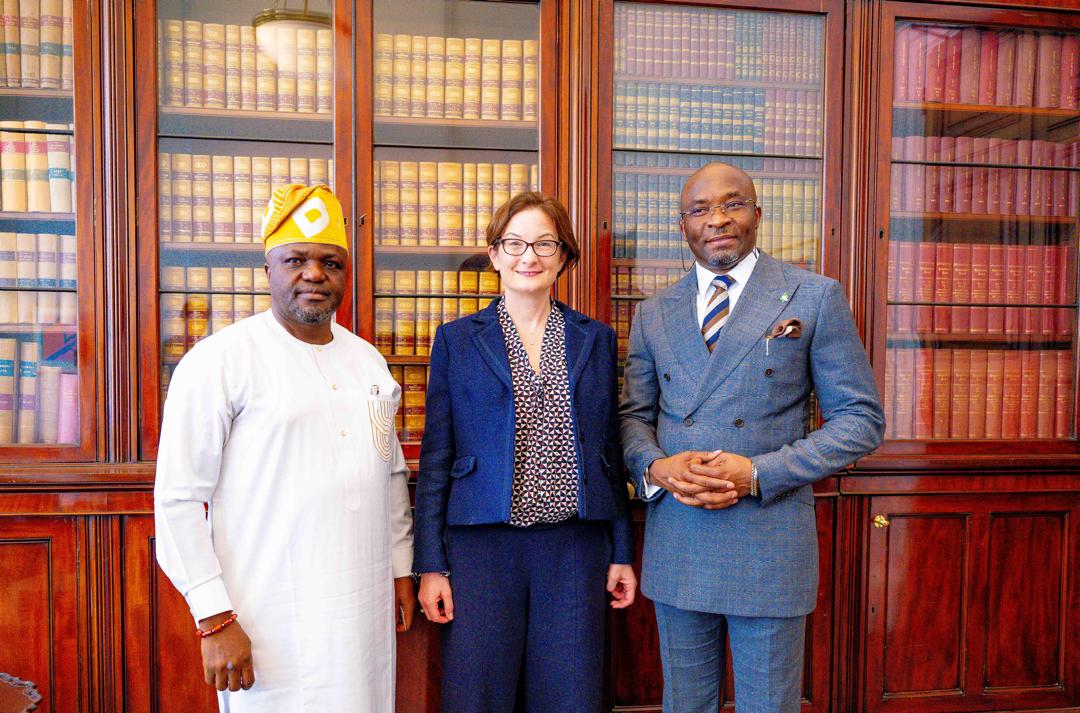
The Deputy Speaker of Nigeria’s House of Representatives, Benjamin Okezie Kalu, has called on the Foreign, Commonwealth & Development Office (FCDO) to sustain its technical support for democratic governance and electoral integrity in Nigeria as the country prepares for the 2027 general elections.
Kalu made the appeal during a meeting with senior FCDO officials led by Christina Scott in London on the sidelines of his engagement at Chatham House.
The Deputy Speaker expressed appreciation to the UK government for its longstanding partnership with Nigeria, particularly in strengthening democratic institutions, electoral processes, legislative capacity, civic participation, conflict prevention and peacebuilding through institutional partners such as the Policy and Advocacy Centre (PLAC).
He noted that Nigeria and the United Kingdom share longstanding historical ties, strong commercial relations and a common commitment to constitutional democracy, accountable governance and the rule of law.
According to Kalu, strong legislatures are essential for strong democracies, stressing that continued UK support for parliamentary capacity building, evidence-based policymaking, transparency, electoral reforms and citizen participation has helped deepen democratic governance in Nigeria.
As Chairman of the House Committee on Constitution Review, Kalu said sustained technical assistance, comparative learning and inclusive public consultations remain crucial to ongoing constitutional reforms aimed at addressing issues of inclusion, federalism, devolution of powers, local governance, security architecture and greater representation of women, youths and persons with disabilities.
He also highlighted recent electoral reforms inspired by lessons from the 2023 general elections, noting that the 2026 Electoral Act has strengthened Nigeria’s legal framework by giving statutory recognition to the Bimodal Voter Accreditation System (BVAS) and electronic transmission of election results. He added that the legislation also clarifies jurisdiction and timelines for pre-election litigation, reducing uncertainty in the electoral process.
Looking ahead to the 2027 general elections, the Deputy Speaker said the National Assembly is committed to ensuring that the legal and institutional framework for the polls is concluded early enough to facilitate voter education, procurement, training and public confidence.
“Our objective is clear: elections that are peaceful, transparent, inclusive, technology-enabled and reflective of the genuine will of the Nigerian people,” he said.
Kalu further stressed that Nigeria’s democratic stability extends beyond its borders, describing the country as a strategic pillar for regional peace and democratic resilience across West Africa.
“As Africa’s largest democracy and one of the continent’s largest economies, Nigeria’s stability has direct implications for regional peace, trade, migration, counterterrorism, democratic norms and collective prosperity,” he said.
He added that continued FCDO support should be viewed as an investment not only in Nigeria’s democratic future but also in regional peace, security and development.
Reaffirming Nigeria’s commitment to constitutionalism, peaceful political competition and the rule of law, Kalu expressed optimism for a stronger and more strategic partnership between the FCDO and the National Assembly to ensure Nigeria’s democratic institutions remain resilient, responsive and capable of delivering stability and prosperity for the nation and the African continent.