
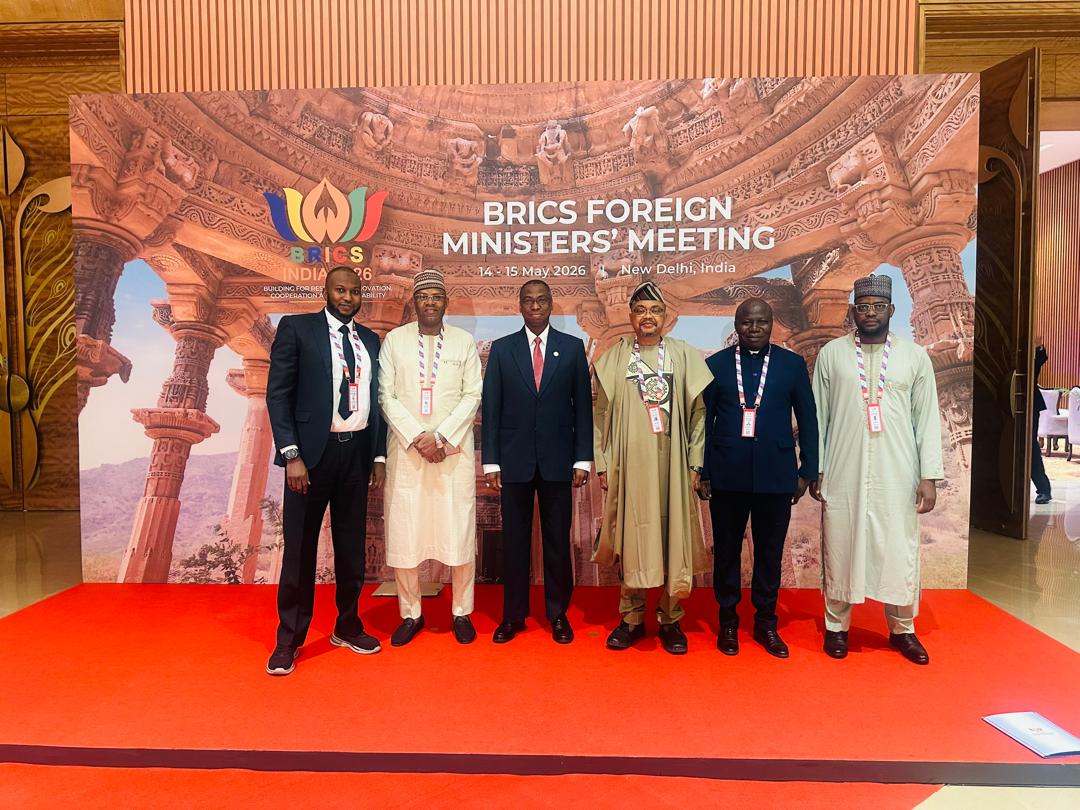
Nigeria has reaffirmed its commitment to resilience, innovation, cooperation and sustainability as key pillars for global development at the ongoing 18th BRICS Foreign Ministers’ Meeting in New Delhi, India.
The Ministry of Foreign Affairs disclosed this in a statement signed by its spokesperson, Kimiebi Imomotimi Ebienfa, noting that the Permanent Secretary of the Ministry, Dunoma Umar Ahmed, is representing the Honourable Minister of Foreign Affairs, Ambassador Bianca Odumegwu-Ojukwu, at the meeting holding on May 14 and 15, 2026, at Bharat Mandapam in New Delhi.
Delivering Nigeria’s national statement at the meeting themed “BRICS at 20: Building for Resilience, Innovation, Cooperation and Sustainability,” Ahmed expressed appreciation to the Government and people of India for hosting the meeting and described Nigeria’s participation as an important opportunity to reaffirm collective commitment to shared growth and sustainable development.
The meeting is chaired by S. Jaishankar and is focused on discussions around economic cooperation, global governance and regional conflicts ahead of the 18th BRICS Summit scheduled for later this year.
Ahmed stated that resilience remained central to Nigeria’s development strategy despite global economic challenges, energy market fluctuations and security concerns. He noted that the country has continued to pursue economic diversification through reforms aimed at strengthening agriculture, manufacturing and services, while also prioritising food security, energy access and inclusive growth.
He further highlighted Nigeria’s leadership role within Economic Community of West African States (ECOWAS), particularly in peacekeeping, mediation and regional security initiatives.
On innovation, Ahmed said Nigeria’s growing technology ecosystem has produced globally recognised fintech solutions, renewable energy innovations and digital platforms driving financial inclusion and youth empowerment.
He cited initiatives such as the Digital Literacy for All (DL4ALL) programme, the 3 Million Technical Talent (3MTT) scheme and the establishment of innovation hubs across the country as part of efforts to achieve 70 per cent digital literacy by 2027 and 95 per cent by 2030.
The Permanent Secretary stressed that cooperation remains the foundation of Nigeria’s foreign policy, noted that the country continues to champion regional integration, free movement, trade harmonisation and collective security within ECOWAS.
At the global level, he said Nigeria sees BRICS as an important platform for dialogue and collaboration among emerging economies and developing nations.
Ahmed also reaffirmed Nigeria’s commitment to sustainability, revealing that the country’s Energy Transition Plan targets net-zero emissions by 2060 through investments in renewable energy, green finance and sustainable agriculture.
He reiterated Nigeria’s support for the Paris Agreement and the United Nations Sustainable Development Goals, while calling on BRICS nations to deepen collaboration on climate resilience and green innovation.
Speaking on Nigeria’s role within BRICS, Ahmed said the country is determined to amplify the voice of Africa and the Global South through stronger South-South cooperation based on inclusion, solidarity, mutual respect and shared development.
He added that the reform agenda of President Bola Ahmed Tinubu’s administration, including economic diversification, fiscal discipline and energy transition policies, aligned with Nigeria’s commitment to working closely with BRICS partners toward global prosperity and peace.