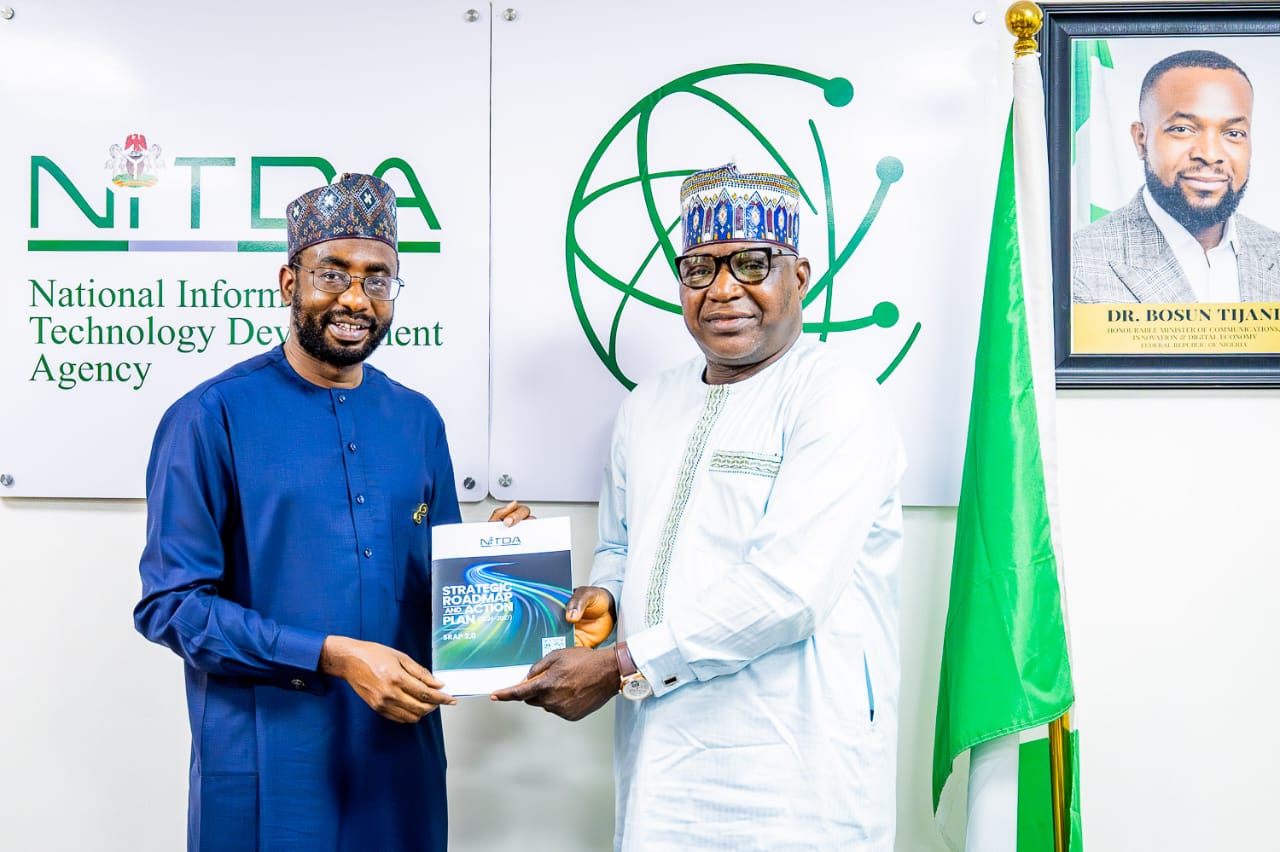
The Director General of the National Information Technology Development Agency, Kashifu Inuwa, has reaffirmed the agency’s commitment to strengthening collaboration with the Federal Ministry of Communications, Innovation and Digital Economy to accelerate Nigeria’s digital transformation and improve policy coordination across the sector.
Inuwa stated this during a courtesy visit by the Permanent Secretary of the Ministry, Nadungu Gagare, to the NITDA headquarters, where both institutions reiterated their commitment to advancing Nigeria’s digital economy through stronger institutional synergy.
According to the NITDA boss, sustained collaboration between the Ministry and its agencies remains critical to achieving the Federal Government’s digital economy objectives. He noted that previous engagements with the Ministry, including a familiarisation visit, had strengthened strategic alignment and improved coordination on key national initiatives.
Inuwa identified the development of a national sovereign cloud infrastructure and a comprehensive cybersecurity policy framework as some of the critical areas requiring continued collaboration and policy direction from the Ministry.
“We are awaiting the Ministry’s guidance on how to move forward, particularly on the national cloud and cybersecurity policies,” he said.
He also stressed the importance of maintaining clear institutional boundaries and mutual respect among agencies to enhance operational efficiency and inter-agency cooperation.
The NITDA Director General further disclosed that the agency pioneered the implementation of the Performance Management System (PMS) years before its adoption across the Federal Civil Service, noting that the framework had improved accountability and measurable performance within the organisation.
“We started PMS about four years ago. What we have now at the national level actually originated from our internal reforms,” he stated.
Inuwa explained that initiatives such as Project NEXT have helped redefine organisational culture at NITDA by promoting accountability, innovation, and performance-driven leadership.
He added that the agency has evolved from a traditional regulatory institution into a dynamic ecosystem enabler focused on innovation, inclusion, and national development.
“We are building a high-velocity organisation one that is agile, inclusive, and driven by innovation,” he said.
In his remarks, Gagare reaffirmed the Ministry’s commitment to strengthening collaboration with agencies under its supervision, describing partnership as essential to achieving meaningful progress in Nigeria’s digital transformation journey.
“If there is no partnership, there is nothing that can be achieved. But with partnership and collaboration, a lot can be accomplished,” he said.
The Permanent Secretary explained that the visit formed part of the Ministry’s ongoing engagements with agencies to improve policy coordination, monitor progress, and address operational challenges requiring higher-level intervention.
He commended NITDA’s management and staff for their contributions to digital literacy, innovation, cybersecurity awareness, and support for startups and young innovators across the country.
“NITDA has continued to play a pivotal role in shaping Nigeria’s digital future through the promotion of information technology development, digital literacy, innovation, and regulatory standards,” Gagare noted.
He also underscored the importance of policy coherence among agencies within the Ministry, stressing that institutional mandates are interconnected and must be implemented seamlessly to achieve national objectives.
The Permanent Secretary further highlighted ongoing Federal Civil Service reforms, particularly the adoption of the Performance Management System, which he said promotes accountability, target-setting, and measurable outcomes in public service delivery.
The visit underscored the shared commitment of both FMCIDE and NITDA to advancing Nigeria’s digital economy through innovation, effective governance, and stronger institutional collaboration aimed at delivering inclusive growth and sustainable national development.