

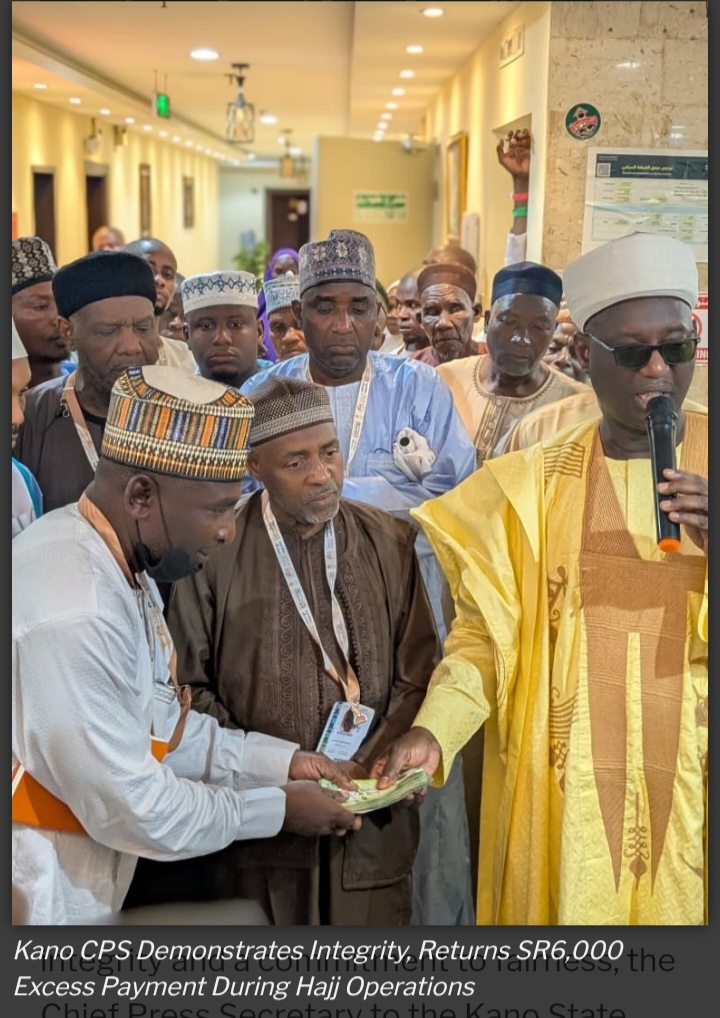
In a country where stories of public officials enriching themselves at the expense of the people often dominate the headlines, acts of honesty have become so rare that they immediately capture public attention. Yet, every now and then, an individual emerges to remind us that integrity is still alive in public service. Such was the case when the Chief Press Secretary to Governor Abba Kabir Yusuf of Kano State, Malam Mustapha Muhammad, returned an excess payment of SR6,000, about N2.4 million that was mistakenly paid to him during the distribution of allowances for journalists covering the 2026 Hajj pilgrimage in Saudi Arabia.
The story itself is simple. An administrative error resulted in Mustapha receiving more money than he was entitled to. Many people might have overlooked the mistake or convinced themselves that it was not their responsibility to correct it. But Mustapha chose a different path. Upon discovering the error, he immediately returned the money so that the records could be corrected and other beneficiaries could receive what was rightfully theirs.
What makes the gesture noteworthy is not merely the amount involved but the principle behind it. At a time when society is desperately searching for examples of ethical leadership, Mustapha demonstrated that public trust is built through everyday decisions. He understood that the money was not his and that keeping it would deny others their legitimate entitlements. His decision reflected a deep sense of responsibility and respect for public trust.
For those who know him personally, however, the action came as no surprise. As someone who has known Mustapha Muhammad since our university days, I can testify that honesty has always been one of his defining qualities. He was hardworking, disciplined, and deeply committed to doing things the right way. Even in the simplest situations, he had little tolerance for cheating or cutting corners. During examinations and academic activities, he believed strongly that success should be earned through effort rather than manipulation. While many students sought shortcuts, Mustapha remained steadfast in his conviction that integrity was worth more than any temporary advantage. Looking back today, it is clear that the values he displayed as a student are the same values guiding his conduct in public office.
My experience is unlikely to be unique. I strongly believe that many of those who worked closely with Mustapha Muhammad during his professional journey, including his time with the BBC and Bloomberg as an international journalist, would have similar stories to tell about his character. Integrity is often most visible not in public ceremonies but in daily interactions, professional conduct and the choices people make when faced with ethical dilemmas. Those who shared newsrooms, assignments and deadlines with him would probably attest to the same qualities of honesty, professionalism, fairness and accountability that have now been publicly demonstrated during the Hajj operation. Such consistency across different stages of life and career is what distinguishes genuine character from occasional acts of virtue.
Character, after all, is not built overnight. It is cultivated over years through consistent choices and adherence to principles. The decision to return SR6,000 in Saudi Arabia was not an extraordinary departure from Mustapha’s character; it was a continuation of the uprightness that those who have known him for years have always recognized.
His action also carries an important lesson for public officials across Nigeria. Every day, individuals entrusted with public responsibilities face decisions that test their integrity. Some involve millions of naira; others involve much less. Yet the true measure of honesty is not determined by the amount at stake but by the willingness to do what is right even when nobody is watching. Public office is a trust, and that trust can only be preserved when officials place ethics above personal gain.
The commendation from the Amirul Hajj and Emir of Gaya, Dr. Aliyu Ibrahim Abdulkadir, was therefore both appropriate and deserved. By describing the gesture as an example of fairness, integrity and responsibility, the Emir captured what many observers felt. More importantly, he highlighted the significance of celebrating public servants who choose honesty when they could easily have chosen otherwise.
Beyond commendation, however, this moment presents an opportunity for Governor Abba Kabir Yusuf. Every administration seeks to promote accountability, transparency and good governance. But values become meaningful only when they are rewarded and institutionalized. Governor Yusuf has consistently projected an image of a people-oriented administration committed to reform. Recognizing Mustapha Muhammad’s conduct would reinforce that commitment and send a powerful message throughout the public service.
Such recognition need not necessarily be monetary. A formal commendation, an award for integrity, or a public acknowledgment would be enough to demonstrate that honesty is valued within the administration. More importantly, it would encourage other public servants to emulate similar conduct. When ethical behaviour is celebrated, it inspires others to uphold the same standards.
Indeed, governments often focus on punishing wrongdoing, which is necessary. But rewarding integrity is equally important. Recognition creates role models, strengthens institutional values and helps build a culture where honesty becomes the norm rather than the exception. Public servants who see integrity rewarded are more likely to resist temptations and uphold the principles expected of them.
Ultimately, this story is not about SR6,000 or N2.4 million. It is about character. It is about choosing conscience over convenience. It is about demonstrating that integrity remains possible in public life. In returning money that was never his, Mustapha Muhammad has offered a powerful lesson in leadership and accountability.
At a time when many Nigerians are yearning for public officials they can trust, his action stands as a reminder that good governance begins with personal integrity. Kano State should celebrate this example and Governor Abba Kabir Yusuf should seize the moment to recognize and encourage such conduct. For when honesty is rewarded, society benefits; when integrity is celebrated, institutions grow stronger; and when public servants like Mustapha Muhammad are acknowledged, a standard is set for others to follow.
*Abdulkarim Ibrahim is Director of Planning, Research and Statistics, Office of the Head of Civil Service, Kano State
Monday June 1, 2026