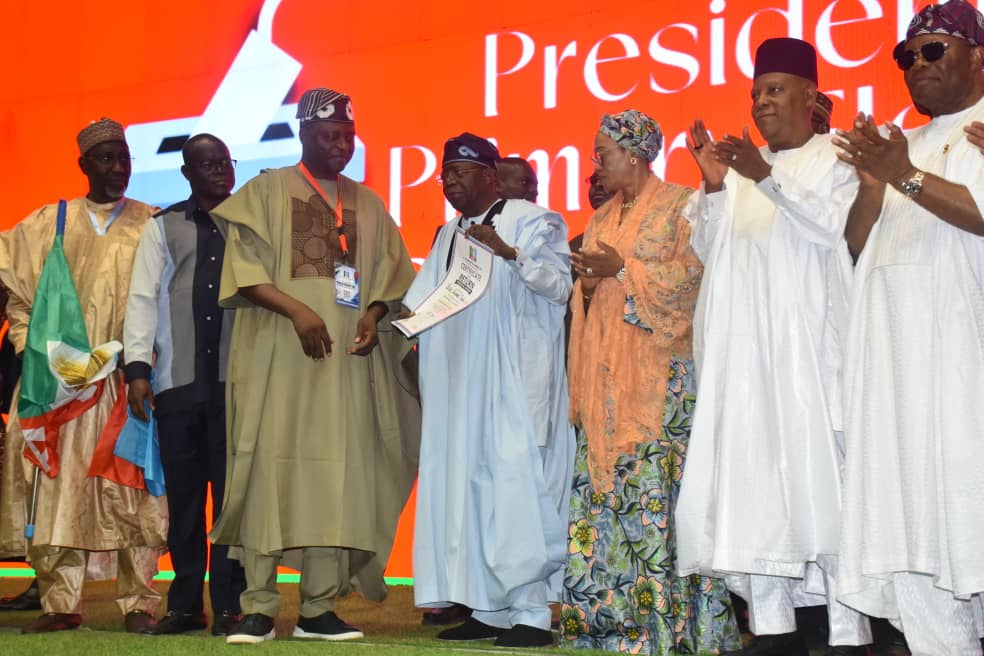
President Bola Ahmed Tinubu has formally accepted his nomination as the presidential candidate of the All Progressives Congress for the 2027 general election, pledging to deepen ongoing reforms and place Nigeria on what he described as an “irreversible path” of economic growth and national development.
Speaking on Sunday at the Bola Ahmed Tinubu International Conference Centre in Abuja, the President said his administration had laid the foundation for a more stable economy and stronger democratic institutions, while acknowledging that many Nigerians still face economic hardship and insecurity.
Tinubu said the 2027 election should serve as “a reaffirmation of Nigeria’s democratic maturity” rather than merely a contest among political parties.
Reflecting on his emergence as the APC candidate in 2022 and eventual victory in the 2023 presidential election, the President expressed gratitude to party leaders, governors, members of the National Assembly, and supporters across the country for their continued confidence in his leadership.
He also paid tribute to his predecessor, former President Muhammadu Buhari, recalling how he sat beside him at Eagle Square during the APC presidential primary in 2022 before emerging as the party’s flagbearer.
According to Tinubu, the political and economic landscape has significantly changed since he assumed office, with electoral reforms strengthening the democratic process and new fiscal policies improving government revenue generation.
He credited his administration with implementing major economic and structural reforms, including the removal of fuel subsidies, exchange rate reforms, and improvements in revenue generation and fiscal management.
According to him, the government has also made significant progress in the education and power sectors. Tinubu disclosed that more than N282 billion had been disbursed through the Nigerian Education Loan Fund, benefiting over 1.5 million students nationwide.
On electricity, the President said the administration had supplied 2.5 million electricity meters under the Presidential Metering Initiative and introduced a N4 trillion bond programme to offset verified debts owed to power generation and gas companies. He added that electricity generation had at times peaked at 6,000 megawatts during his administration.
Tinubu further highlighted ongoing investments in roads, transportation, housing, digital connectivity, seaports, and airports, noting that the government was constructing durable superhighways, including the coastal highway and Sokoto-Badagry road project.
He said the administration had also prioritised infrastructure and industrial development to stimulate inclusive growth and improve the ease of doing business across the country.
The President pointed to reforms in the oil and gas sector, saying Nigeria was now attracting billions of dollars in fresh investments after years of stagnation in the industry.
He further stated that social investment and human capital development programmes introduced by the government were targeted at vulnerable households, youths, women, and small businesses.
Tinubu stressed the need for national unity, citing the country’s revived national anthem as a reminder of the importance of togetherness despite ethnic and religious differences.
“Though tribe and tongue may differ, in brotherhood we stand,” he quoted from the anthem, urging Nigerians to resist divisive tendencies and work collectively for national progress.
Despite the administration’s achievements, Tinubu admitted that many Nigerians were still struggling with inflation and rising living costs, which he partly linked to global geopolitical tensions and the war in Iran.
“We do not dismiss these concerns; we understand them and govern not in comfort, but in reality—with honesty and action,” he said.
On insecurity, the President assured Nigerians that his government remained committed to protecting lives and property, stating that investments had been made in intelligence gathering, surveillance, and modern security equipment.
He also urged the National Assembly to amend the Constitution to allow the establishment of state police, describing it as a matter of national emergency.
“We will not rest until we restore peace and stability to every corner of our country,” Tinubu declared.
The President said the achievements recorded by the APC-led administration since 2015 and the progress made under his government in the last three years should inspire confidence among Nigerians ahead of the next election cycle.
He maintained that the work of rebuilding the country was still ongoing and required continuity, discipline, and cooperation among citizens.
“With another four years of disciplined focus and national cooperation, we will firmly place Nigeria on an irreversible path of economic expansion, industrialisation, energy security, infrastructure development, food sufficiency, and democratic consolidation,” he said.
Tinubu also extended an olive branch to political opponents, saying differing political opinions should not prevent collaboration in nation-building.
“To those who may disagree with us politically, we extend a hand of partnership in nation-building,” he stated.
The President warned against complacency and cautioned Nigerians against entrusting the country to politicians without what he described as a clear alternative vision for national development.
He pledged to build a more inclusive government if re-elected and promised to continue listening and responding to the needs of Nigerians.
Tinubu concluded his speech by expressing confidence in Nigeria’s future and praying for the continued growth of democracy in the country.
“Together, and with the help of God Almighty, we shall build a more secure, united, and prosperous Nigeria for generations to come,” he said.