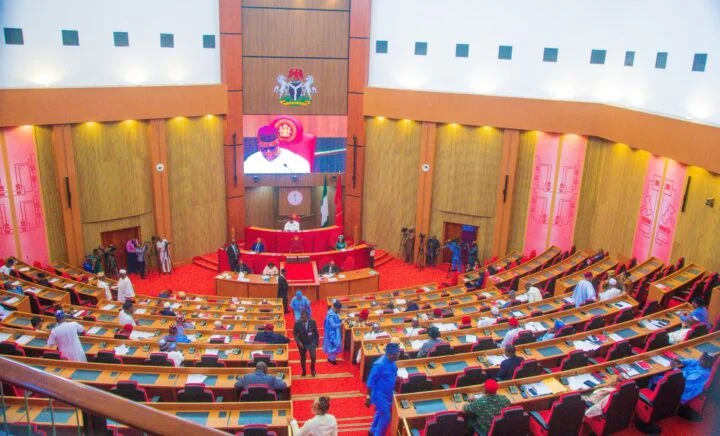
The Senate on Wednesday commenced debate on a landmark constitutional amendment bill seeking to establish State Police Services across Nigeria, in what is being described as one of the most significant security reforms since the return to democracy.
Leading the debate on the Constitution of the Federal Republic of Nigeria (Alteration) (State Police) Bill, 2026, the Senate Leader, Michael Opeyemi Bamidele, said the proposed legislation was an Executive Bill transmitted by President and Commander-in-Chief of the Armed Forces, Bola Ahmed Tinubu aimed at decentralising policing while preserving national security coordination.
Bamidele noted that the current centrally controlled policing structure, established under the 1999 Constitution, has come under increasing strain due to Nigeria’s diverse security challenges, including terrorism, banditry, kidnapping, communal conflicts, cybercrime and organised criminal activities.
According to him, the bill seeks to create a constitutional framework that will allow states to establish and operate their own police services while retaining a strong Federal Police Service to handle national security responsibilities.
He explained that the proposed legislation would maintain a Federal Police Service responsible for protecting federal institutions, policing the Federal Capital Territory, combating terrorism, organised crime, cybercrime, arms trafficking and other inter-state security threats.
Under the proposal, states that choose to establish police services would do so through legislation passed by their respective Houses of Assembly. However, no State Police Service would commence operations without certification that it meets national minimum standards prescribed by the National Assembly.
Bamidele said the bill clearly defines the responsibilities of state police to include enforcement of state laws, maintenance of public order, crime prevention and detection, and protection of lives and property within their jurisdictions.
Addressing concerns about potential abuse of state police by governors, the Senate Leader said the bill contains robust constitutional safeguards prohibiting the use of police powers for partisan, ethnic, religious, sectional or personal interests.
The legislation also proposes the establishment of independent State Police Service Commissions to oversee recruitment, promotion, discipline and accountability, while empowering the National Assembly to set minimum standards on training, recruitment, use of force, firearms management and professional conduct.
The bill further provides for federal intervention in exceptional circumstances such as breakdown of public order, serious human rights violations, electoral intimidation or threats to national security. Such intervention, Bamidele said, must be authorised in writing by the President, subjected to Senate oversight and remain open to judicial review.
Highlighting the benefits of the proposed reform, he said state policing would strengthen community-based intelligence gathering, improve response times to security threats, reduce pressure on federal security agencies and deepen Nigeria’s federal system of government.
Describing the proposal as a constitutional response to Nigeria’s evolving security realities, Bamidele urged lawmakers to support the bill and allow it to proceed to the next stage of legislative consideration.
The State Police Bill is expected to generate extensive debate among lawmakers and stakeholders as the National Assembly continues deliberations on constitutional reforms aimed at strengthening governance and security across the federation.