
In a world where it is considered more altruistic, fitting and popular for women to project feminism, where patriarchy has been accused of most crimes against women, and where patrilineal perspectives are seen as organically conferred with advantages, a young woman, Ameh Odachi, in addition to her conscious fight for women to have their fair share of the world, chose to call special attention to the circumstances of men.
With alluring candour and thirst, she tells everyone to behold the world of men differently – the burden of silence, the struggles, the socially constructed expectations, the crucibles they carry and all those responsibilities hanging on their heads like a Damoclean Sword.
Trained as a Building Construction Technologist at Ahmadu Bello University, Zaria, Ameh became a procurement specialist but none of that draws her passion like men’s wellbeing advocacy, exploration of masculinity, identity and social impact through the instrumentality of contemporary visual art.
Ameh is an artist of immense intellection, vision, grit, courage, and ecumenism because she is so Nigeriana in her paintings – from ‘Odogwu’, to ‘Baba Mutun’, to ‘Omoluabi’, to ‘Jagun Jagun’, and so on, she demonstrates the resilience of men in curations that are distinctive and profound.
In “Decolonizing Nigeria, 1945-1960: Politics, Power, and Personalities”, Toyin Falola and Bola Dauda contextualised events that shaped Obafemi Awolowo’s life, politics and existentialism, referring to the sage’s deprivations, life in orphanage, how he had to attend six different schools to complete primary school because his father died of smallpox and how those circumstances and more that ordinarily amounted to misfortunes defined the character of the nationalist on the objectives to be pursued in life, like free education, among other issues that became cardinal policies of his statesmanship. Falola and his colleague called Awolowo’s circumstance a ‘projected identity’. To some people, Ameh projects a curious identity which history and circumstances foist on her.
Earlier, in “The Eighteenth Brumaire of Louis Bonaparte”, Karl Marx reckoned that “Men make their own history, but they do not make it as they please; they do not make it under circumstances chosen by themselves, but under circumstances directly found, and given and transmitted from the past.” Here, Ameh connects historically and circumstancially.
Ever since she lost a friend in 2023 and fully aware of the factors leading to his death, she seizes the occasion of annual International Men’s Day to call attention to the circumstances surrounding men’s existence and made it an advocacy issue through art exhibitions to project men’s issues to the front burner of social discourse. The vehicle of her entrepreneurship is LoogiiArtractors, where she is Creative Director.
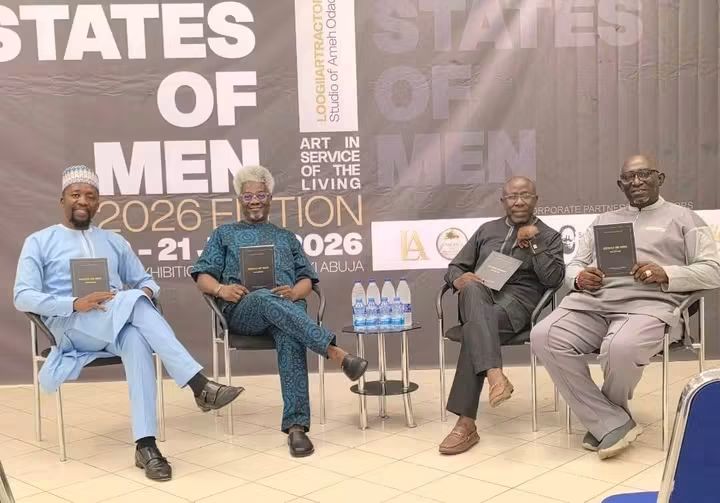
Last year, on Men’s Day, Ameh’s exhibition, titled, “Men, Mask and Meaning”, took place from 19-21 November 2025. This year, the title of her exhibition is “States of Men” and it is ongoing at the Exhibition Pavilion near the International Conference Centre, Abuja.
Ameh constructed a taxonomy by which the circumstances of men should be interpreted – Mental Health, Physical Health, Healthy Masculinity, Employability, Education – including educating men about women, Fatherhood and Family, and the Economic Policies that Affect Men.
A data-driven entrepreneurship, Ameh’s advocacy is underpinned by studies. Besides surveys and other scholastic enquiries, her inquisitorial mind also caused her to ask questions, and her findings are damning: “too many men are carrying what they have never been taught to put down.”
Ameh’s world resonates with that of Precious Eniayekan, founder of Boycode Africa, a platform she uses to organise activities that empower underprivileged youths and arming the male child with essential skills in leadership and technology. Eniayekan consciously seeks underrepresented and marginalised people, especially boys, ensuring they have access to resources of knowledge about coding, design, cybersecurity skills, emotional intelligence and workplace skills. “While we uplifted girls, boys were quietly breaking, dropping out, joining crime, struggling emotionally, and becoming unprepared future men”, says Eniayekan, concluding that Boycode is not a competition but a complement.
Let me conclude by instantiating how consequential Odachi and Eniayekan’s works are in maintaining the social equilibrium. If you lived in a neighbourhood and left to live in other places, possibly out of your country, and you returned to the neighbourhood years later to find most of your childhood mates who are girls are pregnant or are already nursing mothers as teens, would you consider that reality a woman’s challenge or a social problem jointly created by men and women? So, while we have a duty to tell our daughters to avoid getting pregnant inappropriately, we need to tell the boys not get any girl pregnant improperly. Our future requires both civil men and women, so we all must be interested in the States of Men.
HAPPY FATHER’S DAY!