
The Federal Government has reaffirmed its unwavering commitment to eliminating lead poisoning in Nigeria and protecting the nation’s children from the devastating effects of lead exposure.
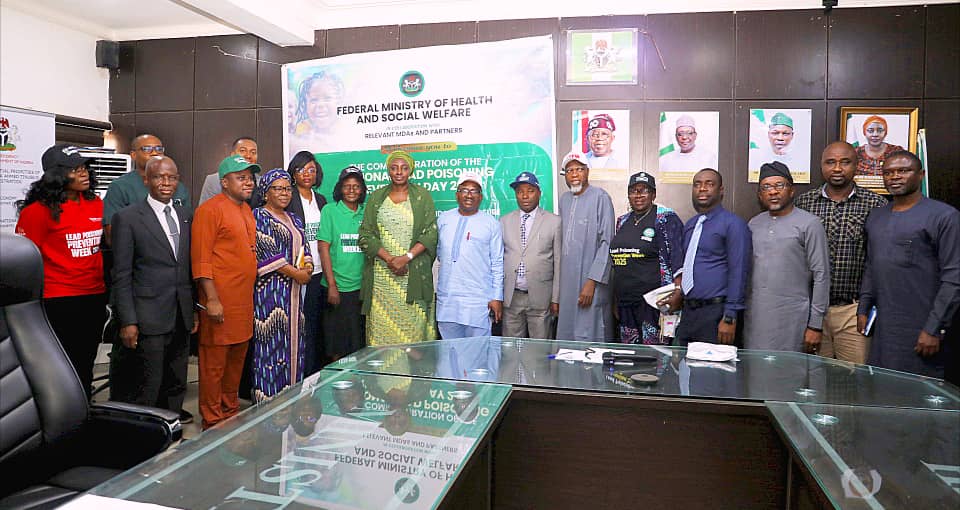
The Coordinating Minister of Health and Social Welfare, Prof. Muhammad Ali Pate, made this known in Abuja during the Ministerial Press Briefing to commemorate the 2025 National Lead Poisoning Elimination Day, with the theme “No Safe Level: Act Now to End Lead Exposure.”
The Minister, who was represented by the Permanent Secretary, Federal Ministry of Health and Social Welfare, Daju Kachollom said the commemoration marks a renewed national resolve to safeguard the health of Nigerians especially children from what he described as “a silent but deadly public health emergency.”
“Lead poisoning is not merely an environmental issue; it is a serious public health emergency that undermines human capital development. Lead is a potent neurotoxin that damages the brain and nervous system, reduces IQ, and contributes to hypertension, kidney failure, and reproductive health problems. There is no safe level of lead exposure and the youngest among us are the most vulnerable,” the Minister stated.
He recalled that Nigeria had experienced several tragic incidents of mass lead poisoning in Zamfara (2010), Niger (2015), and Sokoto (recently), which claimed hundreds of young lives. These, he said, serve as painful reminders of the urgent need for prevention and sustained vigilance.
According to him, the Ministry, in collaboration with sister Ministries, Departments and Agencies (MDAs) and development partners, has taken decisive steps to eliminate lead exposure through a National Lead Elimination Policy and a Five-Year Strategic Plan. The framework, he noted, coordinates prevention, detection, and response across key sectors, including Health, Environment, Mines and Steel Development, Agriculture, and Water Resources.
He disclosed that in September 2025, he inaugurated the National Inter-Agency Working Group on Lead Poisoning Elimination, which is tasked with strengthening surveillance, reviewing regulations, and mobilizing sustainable financing to end lead exposure nationwide.
Prof. Pate further stated that with support from Médecins Sans Frontières (MSF), the government has expanded blood lead testing capacity in high-risk states, provided treatment to affected children, and intensified public sensitization campaigns.
“Our teams have conducted community sensitization and health education outreaches, promoting simple preventive measures such as handwashing, safe water use, and dust control to minimize household lead exposure,” he added.
He explained that going forward, government’s focus will be on formally launching the National Lead Elimination Policy and Strategic Plan with clear funding frameworks; expanding diagnostic and laboratory networks nationwide; strengthening surveillance among vulnerable groups, especially children and pregnant women; ensuring access to treatment through the procurement and distribution of chelating agents; enhancing enforcement of regulations to reduce lead content in paints, food, water, and consumer products; and sustaining public education to raise awareness of the dangers of lead exposure.
Prof. Pate reaffirmed the Federal Government’s commitment to ending lead poisoning in line with global efforts under the World Health Organization (WHO) and United Nations Environment Programme (UNEP).
“Together, let us act with urgency and unity to create a safer, healthier Nigeria one where every child can live, learn, and grow free from the dangers of lead exposure, because indeed, there is no safe level of lead exposure,” he concluded.
Earlier in her welcome address, the Director, Public Health Department, Federal Ministry of Health and Social Welfare, welcomed participants to the event, described lead poisoning as one of the “most preventable yet under-recognized public health challenges in the world.”
She commended partners and stakeholders for their collaboration and reaffirmed the Ministry’s commitment to evidence-based policies, multi-sectoral coordination, and strong community engagement aimed at eliminating lead exposure in Nigeria.
“Every action—from enforcing environmental standards to educating families—counts towards protecting the health of our people and the future of our nation,” she added.
The event brought together development partners, government officials, public health experts, and media representatives who collectively pledged to support Nigeria’s journey toward a lead-free environment.
Share via: