
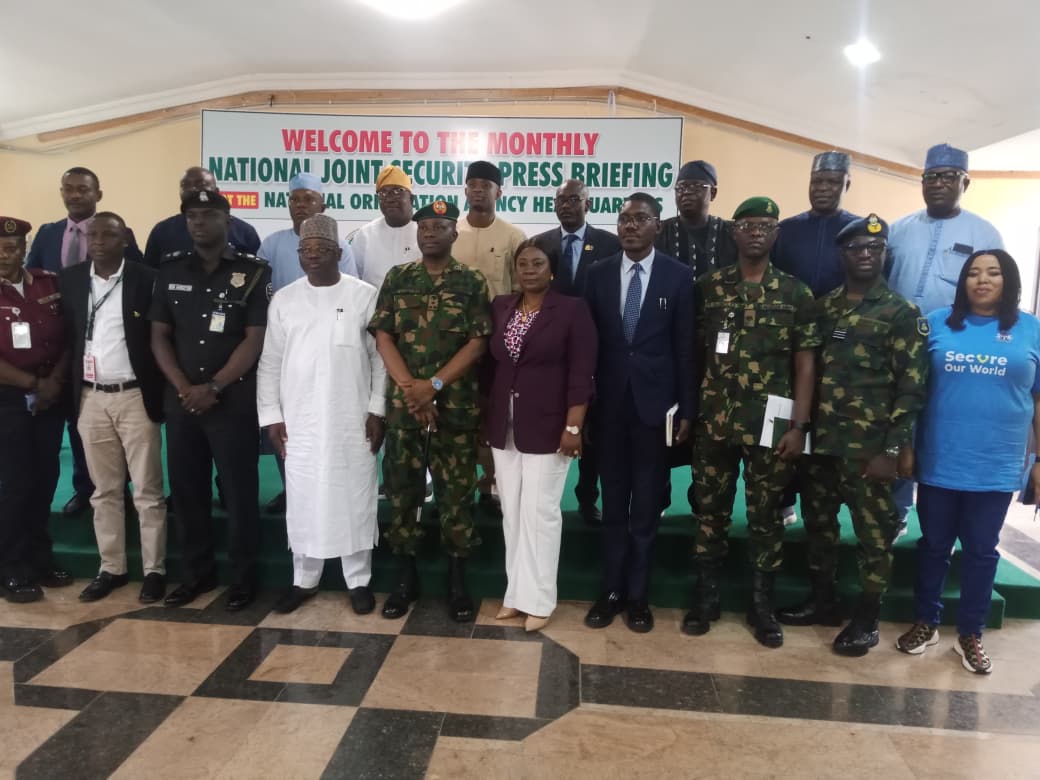
In a significant joint security briefing organized by the National Orientation Agency (NOA), key representatives from Nigeria’s security agencies came together to provide updates on the nation’s ongoing efforts to combat insecurity. The briefing, held at the NOA headquarters in Abuja, saw contributions from the Nigeria Police Force (NPF), Federal Road Safety Corps (FRSC), Nigerian Army, and other security stakeholders, with all agencies reiterating their dedication to tackling various security challenges facing the country.
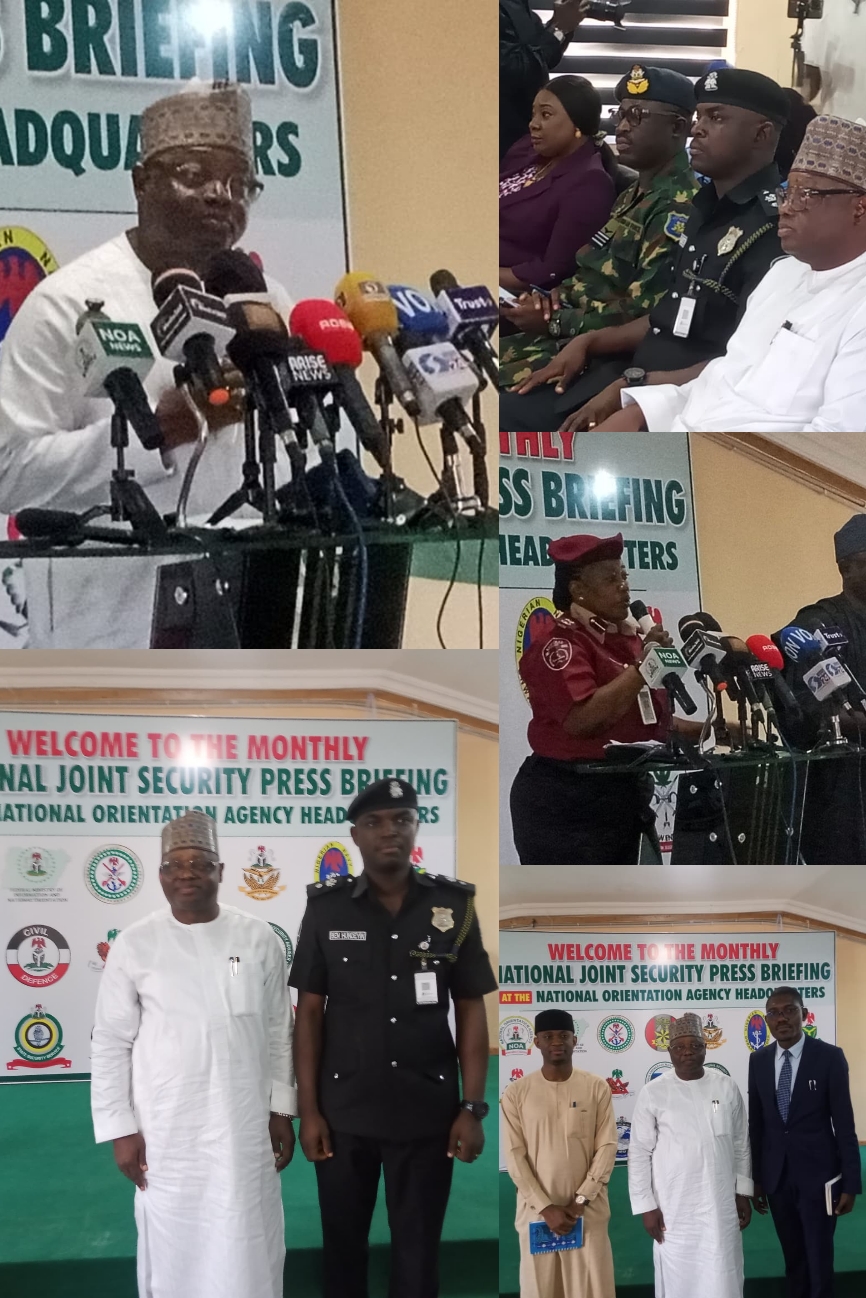
The joint security briefing, a regular initiative by NOA in collaboration with security agencies, aimed to provide a platform for coordinated communication between law enforcement and the public. It serves as an opportunity for security agencies to update citizens on their operational efforts, share insights on crime trends, and engage the public in efforts to foster greater collaboration in addressing national security concerns. The briefing also acted as a space for citizens to voice their concerns and engage with security agencies on the measures being taken to address specific issues.
CSP Ben Hundehin, Force Public Relations Officer (FPRO) of the Nigeria Police Force, addressing the audience, emphasized that while absolute security can never be guaranteed, the police remained steadfast in their commitment to ensuring public safety.
Hundehin acknowledged the presence of insecurity in certain areas, drawing comparisons to global security challenges in countries like South Africa, France, and the United States. He stressed, however, that the Nigerian Police are constantly evolving their strategies to mitigate threats and provide a safe environment for citizens.
“The situation in Nigeria is complex, but as a security force, we are doing everything within our power to reduce crime and improve safety. We cannot promise a complete absence of insecurity, but we are determined to continue our efforts,” Hundehin said. He also pointed out the importance of citizens’ collaboration with law enforcement. “We urge Nigerians to remain vigilant and report any suspicious activities to assist us in our fight against crime.”
The FPRO also added that the police would continue to enhance its operations by focusing on intelligence gathering and community outreach. “We are working closely with other agencies to gather actionable intelligence. Our commitment is to reduce insecurity through effective law enforcement, but we also need the support of the public to make this effort successful.”
The representative from the Federal Road Safety Corps (FRSC) also made key remarks, reaffirmed the agency’s commitment to ensuring safe roadways across the country. While addressing concerns about road safety enforcement, the FRSC spokesperson clarified that the goal is not just to penalize violators but to promote public safety. The Corps emphasized that education and public awareness are crucial in reducing accidents and ensuring that road users understand the significance of traffic laws.
“We train our officers regularly to ensure that they enforce traffic laws in a way that emphasizes safety rather than punishment,” the FRSC representative explained. The Corps also highlighted the importance of public cooperation in preventing road accidents, urged citizens to follow road safety guidelines and to report dangerous driving behavior.
The Nigerian Army, represented by a senior official, discussed its ongoing efforts in the fight against terrorism, particularly in the northeastern region of the country. The Army reaffirmed its commitment to neutralizing terrorist groups and restoring peace in conflict-affected areas. The Army official highlighted several recent successes, including the neutralization of key insurgent leaders and the rescue of civilians who had been kidnapped by militant groups.
“The Army remains fully committed to combating terrorism and ensuring the safety of Nigerians. We are continuously working in collaboration with other security agencies to eliminate terrorist threats across the country,” the Army representative assured the audience. The Army also reiterated that it will continue to provide training and support to personnel in order to strengthen its operational capabilities.
In his remarks, the National Orientation Agency (NOA) Director-General clarified the government’s stance on negotiations with criminal groups. He emphasized that the Nigerian government does not engage in direct negotiations with bandits or insurgents, noted that any peace initiatives involving such groups are purely led by affected communities themselves. He also highlighted the role of the NOA in promoting community-driven security measures.
“The NOA’s role is to foster community involvement in security efforts. We strongly encourage citizens to be proactive in ensuring their safety and the safety of others. We provide platforms for reporting security concerns and encourage constructive dialogue between communities and security agencies,” the NOA Director-General stated.
The Director-General also addressed the issue of security in relation to local communities, pointing out that Nigeria’s security challenges can only be tackled effectively if all citizens take responsibility for their own safety and work with security forces. “While we support local peace efforts, it is essential for communities to cooperate with law enforcement. Security is a collective responsibility, and we must all do our part to ensure a safer nation.”
The session concluded with the reaffirmation of Nigeria’s commitment to security and peace, with all agencies vowing to work collaboratively to address the challenges facing the nation. The security briefing, organized by the NOA, highlighted the ongoing efforts of the various agencies to enhance national safety and called for greater public engagement in the fight against crime and terrorism.